
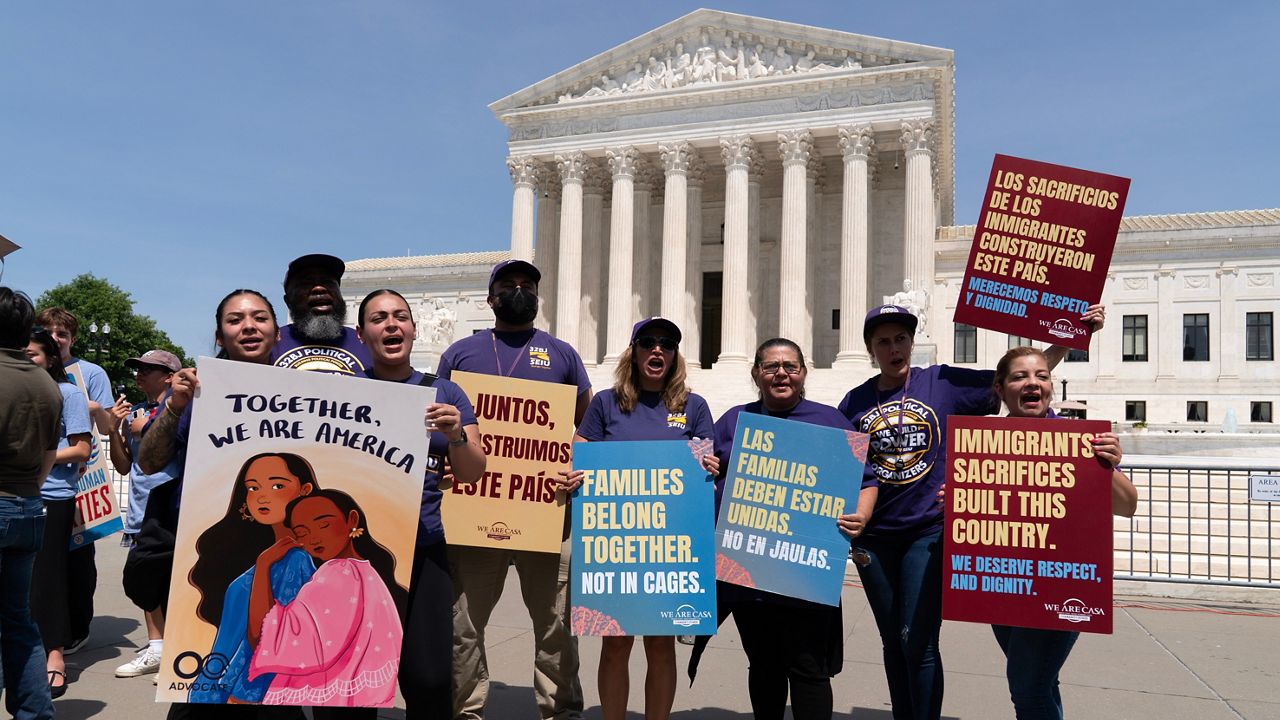
WASHINGTON — After taking up in April the constitutionality of President Donald Trump’s push to end birthright citizenship, the Supreme Court on Tuesday upheld the long-standing principle that nearly everyone born in the U.S. is a citizen, no matter their parent’s immigration status. Some immigrant advocates in Texas say they were relieved to hear that the conservative court reaffirmed what they say is a core constitutional promise.
What You Need To Know
The Supreme Court upheld the birthright citizenship clause in the 14th amendment in a 6-3 ruling on Trump v. Barbara on Tuesday
The high court’s decision invalidates President Donald Trump’s executive order to eliminate birthright citizenship
President Trump called the decision “bad for our country” and is pushing Congress to take up legislation to address it
“It is an American principle and ideal, and something that is embedded deep within our history,” Edna Yang, co-executive director of American Gateways, told Spectrum News. “We are a nation of immigrants, and immigrants came to this country, they had children here, and that is what created the foundation of what we see as the United States.”
Texas Democrats also celebrated the decision.
“Birthright citizenship is in the Constitution, and today the Supreme Court reaffirmed that it is not something Donald Trump can just change,” said Rep. Sylvia Garcia, D-Houston, on social media.
Writing for the majority in the 6-3 ruling, Chief Justice John Roberts declared, “Citizenship, then and now, was the right to have rights — to freely participate in our political community. The framers of the 14th Amendment extended that promise to ‘every free-born person in this land.’ We keep that promise today.”
The Supreme Court’s decision invalidates President Donald Trump’s executive order to eliminate birthright citizenship. In a social media post, he called the ruling “bad for our country” and urged Congress to take up the issue with legislation.
“They weren’t willing to defer to the executive here, on the executive’s interpretation of the Constitution,” said Seth Chandler, a law professor at the University of Houston. “They were going to independently evaluate it.”
Some Texas Republicans want to end automatic citizenship for children born in the U.S. unless they have a U.S. citizen parent.
“I believe we should stipulate very clearly that means that you’re attached to a citizen. You’re born of an American citizen parent, not that you just happen to be born on dirt,” said Rep. Chip Roy, R-Austin.
“Birthright citizenship has become a powerful magnet for illegal immigration that will forever change our nation if left unaddressed,” Gov. Greg Abbott, R-Texas, said on social media.
But some Texas Democrats are concerned that Tuesday’s victory was not overwhelming. Four of the court’s nine justices – Samuel Alito, Clarence Thomas, Neil Gorsuch and Brett Kavanaugh – disagreed with the majority that the president’s executive order overturning birthright citizenship violated the constitution.
However, Kavanaugh did say the president’s executive order violated federal law, and so he sided with the court’s majority in rejecting it.
“Today we may breathe a sigh of relief, but we also recommit ourselves to the fight to protect the rights of all citizens, and the way we do that is reigning in this hyper-partisan Supreme Court,” said Rep. Greg Casar, D-Austin.
Legal experts said changing the birthright citizenship clause would require a constitutional amendment, which has been rare in the country’s 250-year history. It requires the support of two-third of Congress and 38 states.
“That’s a very hard fight for the Trump administration. This was a big loss for them,” Chandler said.