
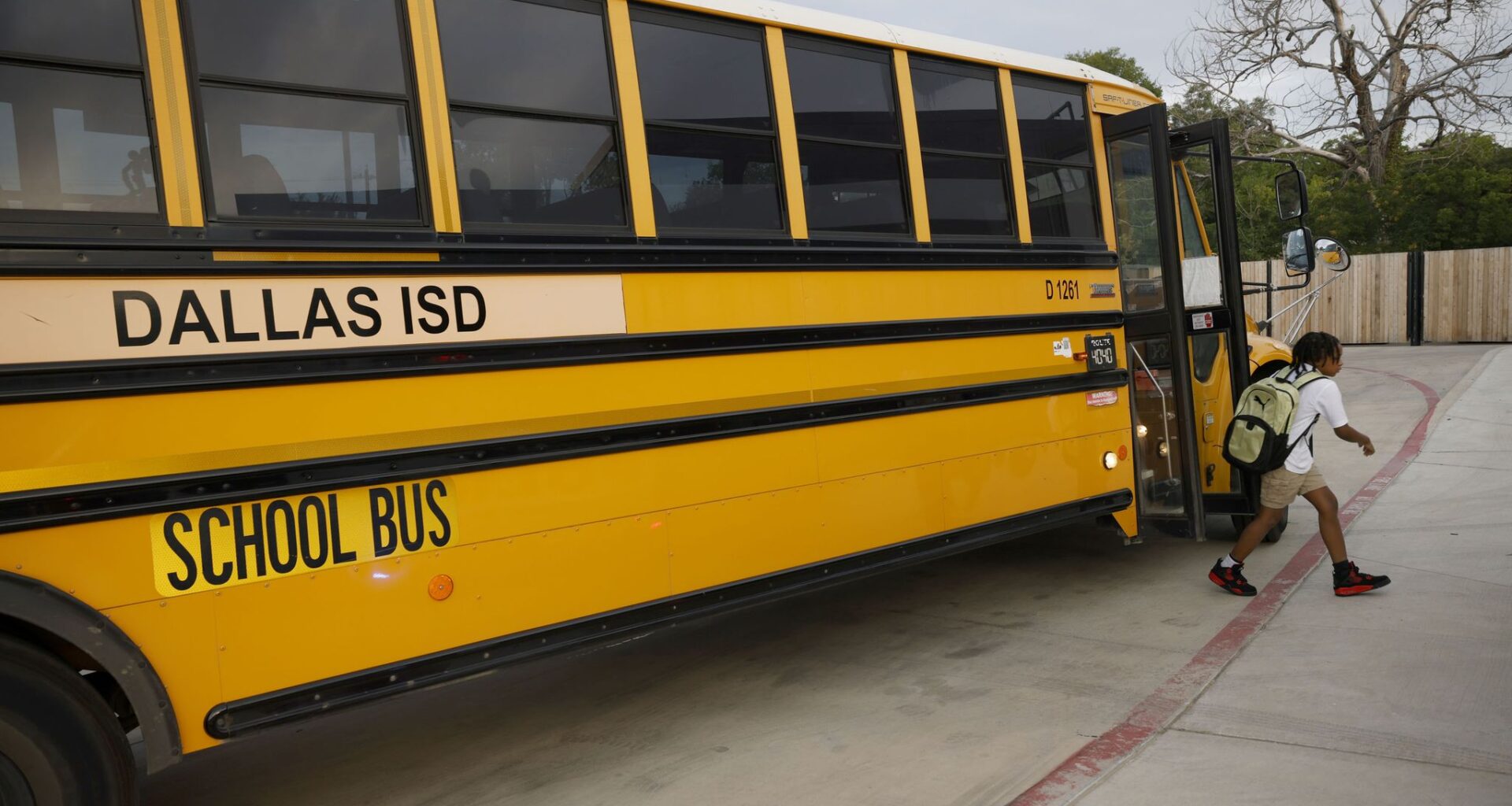
Students arrive at Albert C. Black STEAM Academy during the first day of school, on Aug. 12, 2025, in Dallas.
Chitose Suzuki/Staff Photographer
Students at 20 campuses in Dallas ISD will be heading back to school in a little less than a month – two weeks early.

Starting with the upcoming school year, Dallas ISD is extending the academic year at some of its campuses in hopes of giving students an early start.
Under the program, the district added 15 school days to the calendar for 13 elementary schools and for sixth graders at seven middle schools. Students at those campuses will come back to school on July 28, two weeks before all other students. Students will also come to school on five Saturdays interspersed throughout the school year.
Article continues below this ad
Related: Dallas ISD to offer universal free pre-K. Research shows it could be a game-changer
The 13 elementary schools included in the program are John Q. Adams, Lee McShan Jr., Lida Hooe, John Neely Bryan, J.N. Ervin, José “Joe” May, Julian T. Saldivar, Harrell Budd, Birdie Alexander, Frank Guzick, and Ronald E. McNair elementary schools; H.S. Thompson STEAM Academy; and Marcus Leadership Academy. The middle schools included are T.W. Browne, Hector P. Garcia, Sam Tasby, Harold Wendell Lang Sr., and Boude Storey middle schools; Royce West Leadership Academy; and Young Men’s Leadership Academy at Fred F. Florence.
District officials selected the elementary campuses based on several criteria factors, including historical student achievement trends and the level of poverty in the neighborhoods they serve. Principals at the seven participating middle schools signed their campuses up for the program.
During those additional days, students will get instruction in reading and math, but they’ll also participate in fun, engaging activities designed to help them build relationships with their classmates. The Saturday sessions will have themes such as gaming, sports and superheroes.
Article continues below this ad
The plan is a part of Texas’ additional day school year program, which gives districts extra funding to add up to 30 days to their school calendars. State lawmakers created the program in 2019 as a part of House Bill 2, a massive overhaul of the state’s school finance system. Initially, the program only applied to kindergarten through 5th grade, but lawmakers expanded it last year to include grades six through eight. Lawmakers also loosened certain eligibility rules, making it easier for districts to participate.
Related: Texas requires Bible readings on literary list, embeds Christianity in public school curriculum
During a June 11 board briefing, Tiffany Huitt, Dallas ISD’s chief of school leadership, said district leaders are rolling the program out in hopes of helping students stave off summer learning loss. Every summer in schools across the country, students lose some of the skills and knowledge they learned the year before. By bringing students back to school two weeks early, district leaders hope to give students a chance to brush up on anything they lost before the regular school year begins.
Understanding summer learning loss
Despite more than a century’s worth of research, it’s difficult to get a clear picture of exactly how much ground students lose over the summer, said Paul von Hippel, a professor of public policy at the University of Texas at Austin. That’s because students are rarely tested on the same set of material at the end of one school year and the beginning of the next, he said. So while there’s an extensive body of research on the subject, there’s little consensus.
Article continues below this ad
“Some studies suggest that students fall off a cliff and lose knowledge as quickly as they gained it during the school years, and other studies suggest that kids basically go sideways, and some studies are in between,” he said. “What we do know is that very few kids gain much during the summer.”
Paola Miranda leads a class in the STEM lab on July 26, 2022, at Aldine ISD’s Ermel Elementary School in Houston.
Houston Chronicle/File Photo
That lack of progress during the summer could be due in part to the unstructured nature of students’ time during the break, von Hippel said. Aside from the fact that students aren’t in school, families have fewer planned activities during the summer, he said, and students’ sleep schedules aren’t as regular as they are during the school year. That lack of structure can take a toll on students, both in terms of physical health and academics, he said.
Related: See how your North Texas elementary, middle school fared on STAAR
“So this idea we have that kids are all out playing kick the can or canoeing or whatever, it’s a relatively small fraction of children who are spending their summer that way,” he said. “Most children could use more structure and more activity.”
Article continues below this ad
Rather than wringing their hands over summer learning loss, von Hippel said school districts should look at the issue as an opportunity. Summer learning programs can be an effective way of helping students avoid losing too much ground, he said, but they only work if school districts take them seriously. Although most districts have summer learning in some form, commitment to those programs tends to wax and wane with funding, he said. If they want to get the most benefit out of them, districts need to be consistent about supporting their summer learning offerings, he said.
Does ending summer early help students?
Although interest in the extended school year program is growing since state lawmakers loosened eligibility rules, several districts across the state adopted the program at some of their campuses years ago. Aldine ISD, a northern Harris County school district, adopted an extended school calendar at two campuses, Ermel Elementary School and Vines Primary School, during the 2021-22 school year, then expanded it to two more campuses the following year.
Viviana Zavala reads during fifth grade bilingual language arts class on July 26, 2022, at Aldine ISD’s Ermel Elementary School. Aldine ISD, a northern Harris County school district, adopted an extended school calendar at Ermel Elementary and Vines Primary, during the 2021-22 school year.
Houston Chronicle/File Photo
Rather than simply adding days during the summer, campus leaders completely reworked the school calendar at those campuses, said Adrian Bustillos, Aldine ISD’s chief transformation officer. The school year at those schools stretches from July to June, and district leaders added 30 enrichment days throughout the year.
Article continues below this ad
During the enrichment days, schools devote half the day to reading and math instruction that’s designed to help students move forward more quickly. The other half of the day is devoted to programs like art, music and theater, Bustillos said. Students also get recess and “brain breaks,” short opportunities to let out pent-up energy before they refocus on school work.
Bustillos said the district designed the enrichment days with the idea that every student would get what they need. During reading and math time, students who are behind get the help they need to catch up, and students who are already on grade level get instruction that will help them move ahead. By dedicating half a day to reading and math, school leaders made sure that students who are struggling don’t have to stay behind for extra help while their classmates leave for arts or STEM programs, he said.
The impact on the district’s test scores has been mixed. The district rolled the program out at its first two of schools during the first year after schools reopened following the pandemic. Much like schools across the state, STAAR scores at Ermel Elementary declined dramatically that year. Ermel’s reading and math scores rebounded in 2022-23. But in the years since then, the school’s scores have continued to lag pre-pandemic norms.
The other first-year campus, Vines Primary, only serves students in early childhood, pre-K and kindergarten, so students at that school don’t take STAAR exams.
But the district has seen more success with students who joined the program later. During the 2022-23 school year, the district expanded the school year at Harris and Smith elementary schools. The district closed Smith at the end of the 2024-25 school year and sent the majority of its students to Harris. In 2019, the last round of STAAR testing before the pandemic began, 23% of 3rd graders at Harris tested on grade level in reading. This year, 40% were on grade level.
Article continues below this ad
For any district looking to extend its school calendars, there are many things to consider, Bustillos said. District leaders need to be transparent with their communities about what they’re doing and why, he said. They need to make sure families have an approved school calendar as early as possible so they can make summer travel plans. And district leaders need to communicate clearly about teacher compensation, so teachers understand how much of a pay bump they could see for working those extra weeks.
But for students who are struggling, those extra school days could be the key to getting back on track, Bustillos said. The more time those students have working with teachers who know how to help them move forward academically, he said, the better off they’ll be.
The DMN Education Lab deepens the coverage and conversation about urgent education issues critical to the future of North Texas.
The DMN Education Lab is a community-funded journalism initiative, with support from Bobby and Lottye Lyle, Communities Foundation of Texas, The Dallas Foundation, Dallas Regional Chamber, Deedie Rose, Garrett and Cecilia Boone, Judy and Jim Gibbs, The Meadows Foundation, The Murrell Foundation, Ron and Phyllis Steinhart, Solutions Journalism Network, Southern Methodist University, Sydney Smith Hicks, and the University of Texas at Dallas. The Dallas Morning News retains full editorial control of the Education Lab’s journalism.