
LUBBOCK, Texas (KCBD) – A lively meeting of the Lubbock ISD Board of Trustees last week, as citizens and Lubbock’s State Senator Charles Perry bring forth concerns related to books found in the district’s libraries.
Sen. Perry went before the board as a representative of a concerned coalition. He was specifically referencing one book, which he did not identify in the meeting.
“I don’t want to give credit to the author who produced this trash,” Perry said at the meeting.
KCBD independently verified the book Perry was referencing was ‘Me, Earl, and the Dying Girl’. It was first put in Lubbock ISD’s library in 2012.
According to a report generated by BookLooks, the book contains 341 terms deemed profane or derogatory. It also makes numerous references to sexual organs and sexual activity.
“The language and where they go to is, I believe, not in line with community standards,” Perry said. “A library in a public school should be a place where you don’t have to worry about this.”
Senator Perry says his main concern lies with how the district handled complaints about the book.
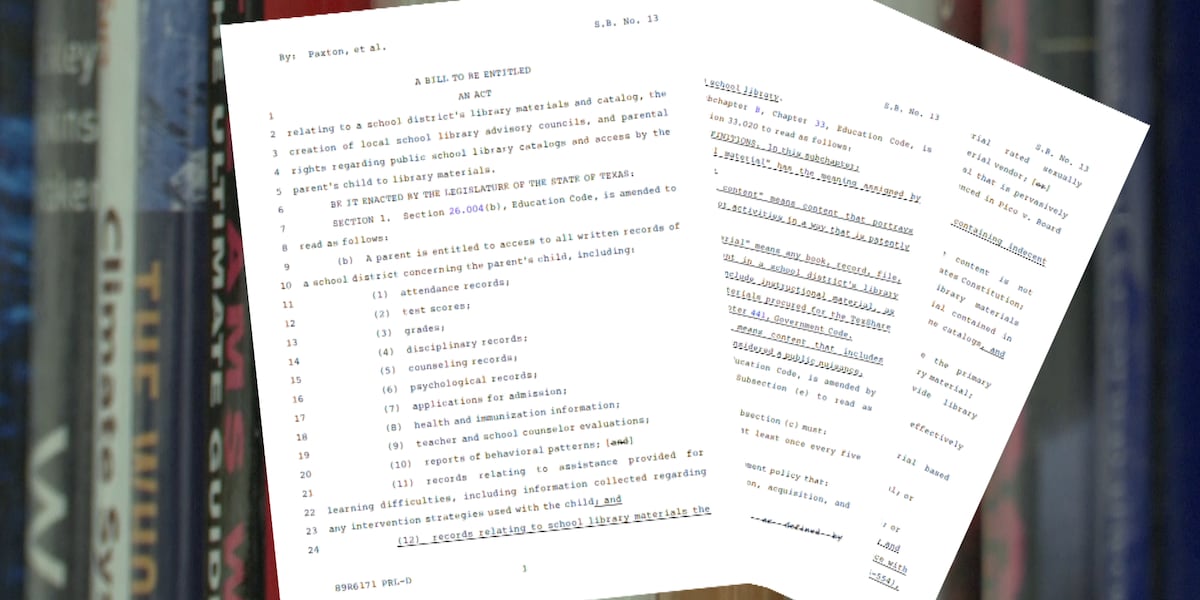
Texas Senate Bill 13 was signed into law last year. Among other requirements, the law required school districts establish a School Library Advisory Council, or SLAC. The council must consist of at least five members appointed by the board of trustees, with a majority being parents of enrolled students who are not district employees.
Lubbock ISD Chief Academic Officer Misty Rieber said the district established its SLAC in the fall and has followed the law’s requirements.
When a challenge form is submitted — which any parent, district employee, or person residing in the district may file — the SLAC appoints a member and a librarian to read the book in full. The council then reviews the challenger’s concerns alongside the legal definitions of harmful and obscene content outlined in SB 13 before voting on a recommendation. That recommendation is then presented to the school board, which holds a final vote in an open public meeting.
“They look at what the challenger listed. They look at what they see when they review and edit it,” Rieber said. “And then if you look at SB 13, it clearly outlines what is considered harmful and obscene. And so they also look at that in its legal definition to determine does the entirety of the book meet that definition? And then they discuss it as a board. Those are open and public meetings.”
‘Me, Earl, and the Dying Girl’ was brought before the SLAC, but it voted voted 3-2 to keep the book on shelves. Perry said that outcome revealed a flaw in how the district implemented the law.
“The intent of the legislature is to get rid of effectively obscene, vulgar [material],” Perry said. “If this book made the cut to go back after their process review, then I think the process that LISD has set up misses the legislative intent.”
SB13 also requires the SLAC to approve new library books before they go into the schools.
Rieber said the district has always maintained standards for library materials, even before that requirement, but acknowledged that some books slipped through the cracks.
“Early on, prior to the procedures that we have right now, when librarians selected books, many times they bought them in bundle,” Rieber said. “So you would look for two or three books in the bundle that you knew that you wanted and vendors sold them in large groups together. And so we’ve discovered through time that sometimes some things in the bundle did not have the same level of vetting.”
Rieber said the district no longer purchases books in bundles and now vets every title individually.
Perry said he does not believe the district deliberately acted against the law, but argued that following the process without regard for its outcome is insufficient.
“It may be to the letter of the law, ‘we did what you asked us to do’, and then turn a blind eye to what it produced,” Perry said. “So it produced exactly what we were trying to get removed. So your process is flawed.”
Perry said the state legislature may revisit the law if the district does not adjust its approach.
While Rieber maintains the district followed the law, she also points out a key part of SB 13: parental involvement.
The law required school districts to create platforms where parents could browse library catalogs and decide what material their child was and was not allowed to read.
Lubbock ISD already had that, Rieber said.
That same system will also notify parents when their child checks out a library book. The book title, author, and genre are all included.
“Maybe I don’t want my child to read about monster trucks in elementary school. Then I can share that with the elementary librarian and they will flag that in the file and my child isn’t allowed to check out things related to that topic or author,” Rieber said.
Reiber also said Lubbock ISD welcomes parental and community feedback. She notes that a majority of the complaints filed about books come from people who live in the district’s bounds, but do not have a child in its schools.
She also notes that the Board is open to discussions like the ones at the most recent meeting, and had the public stayed to hear it, they would have heard the Board agree with many of the points.
“They want open dialogue, they want problem solving, they want to make sure that we’re looking for solutions together,” Rieber said. “Many times citizens have spoken and haven’t stayed to hear that part, so they miss out on some of that opportunity to hear that information.”
Anyone who lives in Lubbock ISD’s boundary, or who has a child in the district, is allowed to file a complaint against a book, according to SB 13. That link and a link to what books are under SLAC’s review are available on the district’s website.
Once a book is submitted for SLAC review, it cannot be accessed by students until the review is complete. If the council votes to keep it on the shelves, only an appeal can be filed. If an appeal is not filed, another complaint against the same book will not be considered for two years.
Copyright 2026 KCBD. All rights reserved.