
The Texas office responsible for distributing over five billion dollars in state and federal money to expand rural broadband faced allegations of “favoritism” and offering “sweetheart” deals at a recent hearing of the State Senate’s Business and Commerce Committee.
At the June 24 hearing, lawmakers suggested the Texas Broadband Development Office was changing rules and giving special treatment to companies that offer broadband via “low earth orbit,” or LEO, satellites.
According to testimony, some of those changes came at the suggestion of the office of Governor Greg Abbott.
Currently, Elon Musk’s company Starlink is the only one in Texas offering residential broadband via low earth orbit satellites at scale, though the Amazon Leo service has also been applying for grants in the state, according to industry monitors.
“I’ll just say it bluntly, favoritism and transparency are real big concerns that have been brought to my office,” committee chair State Senator Charles Schwertner said.
At the hearing, lawmakers criticized how the office has approached a range of its duties, from awarding grants to communicating with applicants to identifying where in Texas there is the greatest need for expanded broadband access.
The allegations of favoritism started early in hearing when Schwertner questioned Broadband Development Office director Bryant Clayton about changes his department made to the way it disburses grant money to companies offering low earth orbit broadband service.
Under those changes, Schwertner said, the office increased the amount of money it provides “up front” to the low earth orbit companies as they fulfilled grant obligations.
Broadband companies using more traditional technologies, like fiber optic and cable broadband, had also asked for changes to the grant system, he said, but had been rebuffed.
Schwertner referenced a letter, obtained by KUT, in which a coalition of eight rural broadband providers proposed changes to how the office distributes grants that, they said, would “increase clarity, decrease risk and provide greater flexibility,” for their companies.
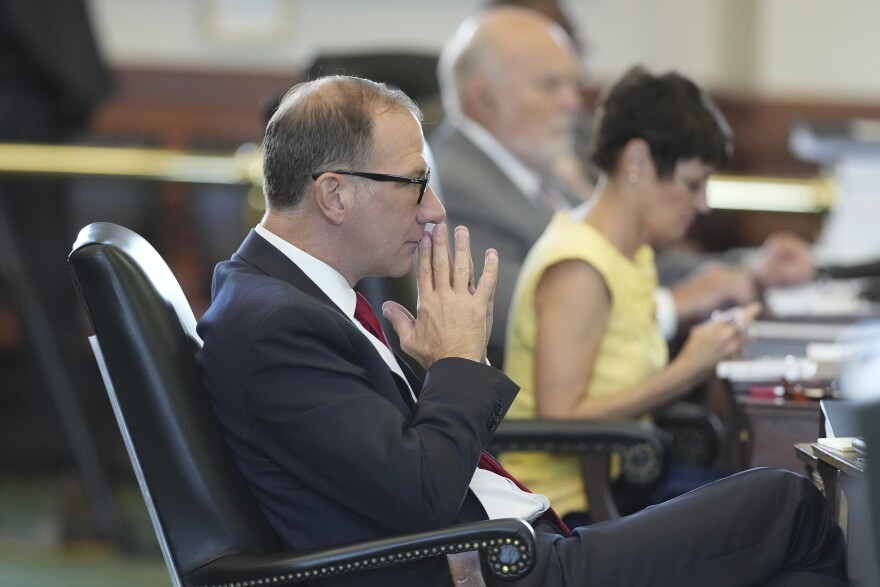
Pool photo courtesy Bob Daemmrich/The Texas Tribune
Senator Charles Schwertner at the Texas Senate in 2023.
“[These were] other grant applicants that were not LEO’s that came forward and said, ‘hey, we want our [application process] to be reconsidered, too. We want the sweetheart deal that was given to the LEOs.’ And y’all chose not to reconsider those applicants, did you?’” Schwertner said.
Clayton did not explain why those companies’ requests were rejected. But, under questioning from State Senator Nathan Johnson, Clayton said the changes to how his office distributes grants to low earth orbit broadband providers came at the urging of the Office of Governor Greg Abbott.
“The office of the governor asked us to look at how our proposed structure compared to other states, ” said Clayton.
He added the concern was “generally that we were out of step with other nearby states.”
Drew Garner, director of policy engagement at the Benton Institute for Broadband & Society, said the testimony reinforces his group’s findings that Musk’s companies have been lobbying to change rules nationwide around how broadband grants are awarded and paid out.
“States would prefer to give them a small amount of money up front and then distribute the rest of the money sort of in increments based on the adoption of internet service,” Garner said. “This is not something Starlink likes. And so they have been pushing back on states that try to implement this reimbursement process.”
In response to questions from KUT, Governor Abbott’s Press Secretary Andrew Mahaleris wrote that: “Governor Abbott supports getting high-speed internet to rural Texans as quickly and cost-effectively as possible. Low Earth Orbit satellite service is essential for the most remote areas where traditional fiber is too expensive and slow to build.”
Mahaleris added that “The Broadband Development Office in the Office of the Comptroller made the decision to adjust the grant disbursement schedule to better align with other states and allow providers to access capital earlier, helping deliver service to rural communities faster.”
Part of a national shake up in grant funding for broadband
States have been struggling with the question of how they should administer broadband grants since recent changes to the program were announced at the national level.
Last year the Trump administration revamped the federal Broadband Equity, Access and Deployment, or BEAD, program. That’s the government’s $42 billion fund that funnels money to states for broadband grants.
While previous rules had favored grants for traditional fiber-based high speed internet, the new rules told states to award grants on a “technology neutral” basis.
That opened up billions more in possible grants for Starlink, and other companies planning to offer low earth orbit broadband, and sent states scrambling to change how they disperse the money locally.
Supporters of the new policy say it could allow grant money to go further. Critics call it a gift from the President to his sometimes political ally, Elon Musk.
“I’m concerned about wasting taxpayer money.” State Senator Nathan Johnson, who is running for State Attorney General, said at the hearing in Austin. “It is relevant that at the time period in question, a guy named Elon Musk who owns SpaceX, that owns Starlink, has tremendous control over the federal government.”
Michael Minasi
/
KUT News
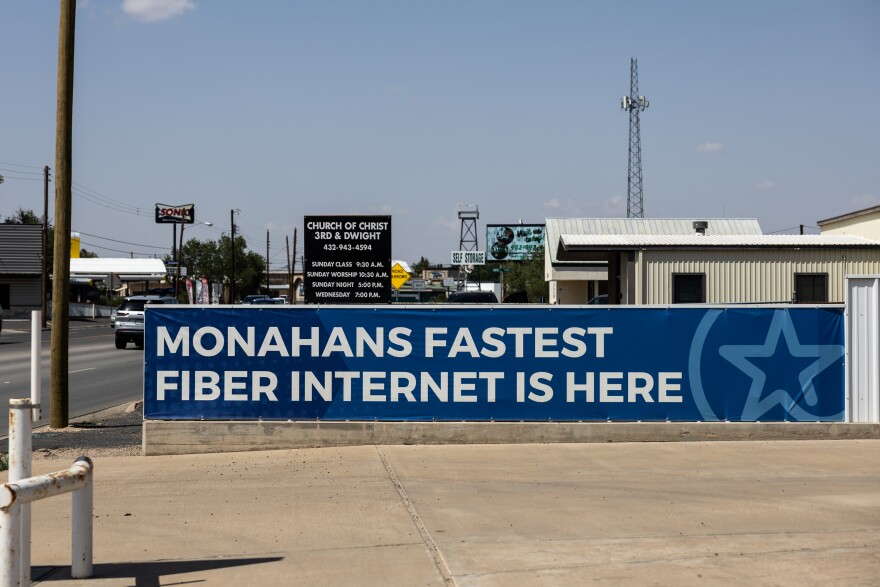
A banner by the Hosted America office advertises the fiber internet expansion in Monahans, Texas.
At the state level, the shift away from fiber-based broadband has left local broadband providers feeling locked out of the grant process.
Some argue that not only is fiber a better product, but that local companies benifit the communities they serve more than space-based providers.
Grant Spence, with Dell Telephone Cooperative in Hudspeth County in West Texas told lawmakers at the hearing that local companies like his “employ local residents, support, and, in fact, provide emergency services, and invest millions of dollars directly into our communities.”
State broadband office told to make improvements
The controversy is likely not going away.
On June 30 Committee Chair Charles Schwertner sent a letter to the Broadband Development Offices’s Clayton instructing him to create a new “strategic plan” for the office to answer concerns raised in the earlier hearing.
Schwertner’s Business and Commerce Committee is tasked with overseeing the broadband office in the State Senate and is empowered to suggest changes to how it operates ahead of the next legislative session.
In his letter, Schwertner asked that the new plan “increase transparency and accountability” and “enhance the efficiency” of the office, among other things.
The Broadband Development Office must provide an update on how it plans to make those changes by Aug. 1 and have a new strategic plan by the end of the year.