
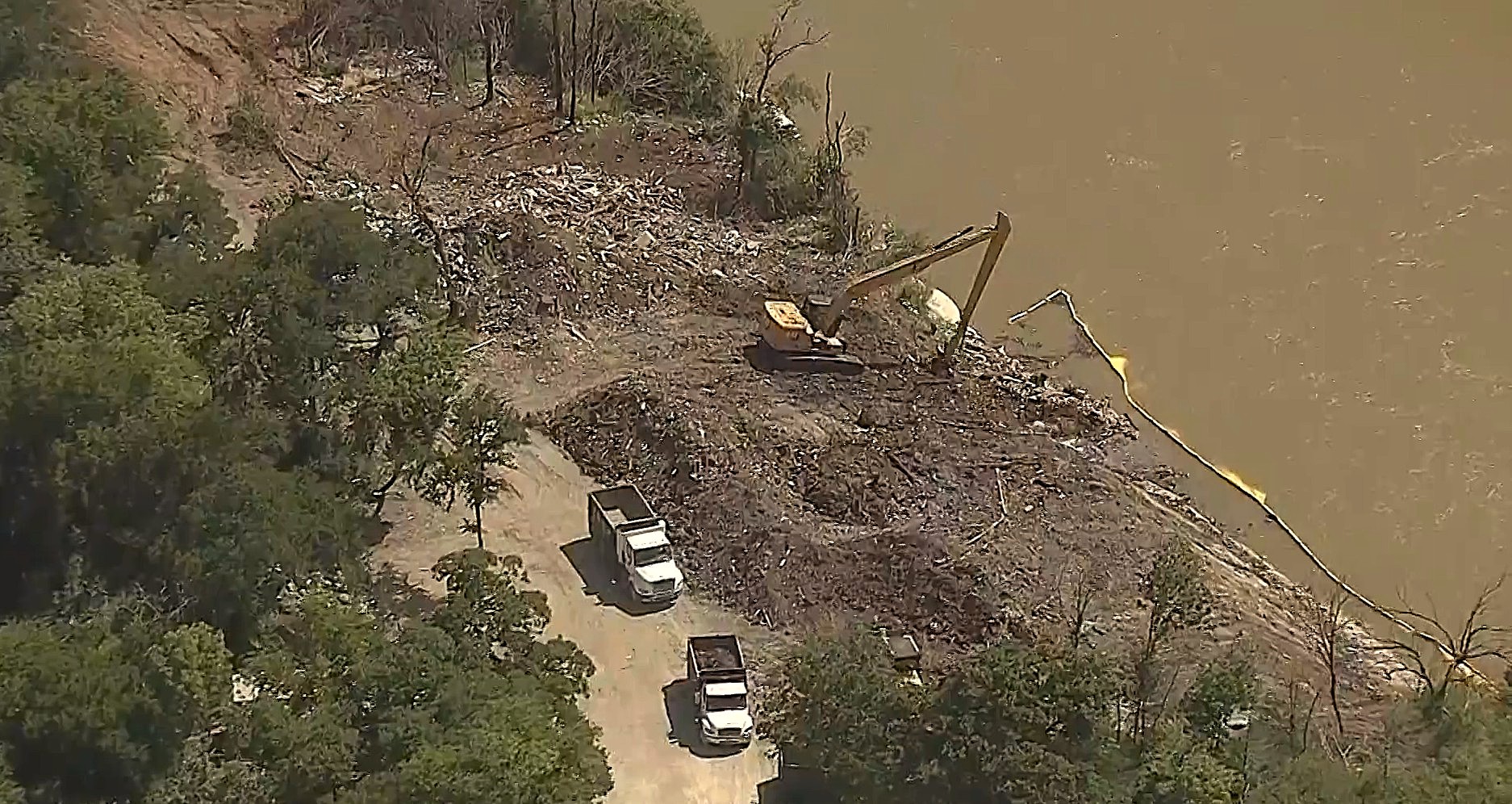
A long-arm excavator is being used to remove debris from the Trinity River banks. Below, Dallas Fire-Rescue installed nets to keep the trash from once again spilling into the river.
Courtesy NBC DFW
Two months ago anyone could access the McCommas Bluff overlooking the Trinity River. And they did, often entering from the mile-long stretch of newly paved, newly housed Riverwood Road, miles south of city life but never out of the skyline’s sight. And they often came in dump trucks — a parade of them, neighbors say, for nearly three years — carrying God knows what from God knows where, spreading detritus as far as the eye could see and, often, over the white limestone cliffs and into the river itself.
Occasionally, too, someone would set the ruinous sprawl ablaze. To make room for more.
One man created this catastrophe, authorities say. One man who, according to court documents and arrest warrant affidavits, stole this land and then ruined it a few dollars and dump trucks at a time. One man who spent a few hours in jail in April and is being investigated by local, state and federal agencies.
Article continues below this ad
That man is 59-year-old Kyle Boyd, who faces, at the very least, three state felony charges for illegal dumping of more than 200 pounds. Each carries a potential sentence of up to two years in jail and a fine up to $10,000.
Now, an army of city workers attempts to undo that damage wrought upon the McCommas Bluff, which naturalist Ben Sandifer in April called “one of the most unique wild places we have in Dallas … a cathedral of our history.”
Gerald Bleau looks at the garbage being removed from the shores of the Trinity River as he’s escorted by Dallas Water Utilities workers across spoiled land his wife inherited but can’t access.
Robert Wilonsky/Staff writer
For the foreseeable future, visitors are unwelcome to this once-glorious stretch of the Trinity River, where, if you look hard enough between the mountains of garbage, you can still see the first lock and dam sunk into the water back when the young city still thought it a viable commercial canal.
On Tuesday morning, a city marshal was parked where Riverwood dead-ends into a thicket of trees and a concrete barricade. Two Dallas Water Utilities workers sat beneath a canopy tracking dump trucks and heavy machinery entering and leaving the site, now decorated with no-trespassing signs and other warnings. The workers also shoot video of the dump site at the beginning and end of each day to track the progress of a clean-up expected to take two weeks now that the thick mud of recent rains has hardened in the summer’s heat.
Article continues below this ad
Gerald Bleau — whose wife, Shannon, inherited 11 acres of this land from her grandfather, then spent two years in court trying to get it back from the man who spoiled it — was standing next to the marshal’s car when I pulled up. He’d recently installed cameras on the site, and on Monday, Shannon noticed workers descending on the illegal dump — at last. “I was excited,” Gerald Bleau said with a deadpan grin.
But the city has deployed dozens of workers from several departments, including DWU, code compliance, sanitation, even Dallas Fire-Rescue. It’s essentially a construction site — deconstruction, really — where no one’s allowed access without hard hats, bright safety vests and steel-toed boots.
Burned and unburned piles of trash littered the banks of the Trinity River near the McCommas Bluff in April.
Angela Piazza/The Dallas Morning News
Bleau and I waited 90 minutes for DWU higher-ups and city attorneys to give us permission to tour the property he and his wife fought to reclaim. Eventually, we piled into an enclosed four-seater for a tour that lasted maybe 10 minutes — long enough to let workers take a short break as the morning heated up. I sat next to Eduardo Valerio, DWU’s assistant director, and asked if he’d ever seen anything this bad along the Trinity.
Article continues below this ad
“Not like this,” he said as we passed what workers call Site 1, which spans what’s called the Riverwood Overlook.
There were several machines along the riverbank, including a long-reach excavator scraping the shores of the Trinity, where Dallas Fire-Rescue set nets earlier this week to keep debris from spilling into the river. Valerio said crews had removed 25 truckloads of waste from the site over the previous 24 hours. Yet, we could barely see the river over and through the mountains of garbage still being pulled from the riverbank.
We drove a few hundred yards down to Site 2, which includes the remnants of a Victorian manse built in the early 1900s for the caretaker of the lock and dam that remain in the river. Last owned by Shannon Bleau’s grandfather, William Wesley Thompson, the Lock Keeper’s House looked beat-up in its final days. But Gerald showed me photos of the inside — all hardwood and warmth, a revelation.
It no longer stands. The Lock Keeper’s House mysteriously burned to the ground in the summer of 2023. Just months after Kyle Boyd filed quitclaim deeds alleging the land had been conveyed to his care, and then carved out paths for dump trucks.
The house’s chimney survived, today surrounded by the mountains of trash the machines dragged up from the riverbank, which included seemingly endless rolls of plastic packaging for sausage burritos. Everything has been tossed down here in recent years. From everywhere. From warehouse supplies and tires to “dirt, rock, concrete debris, rebar, and other construction material,” says one of the affidavits issued in April that led to Boyd’s arrest.
Article continues below this ad
The Trinity River is barely visible between the mountains of debris being removed from the McCommas Bluff.
Robert Wilonsky/Staff writer
There are God knows how many old houses down there, too. Last I was there in April I retrieved from an endless pile of bricks one made by the short-lived Builders Clay Products Co. My grandfather Harry and his brothers co-founded Builders. In 1947.
It appears from the arrest warrant affidavits that marshals knew about the dumping since at least Dec. 16. One guy told an investigating officer “he had been dumping at the location for a couple of years,” according to the affidavits, and paid about $40 per load. The officer wrote, too, that Boyd “stated to multiple City of Dallas employees that he owns multiple properties located on Riverwood.”
That included the property once owned by Shannon Bleau’s grandfather, which is now back in the hands of his estate after a two-year court battle scheduled to end with one final hearing in the middle of this month.
Boyd couldn’t be reached this week: His cell phone has been disconnected, while his wife’s rings and rings without ever going to voicemail. Meanwhile, several law enforcement officials confirmed Tuesday that there are multiple criminal investigations underway involving — among others — the city, the Texas Parks & Wildlife Department and the Environmental Protection Agency.
Article continues below this ad
Excavators have cleared a path two the two sites along the McCommas Bluff that spent the last three years being used as an illegal dump site.
Robert Wilonsky/Staff writer
An EPA spokesperson would only say that the agency “cannot comment on potential or ongoing enforcement cases.” But a spokesperson for the U.S. Army Corps of Engineers, which has a purview over the Trinity River, confirmed Monday: “The EPA will be handling this because they are the ones investigating this.”
It’s possible, too, others could be arrested and charged with illegal dumping, according to the arrest warrant affidavits filled with names of truck drivers and company owners. Which is small comfort to the couple who inherited the land.
“It’s so freaking sad when you think about it,” Gerald said before we parted, as much to himself as to me and the two DWU workers standing there. I asked what he meant. He stared into the distance. He looked like he might cry.
“You should have seen this …” A pause. “Before. It was pristine. Beautiful.”
Article continues below this ad
He muttered an expletive, then turned to walk back to his car. “I don’t even want to think about it.”
Have thoughts about this? Send a letter to the editor using our letters form or email letters@dallasnews.com. Letters should be no more than 200 words and include the first and last name of the writer and city of residence.