
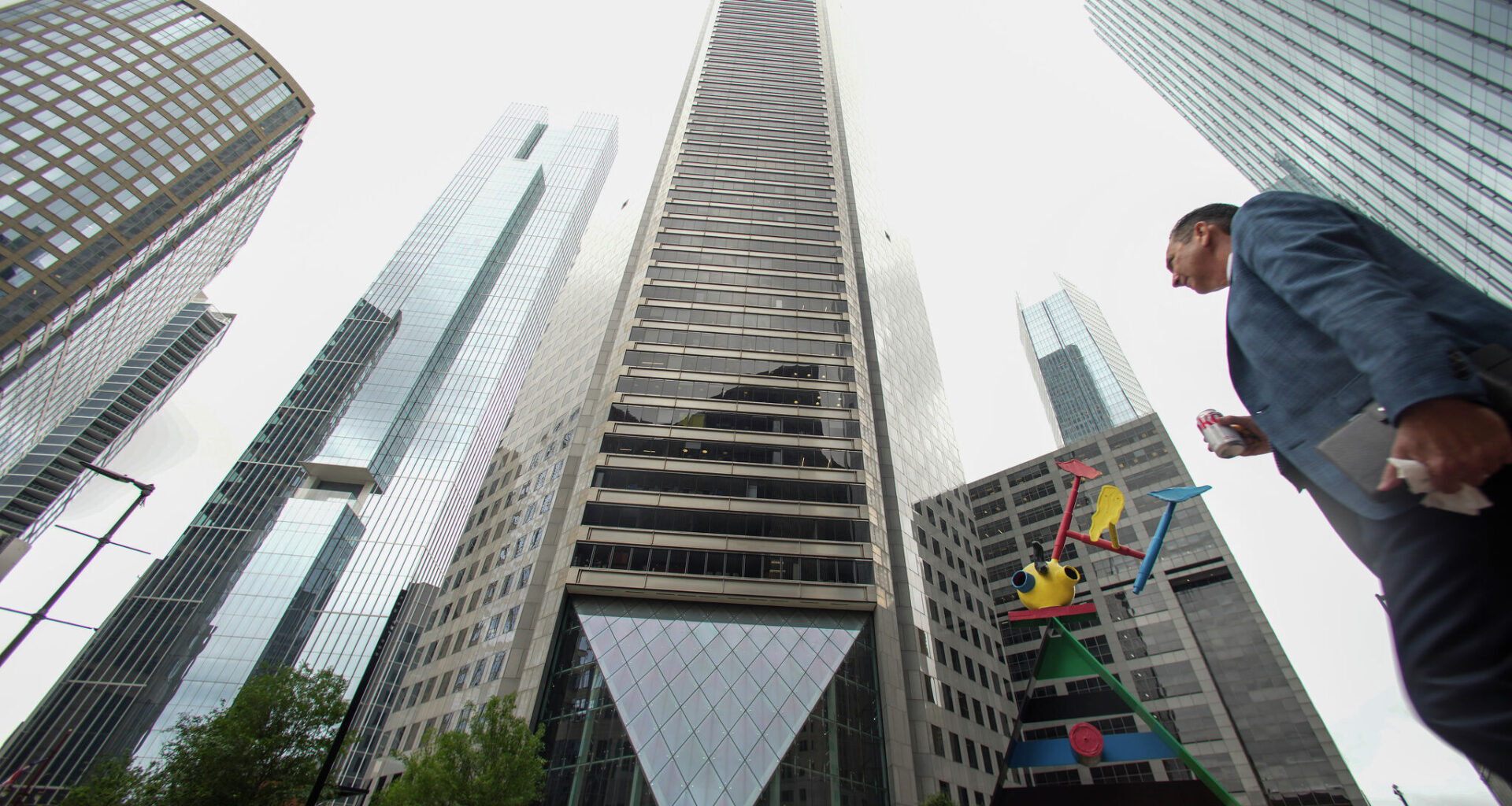
The JPMorgan Chase Tower, formerly Texas Commerce Tower at 600 Travis Street is shown on Wednesday, April 26, 2023 in Houston. The building is a 75-story skyscraper.
Brett Coomer/Staff photographer
Monday nights in my childhood I attended Boy Scouts meetings at St. Paul’s on Main Street, in what was then only newly called the Museum District. The meetings were long — cutting into my limited television allotment — but if I was good, my father would sporadically take the long way home, from Interstate 45 to Interstate 10, wrapping around the south and west ends of downtown. I would stick my head out the window like his Labrador retriever did and gawk at the tall towers. I imagined all the important people who worked in them, assuming every illuminated light meant an occupied office, even at 9:30 p.m.
Decades have passed since then. I now work atop the very tallest of Houston’s towers — and sometimes I am even occupying one of those offices with the illuminated light at 9:30 p.m. So much has changed about Houston, but not the famous tall buildings. Not since 1987.
Critics may point to some sad 40-something floor buildings recently built along Main Street. These do not count.
Article continues below this ad
I’m talking about something on the scale of 600 Travis Street, originally called the Texas Commerce Bank Building, now called the JP Morgan Chase Tower.
For decades it was the tallest building in Texas, bestowing bragging rights on our city, and standing as a symbol of our civic ambitions and successes. But now, after 42 years, that crown has been usurped.
During the 20th century, Houston and Dallas battled for that title, and if Big D had reclaimed the flag, it would have been bad enough. But instead, Austin, a glorified college town, topped out the Waterline in August 2025, and it will open later this year. The 1,031-feet tall tower bests our best effort by nine meters.
Lower Waller Creek is seen from the Confluence as it runs behind Waterline Austin Tuesday, May 26, 2026.
Mikala Compton/Austin American-Statesman
The wildcatters and cheap money that fueled our previous building booms, of course, are gone and will not be returning any time soon. The dated towers of downtown have long been emptied of most petroleum companies and now include lots of empty space. But a defeatist attitude is self-perpetuating. A prideful city, an ambitious city, is a successful city. And a resigned city may not maintain that success for long.
Article continues below this ad
Houston, we should all agree, is the crown jewel of Texas. It should lead our state not only in population, but in culture, prestige and wonder. Losing out on the title of tallest tower may seem inconsequential, but is yet another datapoint in how our city is being sidelined and marginalized to the benefit of those who still have that childlike ambition to reach up.
After all, as Texas Monthly once wrote, Austin is a town for children. And so Houston, the corollary continues, is for grown-ups. But perhaps that is why Houston now loses out upon this enviable title: We are now too old, too staid.
I was obsessed with learning about skyscrapers and memorizing their details when I was a young child. I was also less than five feet tall until high school. It does not take Dr. Freud to put all that together. But there is something more to skyscrapers than a mere contest of size, something that evokes childlike wonder and sense of adventure.
When men first raised their steel to the clouds, they reached out toward the Heavens, toward the celestial realms, having settled and subjected all earthly lands. Once the clouds were conquered, we quickly made jets to go ever higher, then rockets to leave our Earth and pursue the stars. Houston had a very special place in all that, and our city’s name is perhaps most famous for being connected with a problem, but also a solution that was seemingly impossible yet worked because of the indefatigable spirit and ingenuity of our people.
Today, the mighty Intercontinental Airport seems lobotomized, getting lapped so often in service and destination by the Dallas-Fort Worth version that comparison seems mean-spirited. And our trips to the stars seem to have less and less to do with Houston of late. Meanwhile, the Houston skyline has gathered dust.
Article continues below this ad
I recently visited New York City. In the years following 9/11, I found it shocking that the city’s tallest building was one built in 1931. But in the past two decades, Manhattan — as well as Brooklyn and Jersey City — have experienced supertall building booms. Dozens upon dozens of new additions to the skyline abound. Austin’s exponential, Dubaiesque growth is perhaps unfair to compare to Houston. But if old New York can keep growing and growing taller, not just bigger, then so can Houston.
Today, a onetime child, in New York, in Austin, perhaps soon even in Oklahoma City, can look toward the clouds and see new opportunities that were not there two score earlier. Unfortunately, when I drive home — sometimes the long way rambling in traffic down I-45 if I have been good — I see the same towers, seemingly stuck in amber.
Noah Horwitz is a Houston lawyer and writer.