
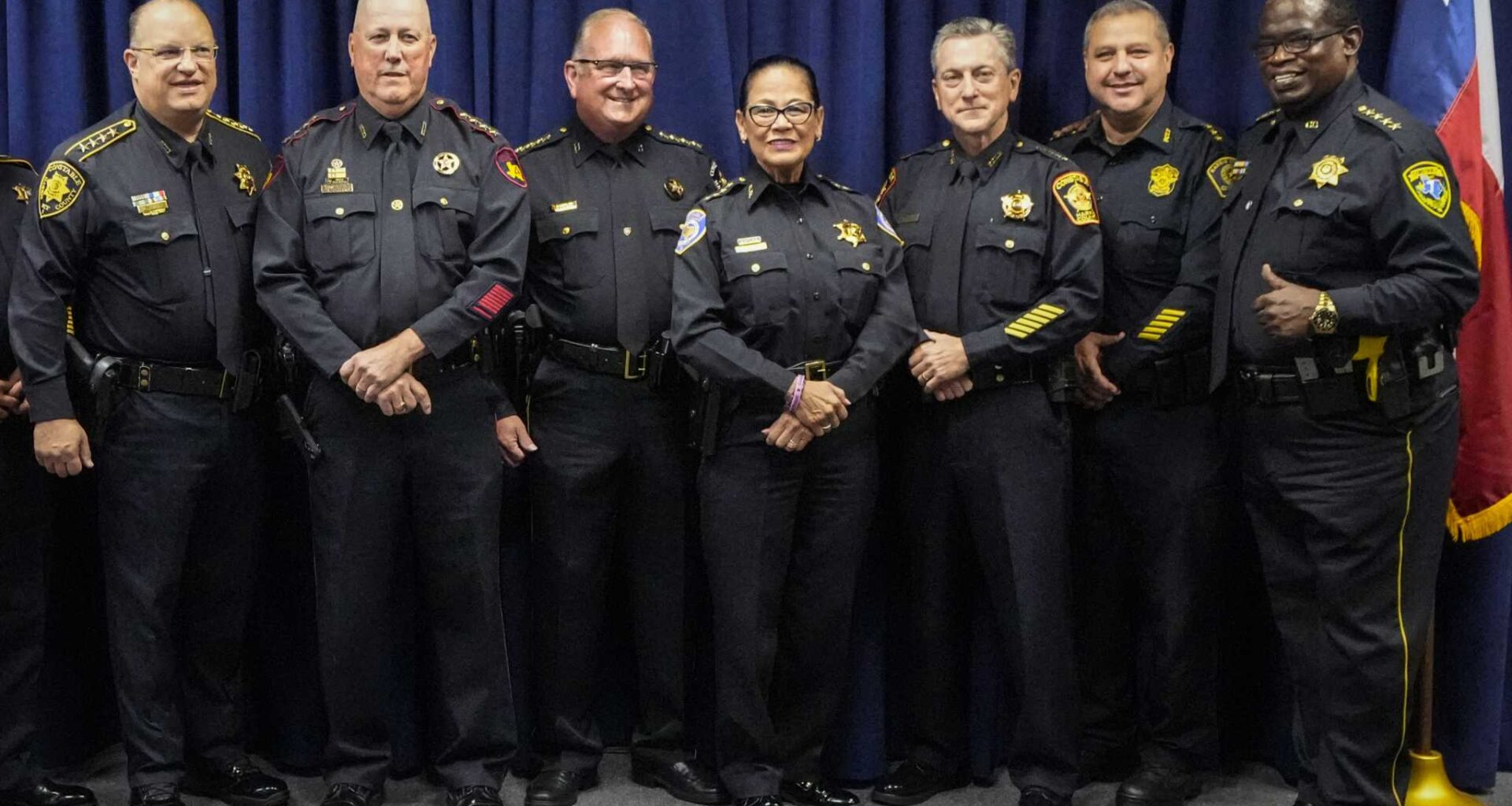
Harris County Constables Alan Rosen, Pct. 1, from left, Mark Herman, Pct. 4, Phil Sandlin, Pct. 8, Silvia Trevino, Pct. 6, Terry Allbriton, Pct. 5, Jerry Garcia, Pct. 2 and James “Smoke” Phillips, Pct. 7, gather together for a photo during a news conference in Houston, Thursday, May 22, 2025. Harris County constables are joined by Harris County commissioners and law-enforcement labor leaders to discuss pay raises for constable deputies.
Brett Coomer/Houston Chronicle
Harris County constables, empowered by legislation expanding their authority, are leveraging the threat of state intervention to pressure county officials for more money and autonomy, according to emails obtained by the Houston Chronicle.
Constable Mark Herman, a Republican who leads Precinct 4 in north Harris County, demanded everything from excess toll revenue to changes to the county’s paid parental leave policy. The emails carried with them the implicit — and at times, explicit — warning that, should the county fail to comply, they will call on their allies in the Texas Legislature to force the matter.
“We would prefer to work this out with our county versus the state,” Herman wrote in one letter, “because if legislation was passed it would certainly take money away from other county venues.”
Article continues below this ad
Harris County’s eight elected constables — who employ a total of about 1,800 deputies — proved they’re a political force by successfully lobbying for a trio of bills that exclusively apply to their offices.
UNCHECKED FORCES: A Houston Chronicle Investigation
One stripped the Harris County Commissioners Court of its oversight of the constables’ lucrative contract patrol program that allows them to raise money by contracting with neighborhood groups for extra patrols. Another law prohibited commissioners from reallocating unspent law enforcement funds to other areas. Yet another mandated any future law enforcement pay raises be given equally to all agencies that report to the county.
All three laws only affect counties with a population of more than 3.3 million — a common strategy employed by lawmakers seeking to tailor legislation to apply only to Harris County. Herman is listed as a supporting witness for two of the three bills.
Article continues below this ad
“The fact that we’ve been arguing over whether or not to have these contract patrols is preposterous,” said state Sen. Paul Bettencourt, one of the legislators behind the bills in support of the constables. “It’s another example of Commissioners Court going in one direction when the public wants them to do the common sense thing.”
Bettencourt said he hadn’t heard from the constables about the upcoming legislative session, and that his only motivation in advancing the bills was helping the residents in Harris County meet their law enforcement needs.
‘So here we are’
Harris County Pct. 4 Constable Mark Herman attends a news conference in Houston, Thursday, May 22, 2025. Harris County constables are joined by Harris County commissioners and law-enforcement labor leaders to discuss pay raises for constable deputies.
Brett Coomer/Houston Chronicle
Herman alluded to his involvement with the legislation in a March 24 email sent to Commissioner Lesley Briones.
Article continues below this ad
“I told (the sheriff) several years back that eventually, if our Commissioners Court keeps raising the contract rates, at some point we will have to get state legislation done to allow us as elected officials to enter into law enforcement contracts, without approval from Commissioners Court,” Herman wrote. “So here we are, with both new laws enacted.”
In another email sent to Briones on May 9, Herman criticized the county’s parental leave policy, which allows employees to take as much as three months paid leave following birth or adoption of a child.
Herman said his inability to replace the six deputies who were on parental leave had begun to impact response times.
The constable asked that Briones and Commissioner Tom Ramsey work to resolve the issue as part of the budget process in October, otherwise he said he would be forced to seek legislative intervention.
PREVIOUS: Exclusive: Constable seeks county-backed patrols for donor Tilman Fertitta’s River Oaks district
Article continues below this ad
Briones — who Herman framed in his emails as a close ally of the constables, along with Ramsey — responded two days later saying she and her staff were “happy to help identify and advocate for solutions.”
In response to questions regarding the emails, Briones said in a statement that she was happy to work collaboratively with law enforcement officials.
“Whenever any of our law enforcement partners share concerns, I am willing to listen and work collaboratively to identify solutions,” Briones said.
In an earlier email sent to the two commissioners, Herman references a dispute with the county budget office. Herman said he and Precinct 5 Constable Terry Allbritton “already have our complaint to the Governor’s Public Safety board drawn up,” should negotiations with the county fail.
In the same email, Herman said he plans to pursue legislation in the next session that would divert excess revenue generated through the state’s toll roads to law enforcement agencies. Herman said lawmakers have already signaled their support for the idea.
Article continues below this ad
In June, Herman and Allbritton sent more emails, this time about staffing complaints. Allbritton accused the court of favoritism toward the sheriff’s office, which requested an additional 20 positions. Allbritton alleged the county consistently rejected similar requests from the constables.
Herman, who was copied on the email, followed up the next day.
“I feel confident we will get what we request, if not I have some ideas on how we can achieve it,” he wrote.
More powerful ‘than they ever have been’
Most Texas counties have independently elected constables, originally intended to serve court documents, guard county property and conduct evictions. But Harris County’s are by far the largest in the state, and have seen their mission creep from one focused on civil process and security to broader law enforcement efforts.
“In Harris County, the constables offices have evolved the last few years into more powerful institutions with political interests and major lobbying capacity,” said University of Houston political scientist Brandon Rottinghaus. “The balance of power in county government has definitely shifted in their favor.”
NEW LAW: Harris County leaders push back on patrol contract law, calling it a “budget killer”
Various disputes between commissioners and the sheriff over the decades have prompted the county to direct resources away from its top law enforcement official to the eight constables’ offices.
The result is that, unlike other urban counties in Texas, Harris County constables wield considerable influence — both through their relationships with state officials, and public goodwill built on the direct service and speedy response times provided to residents in areas that participate in the “contract patrol” program.
The program allows individual landowners, businesses and homeowners associations to pay a portion of a deputy’s salary in exchange for an expanded law enforcement presence in their community. Harris County’s large unincorporated area, which lacks police services normally provided by cities and towns, has partially fueled the program’s growth, along with wealthy inner-city areas where residents have the means to pay for additional law enforcement.
The constables’ rise in political power reminded Rottinghaus of the power some sheriffs and state law enforcement had in 19th century Texas.
“The constables are more politically autonomous than they were originally intended to be,” he said. “They’re certainly more powerful now than they ever have been.”