
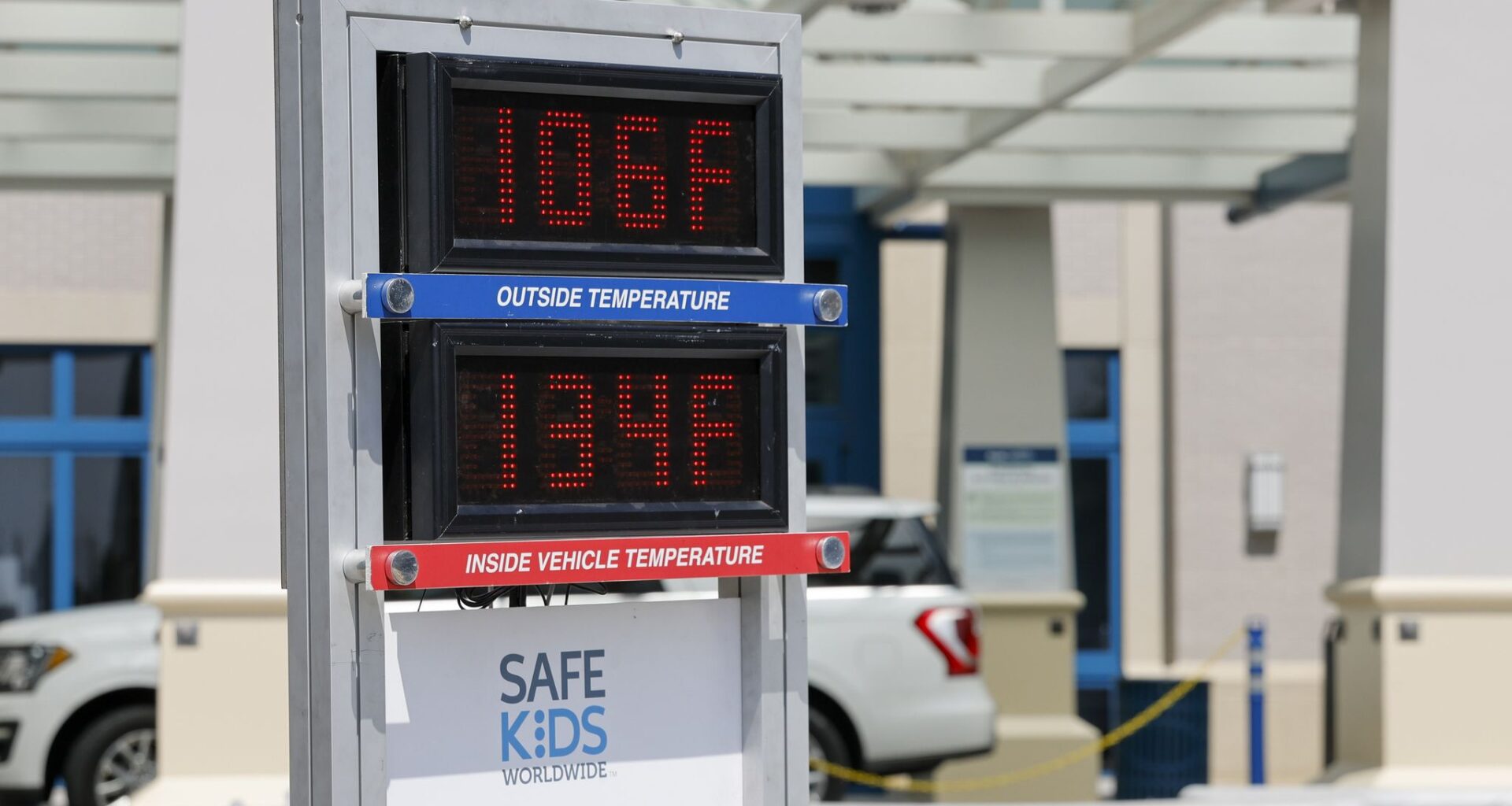
A board displays the outside air temperature while another thermometer measures the temperature inside a parked car outside Cook Children’s Medical Center in Fort Worth on June 21, 2022.
Elias Valverde II/Staff Photographer
With triple-digit days on their way this summer, North Texans know the key to being outside in the heat is finding ways to cool off, whether through trips to the pool or shaded playgrounds.

However, as outside temperatures rise, so does the one inside of your car.
In 2025, 33 children, across the U.S., died from heatstroke after being left in a car, with eight occurring in Texas, according to data from noheatstroke.org — a tracker used by the U.S. Department of Health and Human Services.
Article continues below this ad
Dr. Monica Herrera, a pediatrician at Cook Children’s, said children are especially vulnerable because their bodies warm more quickly than adults’.
“The inside of a car can be as hot as an oven,” Herrera said. “That can happen very quickly, within minutes, on a very hot day.”
The temperature inside a closed vehicle can rise up to 20 degrees in about 10 minutes, or 50 degrees in an hour, according to the National Weather Service. When Dallas temperatures are in the 70s, the inside of a car could reach 120 degrees within minutes and near 150 degrees in an hour.
How do children die in hot cars?
The majority of deaths happen due to caregivers unintentionally forgetting children in the car, according to the Texas Department of State Health Services. Other common scenarios include unattended children gaining access to a car or caregivers knowingly leaving children in hot cars.
Article continues below this ad
Herrera said being in a hot car can make it difficult to maintain a stable body temperature because heat cannot be released efficiently.
“If you’re in an environment where you can’t get rid of the heat, for example, a closed vehicle, there’s no place for the heat to escape,” Herrera said.
Related: D-FW temperatures could reach triple digits by Independence Day
How long can I leave my child in the car?
Under Texas law, it is illegal to leave a child younger than 7 years old alone in a car for longer than five minutes, unless they’re with someone 14 years old or older, according to the Texas Department of State Health Services.
Article continues below this ad
The Texas Heatstroke Task Force is a group working to prevent child injuries and hot car deaths. The group, primarily made up of child safety advocates, first responders and medical professionals, recommends that individuals who rescue a child from a hot car should follow these steps to protect themselves from liability:
Confirm the vehicle is locked and the child cannot get out.
Believe the child is in imminent danger.
Call 911 before entering the vehicle.
Use no more force than necessary to enter the vehicle to free the child.
Remain with the child in a safe location until first responders arrive.
Related: No, you can’t rescue a pet from a hot car in Texas. Here’s what you should do instead
Even though the law allows for up to five minutes, the task force recommends never leaving a child alone in a car and keeping cars locked at all times so children cannot enter unattended.
Herrera said parents should make it a habit to check the backseat every time they leave the car. She added that despite being a common tip to keeping a car cool, cracking a window does not prevent hot car deaths.
Article continues below this ad
Related: Your ultimate guide to dealing with the heat in Dallas-Fort Worth
How do I help a child with heat exhaustion?
To prevent heat exhaustion, Herrera recommends caregivers encourage children to drink fluids every 15 to 20 minutes during outdoor activities.
“As a parent, you know your child the best,” Herrera said. “If there’s a change in behavior, pay attention to it.”
Herrera said early signs of heat exhaustion can include children becoming fussy or irritable, complaining of leg cramps, developing headaches or producing dark-colored urine. If a child’s condition progresses to heat stroke, symptoms could include pale skin, dizziness, sweating or high body temperatures.
Article continues below this ad
If a child appears to be suffering from heat-related illness, Herrera said caregivers should move them indoors or to a shaded area, remove excess clothing and elevate their feet. Call 911 immediately if a child’s condition worsens, such as by developing seizures.
“With the summer here, and the kids out of school, everyone wants to be outside,” Herrera said. “But we have to keep in mind the temperature as a gauge to what is safe and what is not safe.”
Related: Here’s why your car’s temperature sensor is probably wrong about how hot it is outside