
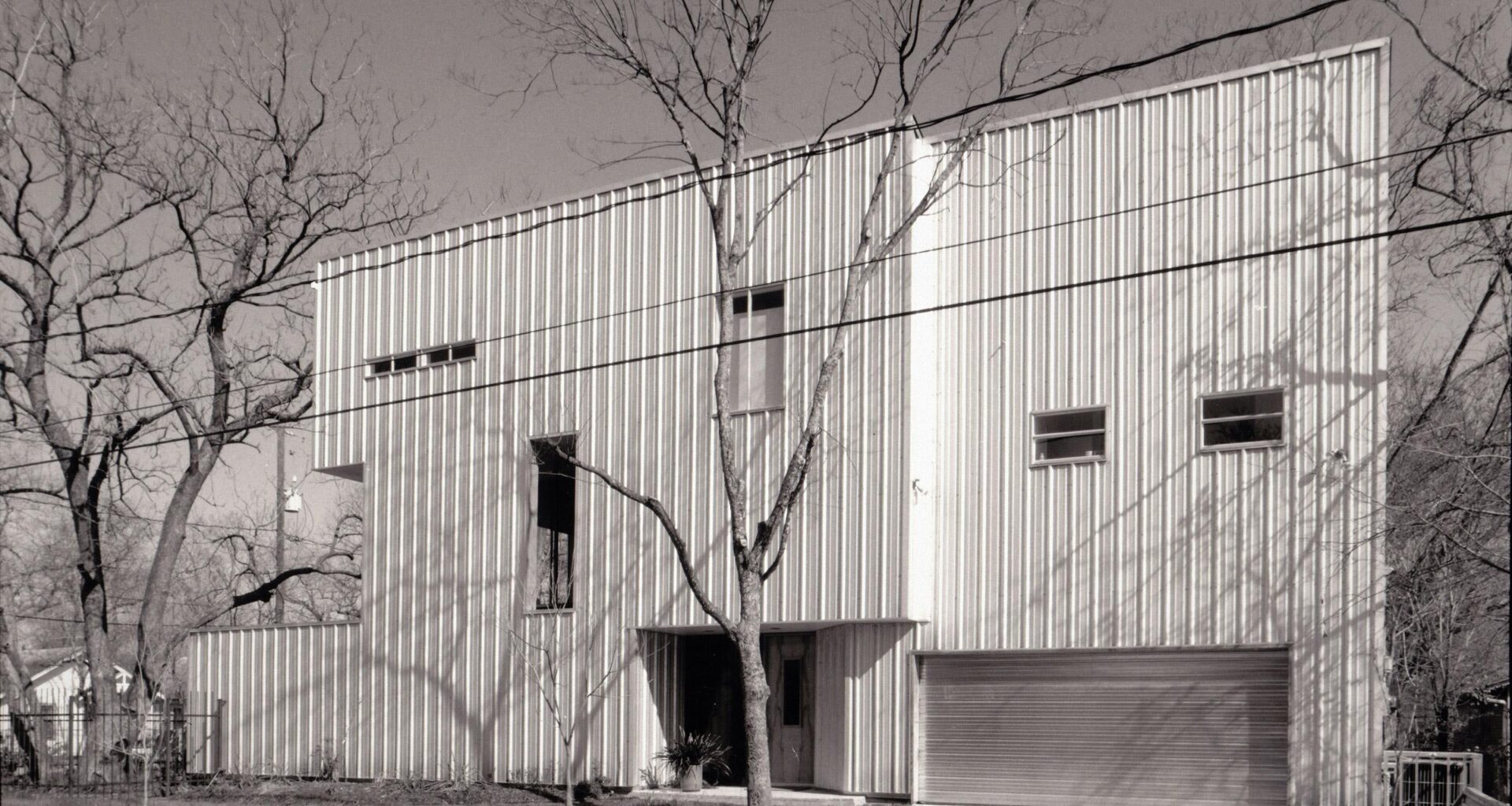
I live in a tin house.
Well, it’s not actually made of tin. It’s made of Galvalume: steel galvanized with an alloy of zinc, aluminum, and silicon and licensed by BIEC International, of Vancouver, Washington. But in Houston, houses like mine—of which there are at least three hundred—still go by that name.
Tin houses became one of Houston’s architectural calling cards between the eighties and late nineties. Local architects including Natalye Appel, Rob Civitello, and Cameron Armstrong (my neighbor) devoted themselves to developing the style. My house, designed and built by the late Bill Anderson, was completed in 2001, meaning it represents one of the final projects of what we might call peak tin house. It’s located dead center in Houston’s West End, a small Inner Loop neighborhood just east of Memorial Park. It’s the ’hood that made tin houses famous.
The history of the tin house movement is well-documented: In fact, for a time in the nineties, reporters from The New York Times, The Wall Street Journal, and other publications knocked on doors in Houston to write about the wonders of residential steel; they described a profusion of houses built in boxy, unadorned shapes and wrapped entirely in corrugated metal.
The homes these journalists found were constructed in stylistic harmony with the industrial buildings they were surrounded and inspired by. They lent themselves to live-work uses attuned to the specifics of Houston’s climate. Unlike wood, their metal didn’t rot in swampy humidity. And unlike brick, it didn’t trap heat inside. The houses were affordable, they lasted, and they were cool in more ways than one. Demand for them accelerated and peaked in the nineties, and architects designed them for clients across Texas—they cropped up in Marfa, Junction, and San Antonio, and as far away as Colorado, California, and Louisiana. In Houston, homes in the tin style continued to be built into the early 2000s. (Some Houstonians still commission them today.)
Local architects don’t really have a unified theory for why they fell out of favor. Most likely, it was just changing tastes. But it’s more exciting to speculate that the tin houses marked Houston’s engagement with the broader industrial aesthetic of the 1990s—the austere styles of The Matrix, Nine Inch Nails, and early Helmut Lang.
What’s been less discussed than the tin houses’ architectural value or aesthetic is how they tell the story of the West End—and, in turn, how the West End tells the story of an “old Houston” more eclipsed with each passing year. Just as the tin houses in the West End endure, so too does the version of Houston they represent. And as the city inches toward overtaking Chicago as the nation’s third-biggest metro—it had a larger population influx in 2024 than any other city except New York—its tin houses are an emblem of an artistic spirit and history that risks getting lost.
If the tale of the tin houses is a tale of the West End, then it is also the tale of a woman named Fredericka Hunter. When she tried to buy a house in the neighborhood in 1973, at 507 Roy Street, banks denied her the loan—after all, she was proposing to build a home in the middle of a redlined “ghetto.” And among warehouses. Many, many warehouses. When Hunter and her partner, the architect Ian Glennie, finally secured a personal loan from the impresaria of Houston’s burgeoning art scene, Dominique de Menil, they built the first of what would eventually be called the tin houses. Theirs was not clad in Galvalume (which didn’t achieve wide use until the eighties), but was instead wrapped in corrugated sheet iron. The home they designed—now demolished—was modeled on the warehouses that surrounded it.
Hunter, who was born in Galveston in 1946, got her degree in art history at the University of St. Thomas, in Houston. While there, she began working for de Menil, but she moved briefly to New York City before returning to Houston in 1971, to take over a business that would eventually be called Texas Gallery. (She runs it to this day.) Her plan was to bring some of the artistic energy she discovered in New York—where she mingled with Joan Jonas and Robert Mapplethorpe, among others—to her new gallery, as well as to 507 Roy. As Hunter recalls, in the early seventies, “Houston was nonjudgmental and less Bible Belt than Dallas.” The city was coming into a new and somewhat surprising identity as an avant-garde outpost.
Right down the street from Texas Gallery, the writer Donald Barthelme was busy at work building the creative-writing program at the University of Houston. The Rothko Chapel was being built. Philip Johnson was designing Pennzoil Place. Houston in the seventies, Hunter remembers, was constantly attempting to capitalize on its equidistance between the more salient cultural capitals: New York and Los Angeles.
This aesthetic ambition coincided with a massive influx of capital into the region and ensuing rounds of investment into Houston’s cultural and arts institutions. The city also rapidly became an arts hub because its most important patrons of architecture, the de Menils (Dominique and her husband, John) and Gerald D. Hines, “were not afraid to commission outstanding architects to design their buildings,” says Rice architecture professor Stephen Fox. Once Hines won acclaim for Johnson’s design of Pennzoil Place, “other Houston developers woke up to the fact that if they wanted to compete, they too had to commission outstanding works of architecture.” Between 1975 and 1985, Fox says, “works of significant architecture were produced at all scales, by architects both out of state and local.”
The flowering of artistic invention in Houston in the seventies and eighties took place against a background of deregulation. Both concepts go hand in hand: The city’s lack of zoning laws and its growing attitude of creative experimentation reflected, as Hunter remembers, a sense of freedom. “There was no plan. We just did stuff.”
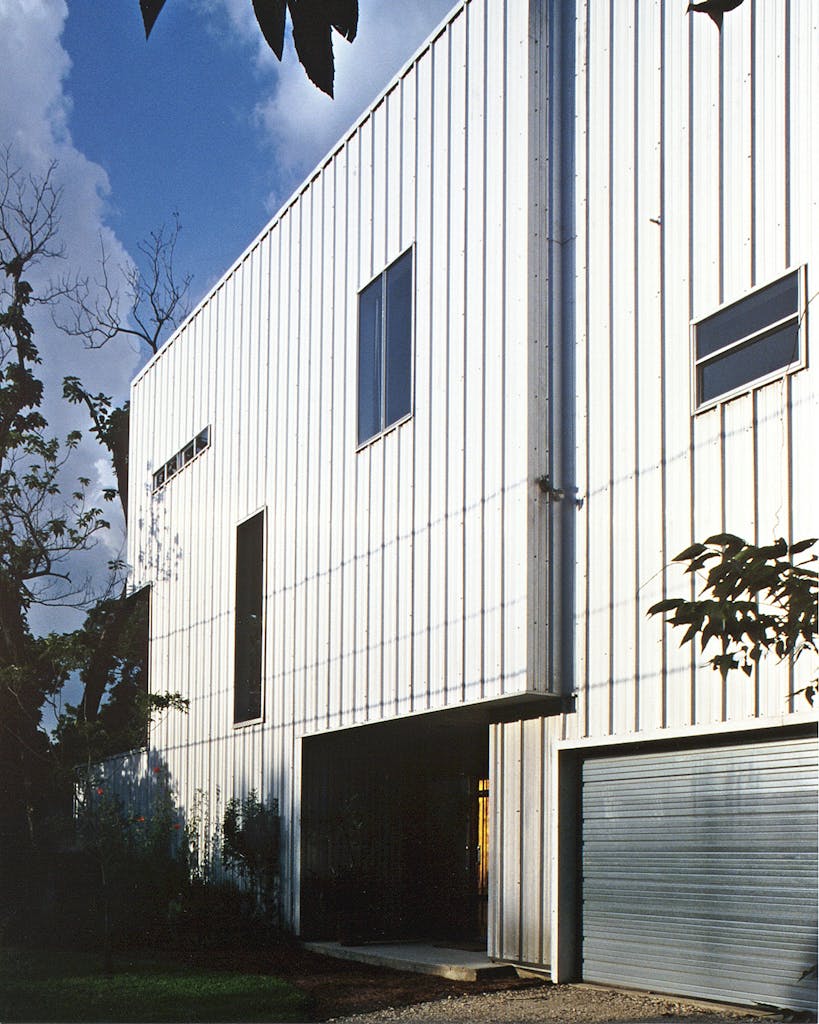 Tin houses were originally modeled on the warehouses that surrounded them.Paul Hester/Courtesy of Cameron Armstrong
The West End was the ideal location for able artists with modest means to “do stuff.” Architect and tin-house owner Cameron Armstrong wrote that during this era, the neighborhood was “subjected to extreme stresses of poverty and decay,” as unreliable land titles and “persistent social problems” dissuaded developers from engaging with the area. This neglect turned the neighborhood into an incubator for artists like Hunter. Rainey Knudson, writing in 1998, called it “Houston’s SoHo.”
The artists who arrived in the West End through the nineties proved to be able students of Houston’s big-name developers, but they lacked capital. By necessity, they embraced a strip-and-salvage mentality, creating tin houses with cheap and easily available materials. It’s hard to get a count of how many such houses were built in total, even at the movement’s peak, though local architects and scholars estimate there were several hundred by the early 2000s. (Part of the reason it’s hard to count is because of Houston’s general indifference to claims of historical significance and preservation. As Fox notes, preservationists even struggled to achieve protective status for the Astrodome. Many tin houses have been scrapped.)
Even in their peak, though, tin houses were always a rare part of Houston’s residential landscape—it’s not as if the West End was an entire subcity of metal in the nineties. And even as the architectural press took note of the style’s spread in that decade, nonlocal writers were eager to characterize tin houses as mere local examples of postmodernism, often connecting them back to the house that postmodernist in chief Frank Gehry built for himself in Santa Monica, California, right around the time Hunter and Glennie commissioned 507 Roy. But tin houses had an improvisational and site-specific quality. Metal cladding, for example, was particularly useful in Houston as an affordable climate solution. As Armstrong explains, very little of the metal paneling on tin houses is in direct surface contact with the walls, meaning that Galvalume allows a heat break and, in turn, major cost savings. (Of the large quantity of brick houses in Houston, Armstrong remarks, “Many people in Houston live inside ovens; it’s mind-boggling.”)
Above all, Armstrong says, the virtue of pliable and inexpensive metal sheeting was the material’s capacity to allow homes to “follow the inner life of clients’ requirements wherever they might lead.” The houses’ undefined interiors lent themselves to combined live-work arrangements—whether the work was painting, writing, or keeping a legal practice. Metal materialized the modular spirit of the neighborhood and of the city surrounding it: pragmatic, unregulated individualism.
The houses lived out with pride Victorian art critic John Ruskin’s comparison of sheet metal in design contexts to “parchment,” or a blank surface for creation. That isn’t a bad way to describe tin houses in general, or the attitude that inspired them. Armstrong and Frank Zeni run their architectural practices from their (self-designed) houses, and my next-door neighbor runs a commercial design practice from hers. And even if their occupants aren’t actually artists, tin houses allow residents, according to Fox, to at least signify that they’re “affiliated with the world of art.” The homes, he says, historically “represented the ways their occupants wanted to be seen: as respectful new neighbors rather than intrusive outsiders. Rather than aligning with broader architectural trends, the tin houses were exceptional in the history of Houston architecture as emerging out of a local, neighborhood context.”
For me, Fox’s thinking rings true. The light-flooded interiors of my home, accentuated by the lack of ornamentation, inspire my wife’s painting and art, as they do my writing. I take a different walking path through the neighborhood every day, and with seemingly each itinerary, I discover a tin house I’ve never seen before, each playing with geometry, volume, texture, and its geography. Each inspires ideas and perspectives. To be sure, in recent decades developers have swooped in and finally had their way with my once resistant and overlooked neighborhood. Its streets are now stuffed with the same neo-something pablum ornamented with marble and the same gauche amenities (“farmhouse” sinks, anyone?) you’re likely to find in any city’s suburbs. But I continue to feel like I live in the past—in Houston’s past—in an urban artistic vision the city hasn’t been able to smooth or develop out of view.
The University of Houston architecture professor Drexel Turner once described sheet metal cladding as “something of an architectural comfort food,” a material that had lost its shock value. But I’m not sure that verdict holds in Houston, where tin houses—as Armstrong and Fox both agree—have always stoked emotion. On the one hand, their embrace of the industrial aesthetic puts them at odds with most residential architecture. On the other, tin homes also reject what Fox calls “the glamour, sophistication, and elegance” of establishment architecture. Fitting neatly into neither camp, they materialize a counterculture by embracing “the plain, the ordinary, and the unpretentious.” Tin houses give concrete shape to the old West End’s attitude of rebellion and invention. As they reflect sunlight, they also reflect the collision of high art and populism. Bless their shiny hearts.
Is that rebellion or invention present in Houston today? What will happen as this place continues to grow—aside, of course, from it sinking deeper into the swamp? Will the spirit that gave rise to tin houses die off? Fredericka Hunter, tin houses, and the West End tell a story about Houston: that then and today, what makes the city “cool” is its messy, misfit, working-class mix of modernist ambitions, monstrous amounts of deregulated capital, and individualism. But the city is evolving fast, and it’s possible that the story of this unique style of home—so vital to understanding an era of Houston’s artistic spirit—might get forgotten.
Houston is a place that has historically done a poor job of preserving its past. For a booming metropolis, relentless forward drive can be vital to progress. But the best incarnation of Houston’s innovative spirit is found in its history, including in tin houses like mine. As long as they’re still standing, that spirit will still be accessible, because my home and those in my neighborhood are not unlike Galvalume itself: covered by warranty.
Read Next