
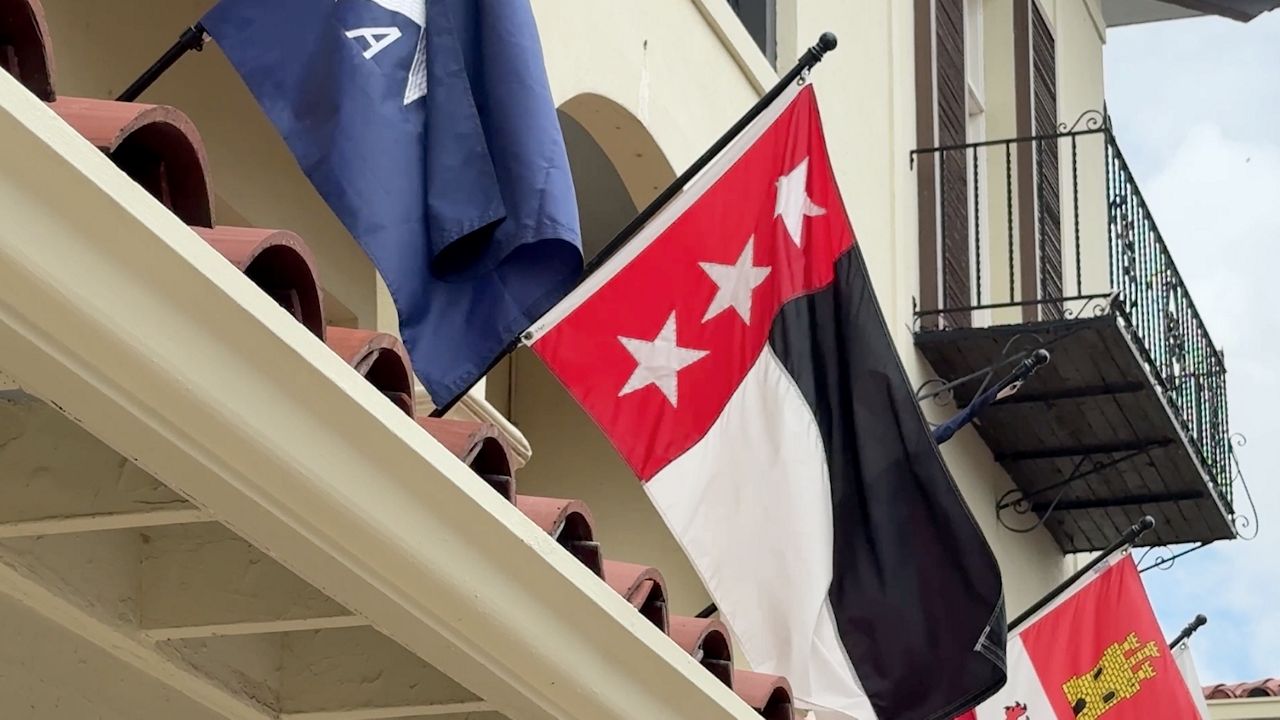
LAREDO, Texas — There are six flags that fly high in the mind of every Texan, but there’s a seventh that was never quite acknowledged by any of the other countries. Nearly 200 years after the end of the Republic of the Rio Grande, its spirit still bonds Texas and Mexico.
Stretching from above Laredo to Brownsville and reaching down past Monterrey, Nuevo Leon, the legacy of this short-lived country is still ever-present in South Texas and North Mexico.
Since the 1700s, when this area was under Spanish rule, people living here were often an afterthought.
“Since the beginning of the settlements here people were really left to their own devices,” said Andrea Ordoñez with the Webb County Heritage Foundation.
Ordoñez explained that people north of the Rio Grande were mostly okay supporting themselves, until Antonio Lopez de Santa Anna came along. Viewed by many as a dictator, Santa Anna dissolved Mexico’s Congress, dismissed its constitution and declared himself the center of power. Ordoñez says it was unpopular in many parts of Mexico and further isolated those who already saw little benefit from their federal government.
“[People living along the Rio Grande] thought, ‘why are we going to be sending all our money to the center, when we have basically survived this area for a century without any kind of representation?’” she said.
In search of a solution, they looked to neighboring Texas for answers.
The Lone Star State had been independent for four years by this point, for the same disapproval of Santa Anna. Texas didn’t want to be overly involved with helping Mexico lose even more territory for fear of retaliation. However, Ordoñez says Texas shared soldiers, money and resources — seeing it as a positive for Texas’ own independence.
“The people of Texas said, ‘well, if we let the Republic of the Rio Grande happen, there’s a buffer between us and the Mexican government,’” she said.
The Republic of the Rio Grande declared independence from Mexico in January 1840, but was never formally recognized by Mexico, Texas or the United States. It would end only 11 months later, in November, after a series of Mexican military defeats. The three-starred flag, however, is still incredibly important to the area. It’s even featured on Laredo’s official city seal.
“I think it just speaks to who … the people of South Texas and the North of Mexico are. We are independent people, we are ni de aqui, ni de alla,” Ordoñez said.
“Ni de aqui, ni de alla” is a common phrase on the border translates to: “Neither from here, nor from there.” Between two places, but living as one, is the spirit of the Republic of the Rio Grande that is still alive today.
“If people maybe feel like they don’t belong in one side or the other, well, you belong in the Republic of the Rio Grande,” Ordoñez said.