
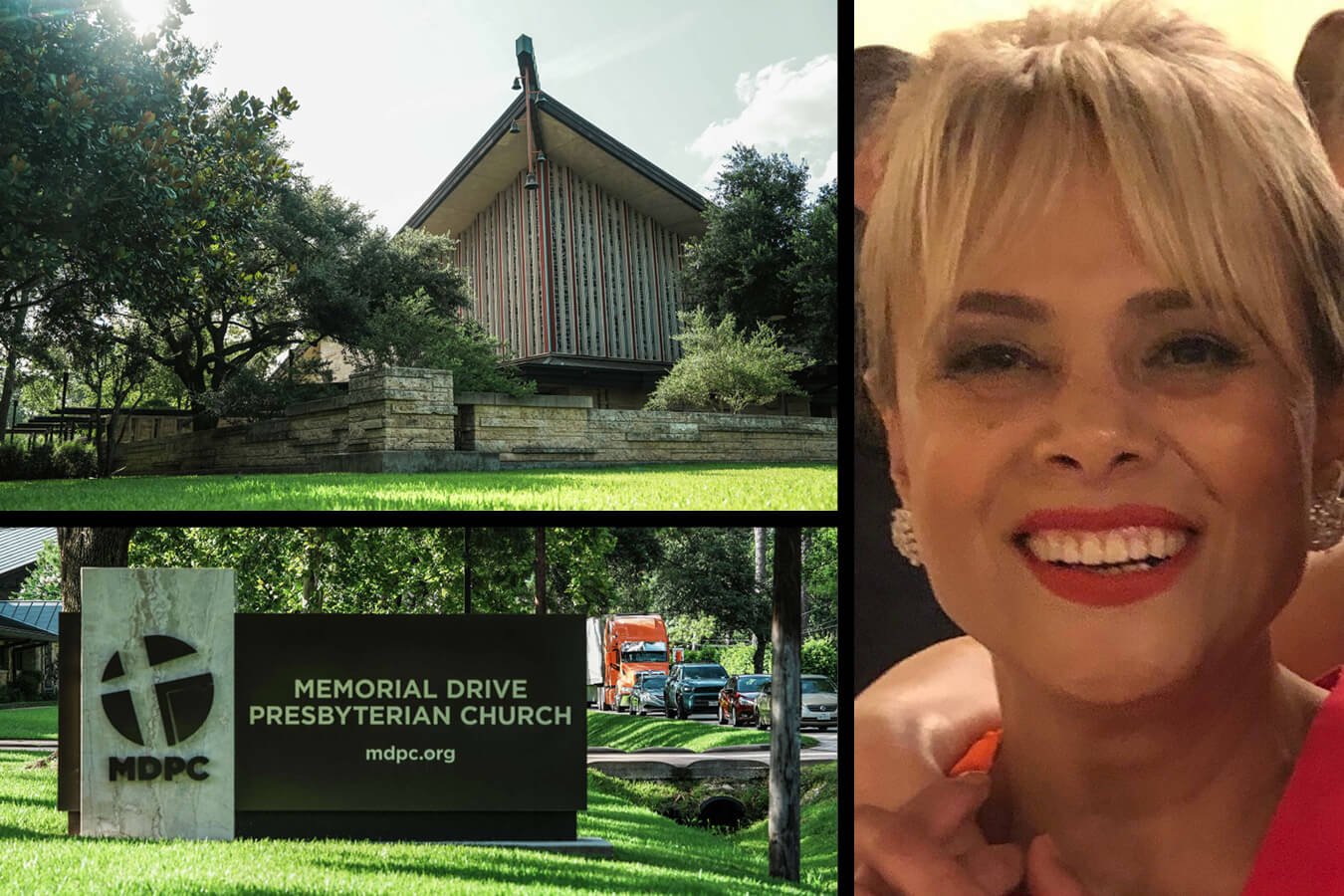
Zahra Razavinik, a Christian from Iran, taught preschool students at Memorial Drive Presbyterian Church for years. Immigration officials detained her in January 2026. (Photo montage by Susan Barber)
Jacob Lujan/Houston Chronicle
Zahra Razavinik, an Iranian immigrant who has lived in the United States for nearly three decades, is part of a team of teachers at Memorial Drive Presbyterian Church who encourage preschool children to develop their “God-given gifts.”
Federal immigration officials have deemed her a threat to national security and sent her to the El Valle detention center in Raymondville. She’s been detained since January, despite her lack of criminal history and efforts to relocate to a country that will grant her a visa.
READ MORE: How Trump’s immigration crackdown reshaped Texas and Houston’s immigrant landscape
Article continues below this ad
“She cannot go back to Iran. Keep in mind the country conditions over there,” Razavinik’s attorney, Misbah Chaudhry said. “Right now, it’s open war between Iran and USA.”
What’s just as concerning, Chaudhry added, is that Razavinik, 66, is a Christian.
“It’s a fundamentalist government over there, very conservative,” she said. “She is a liberal and because of her religious activities, she has no option to go back.”
It’s unclear how the current conflict between the United States and Iran could impact Razavinik’s fate. The United States and Iran came to an agreement this month to cease hostilities. Chaudhry doubts conditions for people like Razavinik will improve.
Article continues below this ad
Christians in Iran continue to be arrested and imprisoned in the aftermath of the June 2025 12-Day War with Israel, human rights groups have reported.
Last year, authorities in Iran arrested more than 250 Christians on charges related to their religious beliefs, an increase of more than 80%, according to Article 18, a London-based nonprofit that advocates for religious freedom in Iran.
More than 40 Christians were still serving sentences at the end of 2025, and at least 16 others remained in pre-trial detention, the report states.
MORE COVERAGE: ‘An absolute nightmare’: Trump’s overhaul of legal immigration is alarming critics
Razavinik has been in the United States since 1997 after she entered the country from Germany, where she was previously granted asylum. In 2006, an immigration judge granted her withholding of removal, a relief from deportation to an immigrant’s home country due to a fear of persecution. She was granted that relief because she was a Christian in a majority Muslim nation, according to a court filing.
Article continues below this ad
She was ordered to return to Germany or apply for a visa to enter another country but had no luck, Chaudhry said.
“She repeatedly applied to go to Holland, Norway, Canada, France, Denmark, Sweden, Switzerland, and Germany,” she said.
Memorial Drive Presbyterian Church sits on the corner of Memorial Drive in Houston. Zahra Razavinik, a teacher from Iran, taught preschool students there for years.
Jacob Lujan/Houston Chronicle
For the last two decades, her friends and family said that Razavinik led a quiet but productive life and worked as a preschool teacher at Memorial Drive Presbyterian Church. She has a valid work permit until 2030, her attorney said. Razavinik was also the chief caretaker for her husband, who has a heart condition.
During a routine check-in with Immigration and Customs Enforcement agents in January, Razavinik was detained after showing proof that she had applied for visas elsewhere. A pastor from the church accompanied her to her appointment, but Razavinik never emerged from the building.
Article continues below this ad
The ICE field office in Houston did not respond to a request for more information about Razavinik’s detention.
READ MORE: HISD student detained by ICE was on the verge of a successful asylum claim
“We applied for parole, we applied for a bond request with the judge, we presented everything in front of the judge to show that she has been continuously trying,” Chaudhry said.
Mohammad Reza Modaresi, Razavinik’s husband, said his wife’s time in detention is taking its toll. Earlier this week, Razavinik was almost mistakenly sent to Mexico without explanation, Modaresi said. If not for a last-minute call to the transport agents after officials realized their mistake, Ravazinik could have been sent to a country she’s never known.
“Zahra called me as soon as she returned to her dorm,” he said. “She is deeply shaken. She told me that the stress of those few hours was much worse than her entire six months in detention.”
Article continues below this ad
‘She’s part of the family’
Karen and Kyle Wittenbraker, whose children Razavinik taught at Memorial Drive Presbyterian Church, told the Houston Chronicle that Razavinik was an easy target for the Trump administration as it looks to ramp up its immigration detention and deportation numbers.
“They’re the ones who come in and check in and are trying to do the right thing, and then you just catch them at their check-in appointment and detain them,” Kyle Wittenbraker said.
Razavinik cared for the Wittenbrakers’ children, including a son with autism, after preschool. The family considers her more than a babysitter.
READ MORE: Houston immigration advocates celebrate as Texas Republicans criticize birthright citizenship ruling
“She would help drive him to his appointments and therapy, because that’s a lot of extra work,” Kyle Wittenbraker said. “I don’t really like calling her a nanny because she’s sort of more than that. She almost became — or did become — sort of part of the family.”
Wittenbraker, a Marine Corps veteran who deployed to combat three times, said Razavinik’s detention and the Trump administration’s immigration crackdown has stained the country’s reputation.
“This isn’t the country that I served. I’m embarrassed by the Gestapo tactics,” he said. “It’s cowardly, and it’s incredibly disappointing.”
The El Valle Detention Center in Raymondville, Texas is pictured, Thursday, May 1, 2025.
Valerie Gonzalez/AP
‘Stateless and not deportable’
Razavinik’s legal team is seeking her release from detention. She has a pending petition for release before a federal court in Brownsville.
Brian Green, a Colorado-based attorney handling Razavinik’s habeas corpus petition, said her prolonged detention goes against U.S. Supreme Court precedent.
“It’s been 20 years since the end of her immigration court litigation,” he said, citing Razavinik’s order to return to Germany in 2006. “(The government is) supposed to remove someone within six months. Putting her back into detention now is unfair unless they have a third country that’s going to take her back now.”
In a court filing, Green argues that ICE has not presented evidence that Germany or any other country will grant Razavinik’s application for a visa.
“She is stateless and thus not deportable,” the filing states.
Green also argues that keeping Razavinik locked up would “create a regime of shadow detention authority.”
“ICE could maintain lists of individuals with decades-old removal orders and strategically detain them whenever politically expedient or when seeking to bolster removal statistics, regardless of whether removal is actually possible,” the petition states.
Modaresi said foreign governments have denied Razavinik’s applications for a visa for different reasons. Some require a person to be in the country where they are seeking refuge, others have told her she is currently in a “free country” and she does not face a viable threat, and others have simply not provided the travel documents necessary to apply.
Modaresi hasn’t visited his wife because she’s worried about the toll the 300-mile trip to Raymondville might have on her husband’s health as he battles a heart condition. But Modaresi said that’s not the only concern.
What’s stopping ICE from detaining him, too?
“I have a work permit, I have a judge’s order, I have a withholding of removal,” he said. “But why would I think I am safe?”