
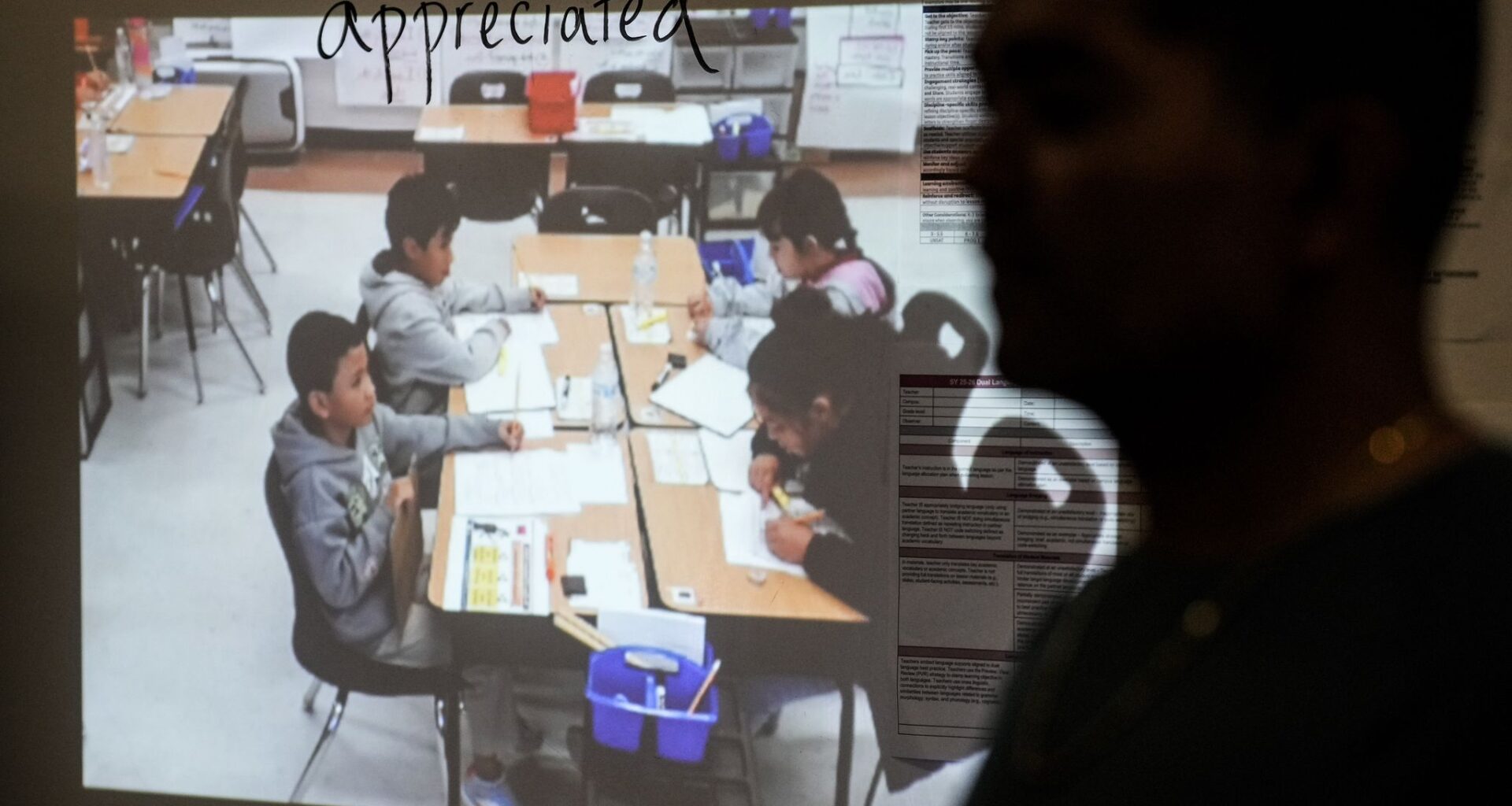
Juan Garcia works with his third graders one at HISD’s A.A. Milne Elementary School in Houston, Wednesday, Nov. 12, 2025. As schools across the country curb devices, HISD is expanding educational technology and AI use, raising parent concerns about screen time and lesson quality.
Brett Coomer/Houston Chronicle
While many school districts across the country are reducing screen time for students, Houston ISD is going in the opposite direction with its educational technology, prompting concerns from some parents.
Districts in California, Pennsylvania and Texas have introduced new guidelines to limit devices in classrooms after parents have protested the screens are harming their children’s development.
Meanwhile, leaders at HISD continue to adopt technology and experiment with AI, such as AI-generated curriculum, ChatGPT for special education, and other learning platforms. All high school students receive a Chromebook, and in August, HISD will debut its new AI-focused model, called Future 2 schools, which have drawn mixed reactions from the community.
Article continues below this ad
TECH POLICIES: From Chromebooks to iPads, here’s what tech policies look like at Houston-area schools
State-appointed Superintendent Mike Miles said during an April virtual town hall that the district does not “overwhelm” students with screen time during the day. In fact, he said the district is “geared to non-screen time” and people are complaining that students are reading too many paper packets.
“We’re not anti-AI. We’re not overwhelmed by AI. There won’t be a lot of screen time (in Future 2) but there will be some screen time, and we’re not going to apologize for that,” Miles said. “Kids need a little bit of that if they’re going to be successful in the future.”
However, some parents like Casey Williams worry that their children spend too much of their school day online. Williams said her son takes exams online at Heights High School, and his science and history classes rely on third-party platforms.
Article continues below this ad
She said the extra screen time has made her son, who has ADHD, less engaged and more distracted at school. Williams has watched her son play a video from an online quiz and then leave the room until it’s over. Another time, she saw him click through lessons from an educational software program and do the bare minimum “to get the teacher off his back.”
He told her the online tools and education platforms make him feel like his educators are less invested in his learning.
ALSO READ: HISD reaches the 3rd anniversary of the state takeover. What’s been lost, gained since 2023?
“As a parent, I hate hearing that,” Williams said. “And when I look at the actual content, yes, he definitely has better things to do.”
HISD said it provides Chromebooks to all students at high school campuses. However, the district did not respond to a request for comment on its policies regarding screen use for students.
Article continues below this ad
What the experts are saying
Experts said increased technology use in schools can have long-term effects on students.
David Kahn, a clinical assistant professor of psychology at Texas A&M University, said schools need to make sure that they are not exposing students to an excessive amount of screen use, which can cause attention problems for children.
“I recommend that tablets be used at a minimum at the elementary school level,” Kahn said. “And then, of course, once you get into middle school and high school, certainly by high school, it becomes a little bit more age appropriate, for a lot of the instruction to involve tablet-based learning.”
Kahn said he supports more traditional assignments with paper and pencils in Texas schools. However, he said they must expose students to screens to a certain extent because students take state standardized exams online, which measure their performance in critical subjects like reading and math.
Article continues below this ad
STAAR SCORES: Texas elementary, middle school STAAR results are out. See how your Houston-area school performed.
“The reality is screens are a big part of our daily lives,” Kahn said. “They’re not going to go away, and they’re going to be a big part of our children’s lives, but we also need to make sure that from a developmental perspective, we are giving children the access to traditional paper-pencil activities, traditional project-based activities that have always been part of learning.”
HISD’s approach to technology has also expanded beyond student devices.
The district has also embraced generative artificial intelligence under Miles, including a partnership with an AI company to produce thousands of reading passages and the use of ChatGPT to help teachers manage special education compliance.
Williams said there’s not much of a difference in what her son learns online in school versus the paper packets which she says are AI-generated. She said she’s seen her son and his friends become irritated and offended by the use of AI to produce class work, which she said is often riddled with typos and errors.
Article continues below this ad
“There is an entire wealth of curricula out there that’s not AI-generated, that’s not screen-focused, that if they were just to give the teachers enough autonomy to use it, it certainly exists,” Williams said. “I’ve seen quality curriculum. I know what that looks like, so it’s not like, ‘Oh, they either have screen time or they have these paper packets.’ That’s a false dichotomy.”
CURRICULUM: HISD adopted the controversial state Bluebonnet curriculum. Here’s what to know.
Greta Griffiths, an eighth grader at Pershing Middle School, said she’s noticed AI is often used for classes, such as an image of George Washington with three hands displayed in lesson slides or incorrect information included in her assigned worksheets.
“It’s difficult to pay as much attention when the packets that you were supposed to be learning from do not have the most reputable information because they are generated by AI,” Greta said.
Her mom, Amber Griffiths, said it’s frustrating to see her daughter’s enthusiasm for learning decline under the use of devices and AI in classrooms.
“I think, in part, because she can no longer have faith that what she’s being taught is accurate or well planned,” Griffiths said. “And so when a child loses faith in the instruction they’re being taught, it makes it that much harder for them to really engage in the learning.”
A new school model for an AI-driven world
HISD plans to launch AI-focused “Future 2” schools in the 2026-27 school year, which will serve students in kindergarten through eighth grade. The first four hours of the day will follow the standard NES curriculum. Then students will spend an hour on a seminar and two hours on “experiences,” like learning chess or creating a musical.
REFORM MODEL 2.0: Three years into the takeover, HISD is embracing AI, evolving its signature NES reform model
“The Future 2 model is not an AI school,” Monica Zdrojewski, HISD’s chief of staff, told the District Advisory Committee in May. “In fact, I would argue it’s the opposite. It’s actually looking at what are employers going to need in the future, and how are we designing a school system to help support our students in that ever changing world.”
Miles said the district is “very conscious” of students needing to use their own mind, express their creativity and write and do math without ChatGPT. However, he said HISD is trying to strike the right balance, and it would be false to say HISD is “not using AI-enabled tools.”
“We know that down the road, when they graduate, they’re going to be entering offices and competing with other colleagues who understand AI tools, who do good prompt engineering and framing of problems using AI, and if they haven’t had any experience with that, they will be at a disadvantage,” Miles said at the April town hall.