
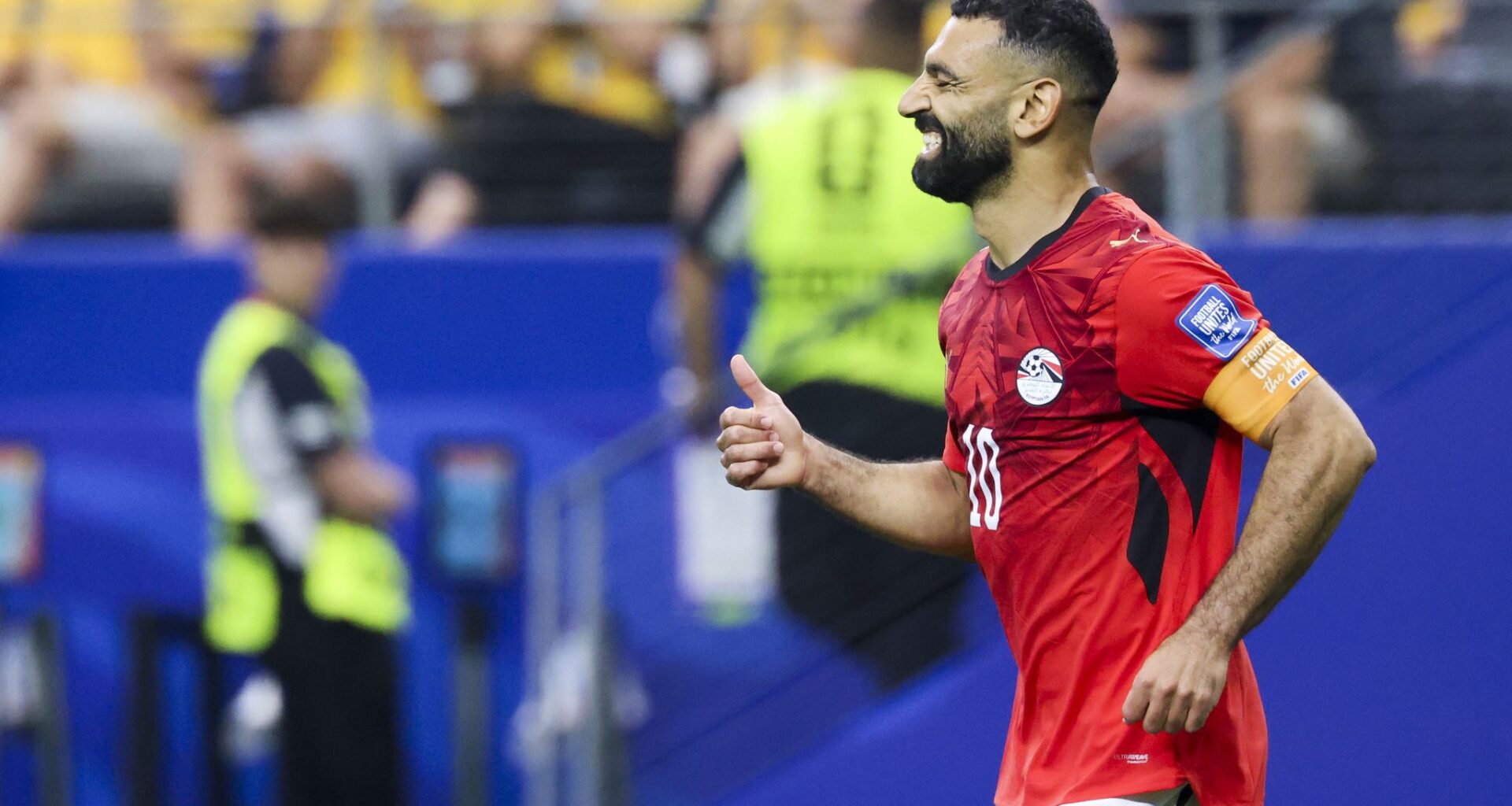
Egypt forward Mohamed Salah (10) leads his team as the take the pitch before a World Cup Round of 32 soccer match against Australia on Friday, July 3, 2026, in Arlington.
Smiley N. Pool/The Dallas Morning News
ARLINGTON — Regarded by many as the greatest African footballer of all time, he finally got his shot at redemption. On the sport’s biggest stage, the moment didn’t break him — Mohamed Salah seized it, and Egypt made history.

The Pharaohs defeated Australia in a dramatic Round of 32 match decided by penalty kicks Friday at Dallas Stadium, pushing them into a stage Egypt had never reached in three previous World Cup appearances.
With Lionel Messi and Kylian Mbappé commanding most of the spotlight at this World Cup, Salah is determined to make sure his name belongs in the same conversation — among the tournament’s best.
Article continues below this ad
Messi and Mbappé sit atop the scoring charts with six goals each. Salah, whose penalty goal Friday doesn’t count as official, lags far behind with just one — a gap that has only intensified the perception that he doesn’t belong in soccer’s exclusive circle of global superstars.
Yet few players in the modern era have built a résumé as complete as Salah’s.
He ranks among the most prolific wingers the sport has ever seen. He owns multiple Premier League Golden Boots and the record for the most goal involvements in a 38‑game Premier League season.
And while he arrived at Liverpool in 2017 with doubts swirling after a disappointing spell at Chelsea, he erased them almost instantly.
Article continues below this ad
By the end of his first season, he had scored 44 goals — a Premier League record for a 38‑game campaign — launching a run that would cement him among the league’s most productive forwards.
His 131 goals in 158 appearances put him in rare company, rivaled only by icons such as Sergio Agüero.
Is Salah the most underrated player at the World Cup?
Egypt forward Mohamed Salah (10) keeps the ball away from Australia defender Lucas Herrington (25) during extra time of a FIFA World Cup Round of 32 soccer match, Friday, July 3, 2026, in Arlington.
Chitose Suzuki/The Dallas Morning News
“That question should be answered by those who believe that about Salah,” Egypt coach Hossam Hassan said Thursday during a news conference at AT&T Stadium. “He is one of the best players globally, and I’m very lucky to work with him. I’m very happy with our work together so far.”
Article continues below this ad
Hassan speaks from authority. Appointed Egypt’s head coach in February 2024, he is one of the greatest strikers in African history — the national team’s all‑time leading scorer with 69 goals across 177 caps.
Salah is now just one goal away from matching him.
Some argue Salah doesn’t receive the attention he deserves because he doesn’t play for a global powerhouse, such as Messi’s Argentina or Mbappé‘s France.
Hassan rejects that notion outright.
“We are not just any team,” he said. “Egypt has won the Africa Cup of Nations seven times — no one has won it more. Egypt is an important team.”
Article continues below this ad
Salah started against Australia despite suffering a hamstring injury in the final group‑stage match against Iran. After physical therapy and rest, the 34‑year‑old stepped onto the Dallas Stadium pitch determined to lead his team.
Friday’s match was a roller coaster of emotions.
Full coverage: Egypt makes history in World Cup win over Australia at Dallas Stadium
Egypt didn’t take long to open the scoring. In the 13th minute, Karim Hafez collected the ball on the right side of the box and floated a cross toward the far post, where Emam Ashour rose to head it past Australia goalkeeper Patrick Beach.
Australia displayed its typical style of play: solid defensively but lacking creativity in attack, which meant Egypt’s goalkeeper was rarely troubled throughout the first half.
Article continues below this ad
The Socceroos’ goal came in a way that has become all too familiar for them.
A set piece, a cross into the box — but this time it was compounded by an error from Egyptian defender Mohamed Hany, who tried to clear the ball and instead redirected it into his own net in the 55th minute. It was Hany’s second own goal of the tournament.
Egypt forward Mohamed Salah (10) reacts towards his teammates after missing to connect with a scoring opportunity during the first half of a FIFA World Cup Round of 32 match against Australia, on Friday, July 3, 2026 , at Dallas Stadium in Arlington.
Shafkat Anowar/The Dallas Morning News
Things wouldn’t have gotten so complicated for the African side if it had taken advantage of the moment when Omar Marmoush found himself alone in front of the Australian goalkeeper, but he pushed his shot wide of the left post just 20 seconds into the second half.
Before the match reached extra time, Australia’s goalkeeper produced a spectacular save, twisting in midair and stretching out his left hand to stop Ramy Rabia’s powerful header.
Article continues below this ad
In the first extra period, Salah had a golden chance of his own, breaking free in front of the Australian keeper. But his shot sailed over the crossbar, drawing a collective gasp from the 70,244 spectators who packed the stadium in Arlington.
With one minute left in the second extra period, Australia made a strategic switch in goal, bringing on Mathew Ryan to handle the upcoming penalty shootout.
Salah was the third Egyptian to step up in the shootout, and with ice in his veins, he buried his penalty — a slow, composed touch straight down the middle as the goalkeeper dove to his left.
As Salah jogged back toward midfield to rejoin his teammates, several of them dropped to their knees and bowed in his direction.
Still, critics persist. They argue that while Salah is a lethal finisher, he can drift out of games. His style isn’t flashy — not like Messi’s hypnotic dribbling — and his speed is merely average, far from the explosive bursts of Mbappé.
Related: The inevitable Messi, pushing 40 at the World Cup, still stands alone on the biggest stage
Such perceptions have consequences. Despite his staggering production, Salah has never earned enough votes to win the Ballon d’Or.
Part of the problem is that his excellence has become routine. When a player regularly posts 20‑plus goals and double‑digit assists, fans and media begin to treat those numbers as normal — noticing only the rare dips in form.
And then there’s the matter of trophies. Salah’s cabinet is overflowing: Premier League, Champions League, FA Cup, League Cup. He has won every major honor with Liverpool, securing his legacy as one of the most decorated wingers in Premier League history.
Now his career sits at a crossroads. Last season was his final with Liverpool. He will decide his next destination only after the World Cup ends.
For now, he has another chance to shine.
Egypt’s next match will be against the winner of Argentina vs. Cape Verde. If Argentina advances, Salah will have a rare opportunity: a chance to steal the spotlight from Messi himself — and perhaps erase, once and for all, the stubborn stigma that has followed him throughout his career.