
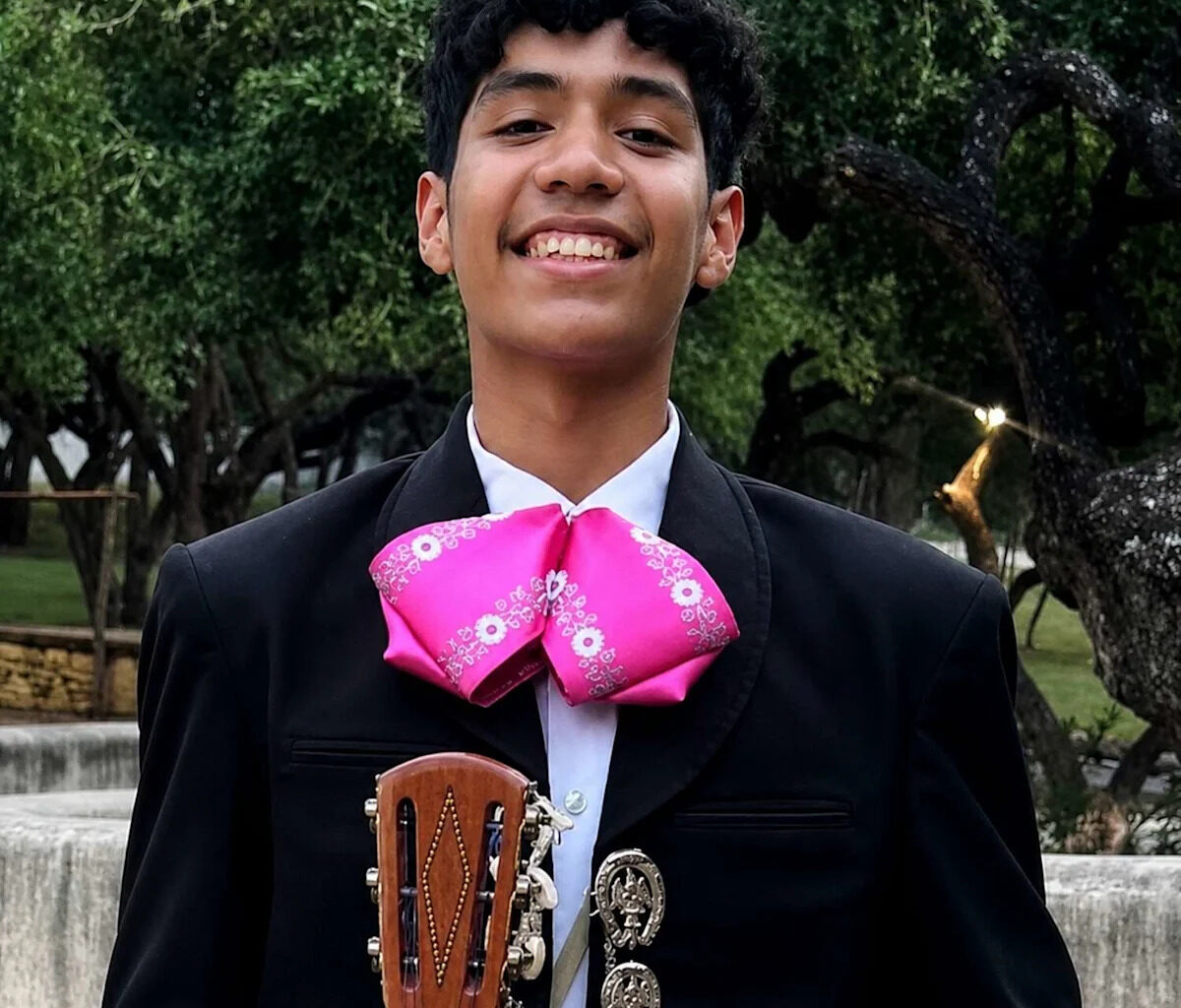
A San Antonio mariachi musician who was brought to the U.S. at age four and is facing possible deportation under the Trump administration’s immigration crackdown sang “The Star-Spangled Banner” Thursday for a July Fourth observance at the federal detention center in South Texas where he is being held.
Hebert Kaleth Ibarra Castro, 20, said he agreed to be recorded singing the national anthem even though he considered the request “weird” and “ironic.”
“They can treat us this way and lock us up and chain us up like animals, but still request for us to sing a song that speaks about a land that is free,” he said in a phone interview from the South Texas ICE Processing Center in Pearsall, 55 miles southwest of San Antonio.
Hebert was taken into custody June 25 after police pulled him over for speeding in China Grove, a small city 12 miles east of San Antonio. When he showed the officer a Mexican driver’s license, local police contacted U.S. Immigration and Customs Enforcement, whose agents interviewed Hebert and determined he was in the country illegally.
His performance of “The Star-Spangled Banner” grew out of an effort to mark Independence Day for detainees at the ICE facility.
The center held a contest in which detainees created Fourth of July-themed handkerchief arrangements. Winners received a goodie bag with Cokes, chips and cookies. Staff members at the facility also wanted someone to sing the national anthem, and Hebert said one of them asked him if he would do it. Many of his fellow detainees do not know English, much less the anthem, so he agreed, he said.
On Thursday afternoon, Hebert stood beside a poster of the American flag and a display of detainees’ red-white-and-blue handkerchief arrangements and belted out “The Star-Spangled Banner,” according to his wife, Marisol Pantoja, who spoke to him by phone afterward and received a detailed account.
The warden recorded the performance. Afterward, she told Hebert, “Dang, you have some pipes.” She asked Hebert where he had learned to sing. He told her he had been a musician all his life.
Staff members planned to pair the audio of his performance with video of the handkerchief display and screen it on televisions in the detainees’ housing units on July Fourth.
Hebert comes from a long line of mariachi musicians and earned a full-time job with Mariachi Los Galleros de San Antonio, a professional ensemble, at 18. He plays the vihuela, a five-stringed, guitar-like instrument, and he is the youngest member of the group, dubbed “El Niño,” or “the kid,” by his fellow musicians.
The ensemble has performed across Texas, including serenades for retired NBA star Charles Barkley and comedian Ben Stiller during the San Antonio Spurs’ NBA playoff run and at a Dallas Cowboys preseason game last year at AT&T Stadium in Arlington.

Hebert Kaleth Ibarra Castro, 20, is being held at the South Texas ICE Processing Center in Pearsall after the China Grove Police Department stopped him for speeding and called ICE. (Courtesy Marisol Pantoja )
‘Sing me a song’
Hebert was driving home on the morning of June 25 after performing at a birthday party with his mariachi group when he saw police lights behind him. A China Grove police officer pulled him over near U.S. 87 East and told him he had been going 69 mph in a 50-mph zone.
The China Grove Police Department is among local law enforcement agencies in Texas that partner with ICE to do limited immigration enforcement. Under its agreement with the federal agency, China Grove contacts ICE when officers encounter suspected undocumented immigrants during routine police activities.
ICE agents took Hebert into custody around 9:40 a.m. that day and brought him to the agency’s Crosspoint processing facility in San Antonio. Workers there congratulated one other on bringing in a mariachi, Hebert said. One told him, “I’ll let you go if you sing me a song.”
Hebert was still wearing his traje de charro, a highly ornamented suit worn by Mexican horsemen and mariachi musicians. His consisted of a navy-blue camisola, or long-sleeved shirt, and black pants with silver button adornments down the legs.
The ICE agents put him in handcuffs, ankle shackles and a belly chain, he said. He wore the traje for nearly 18 hours before he was allowed to shower and change at 3 or 4 a.m. the next day, he said.
In a statement to the San Antonio Express-News, the Department of Homeland Security, ICE’s parent organization, said Hebert had entered the United States “at an unknown date and location,” would receive due process and would remain in custody while the government pursues an order for his removal in federal immigration court.
His detention comes amid a broader immigration enforcement surge. Days after Hebert was arrested, Sister Leticia “Letty” Ugboaja, a Catholic nun, was detained while on her way to Sunday mass in McAllen. Ugboaja, a member of the Daughters of Mary Mother of Mercy, a religious order based in Nigeria, was held for nine hours before bipartisan political pressure led to her release.
From Nuevo León to San Antonio
Hebert’s family say they came to the U.S. to escape cartel violence in Nuevo León, Mexico. Disputing the ICE statement, they say they entered the country legally in May 2010, when Hebert was 4, but then overstayed their visas.
Hebert’s mother said she and her husband initially thought they would return to Mexico but decided against it when relatives there were threatened, killed or disappeared. Lawyers they consulted told them it would cost $25,000 to pursue asylum in the U.S. and that their chances of success were minimal because they had remained in the country after their visas expired.
Hebert’s wife, Marisol Pantoja, 20, showed the Express-News an image of what she said is his U.S. State Department border crossing card, a B1/B2 visitor visa that allows temporary travel to the United States. The card, which identifies Hebert by name and bears a photo of him, was issued in 2010 and expired in 2020.
Marisol Perez, a partner at a San Antonio immigration law firm, De Mott, Curtright & Armendáriz, said she saw news coverage of Hebert’s detention and recognized him and his mariachi group.
“We’re all part of the same community,” she said. “He represents the best of San Antonio.”
Perez said she and law partner Lance Curtright are representing Hebert pro bono and are seeking his release on bond.
The Deferred Action for Childhood Arrivals program, known as DACA, gives temporary protection from deportation to people who entered the U.S. without legal authorization when they were children. Perez said Hebert was not eligible for DACA because he entered the country in 2010, after the program’s cutoff date of 2007.
His most promising path to legal status, Perez said, is through his marriage to Pantoja, who is a U.S. citizen. The couple met as students at Fox Tech High School, where both participated in the mariachi program. They recently filed an adjustment-of-status petition, seeking legal permanent residency for Hebert as the spouse of an American citizen.

Hebert Kaleth Ibarra Castro and his wife, Marisol Pantoja, pictured in an undated photo, met as students in Fox Tech High School’s mariachi program. Hebert, 20, was detained by U.S. Immigration and Customs Enforcement agents after a traffic stop in China Grove on June 25. (Courtesy Marisol Pantoja )
‘Play a song for Hebert’
Anthony Medrano, a celebrated San Antonio mariachi musician, has been gathering support for Hebert and his family. He created a Facebook account, “Play a Song for Hebert,” where he provides updates, urges musicians to record and post songs, and advocates for Hebert’s release.

A social media post urges musicians to “Play a Song for Hebert,” a campaign launched by mariachi musician Anthony Medrano to support Hebert Kaleth Ibarra Castro, 20, who is in an ICE detention center. (Courtesy Anthony Medrano)
Medrano said mariachi musicians, former classmates, teachers, family friends and strangers see Hebert’s case as part of something larger than a single traffic stop.
“You mess with one of us, you mess with all of us,” he said.
On Wednesday, Brenda Smith of Mariachi de Mi Rancho, an all-female ensemble, posted a video of the group performing “Los Mandados,” Vicente Fernández’s corrido about a man who repeatedly crosses the border into the United States.
Vanessa Alonzo, a Houston ranchera and mariachi vocalist, posted a video of a performance. She dedicated it to the ICE agents Hebert said had teased him about being a mariachi. “You asked for a song, well, there you go,” she said.
Hebert’s case is one of several immigration cases in which U.S. Rep. Joaquin Castro, D-San Antonio, has intervened this year. In March, three McAllen mariachi students and their parents were released from detention after bipartisan pressure and national attention. Earlier this month, a 15-year-old Churchill High School soccer player and his father were released from ICE detention in Dilley after Castro’s office advocated for them.
“What was meant as mockery, mariachis across San Antonio have turned into an act of solidarity and are banding together to sing for his release,” Castro said on Facebook. “My office is working to bring Hebert home where he belongs, with his young wife and family.”
The response has spread beyond mariachi musicians. On Thursday, the “Play a Song for Hebert” Facebook page featured a poem by Eduardo “Eddie” Vega, San Antonio’s poet laureate. It invokes Psalm 137:3, a biblical verse about the Babylonian exile of the ancient Israelites, whose captors mockingly asked them to sing joyous songs from their homeland.
Vega’s poem, which he reads aloud on the video, described Hebert as a mariachi who used his voice not to bargain for freedom but to comfort others in custody.
‘My treasure’
Hebert said he misses his wife and keeps busy serving others. Each morning before 7 a.m., he distributes food trays to fellow detainees for $1 a day. He translates for detainees who do not speak English, helping them communicate with guards, understand documents, and use phones or tablets to call relatives. For those who have no money, he said, he shares from his commissary account.
“If anybody needs a question or anything, they come to me,” Hebert said.
Hebert said detainees are given an hour per day in a recreation room with musical instruments. He most enjoys singing “Mi Tesoro,” or “my treasure,” the Ramón Ayala song he sang to his wife on their wedding day.
Subscribe
There’s more to San Antonio with the Express-News. Subscribe today for just 25¢.
This article originally published at San Antonio mariachi in ICE detention records ‘Star-Spangled Banner’ for July Fourth.