
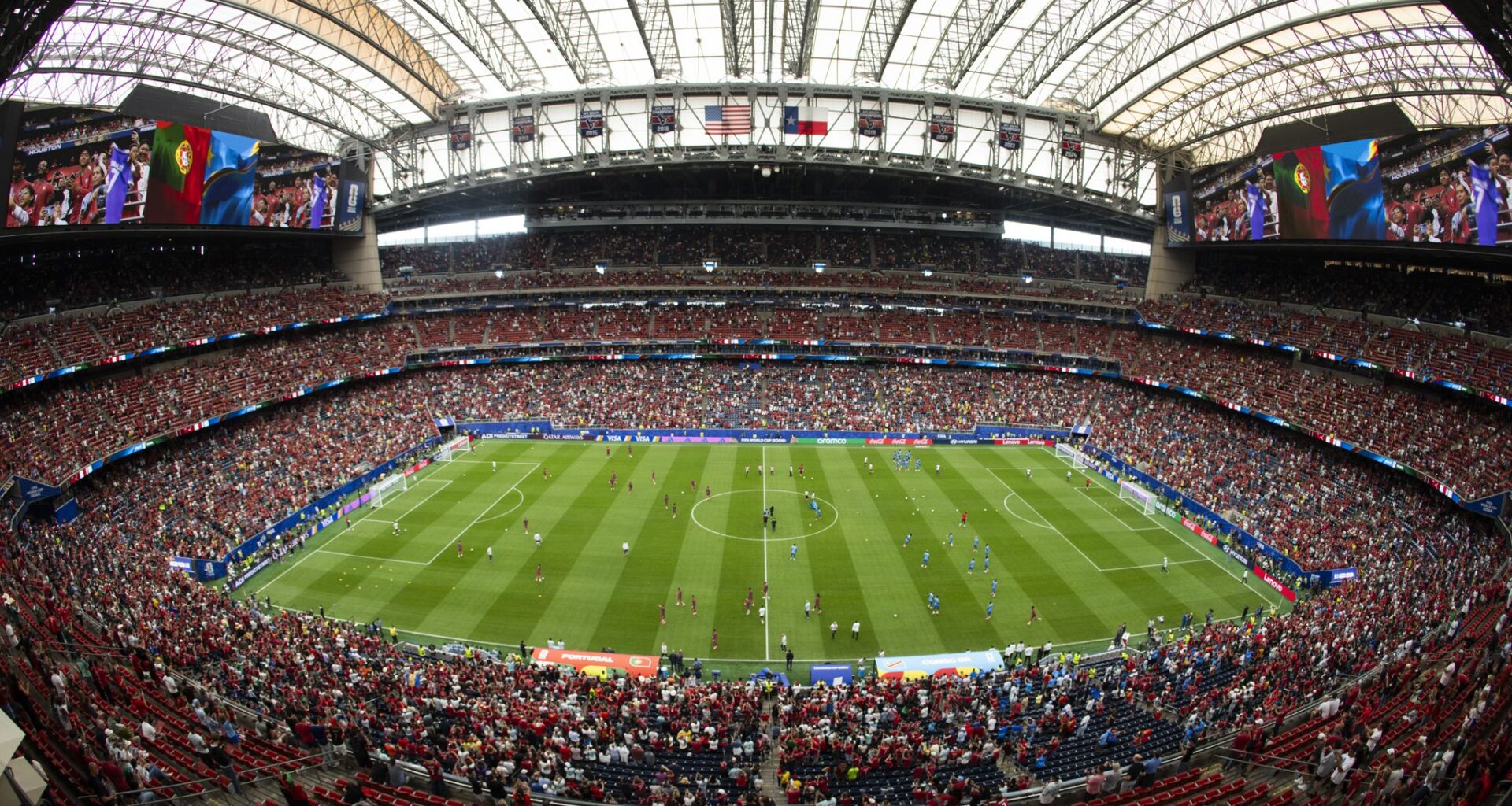
Players warm up before a FIFA World Cup between Portugal and DR Congo in Houston, Wednesday, June 17, 2026.
Jason Fochtman/Houston Chronicle
A pitch worker gets a little wet while working on the pitch before World Cup Group F game action between Netherlands and Sweden at FIFA’s Houston Stadium on Saturday, June 20, 2026.
Elizabeth Conley/Houston Chronicle
The types of grass being used at the stadiums hosting the 2026 World Cup.
Ken Ellis / Houston Chronicle
Japan team warms up during halftime against Brazil in the World Cup Round 32 playoff match at Houston Stadium on Monday, June 29, 2026. Brazil won the match 2-1.
Elizabeth Conley/Houston Chronicle
Grow lights from the Netherlands provide an artificial light source for grass to grow indoors.
Ken Ellis / Houston Chronicle
A worker moves equipment inside Houston Stadium previously known as NRG Stadium, prior to the start fo the FIFA World Cup 2026 tournament in Houston, Wednesday, June 10, 2026.
Jacob Lujan/Houston Chronicle
The three types of grass being used at World Cup venues.
Ken Ellis / Houston Chronicle
Houston’s World Cup stories have been numerous since the start of the tournament, from 25,000 Dutch fans walking through the streets to Mexico watch parties electrifying the city to Cape Verde becoming the smallest country by population to qualify for the knockout stage.
But one thing that nobody has really talked about since June 11: Reliant Stadium’s grass turf, installed exclusively for the World Cup.
Houston’s host committee hoped that would be the case.
Article continues below this ad
WORLD CUP GUIDE: What to know in Houston
“I’ll use this analogy: a good referee is one that you don’t notice, right?” said Chris Canetti, president of the host committee. “That means they’ve done their job. You’ve heard very little about the pitch, which means it’s exactly the way it’s supposed to be. It’s been beautiful.”
The planning and preparation to put in the grass field took more than seven years, Houston leadership has said. Dan Bergstrom, the host committee’s pitch consultant, led the charge from the beginning.
The importance of the years-long project cannot be overstated. John Coppins, the host committee’s vice president of operations who worked closely on it for about a year-and-a-half, said in May that without the plan spearheaded by Bergstrom, there would be no World Cup in Houston.
Article continues below this ad
But the plan wasn’t done in isolation. FIFA paid millions for research in sports turf and experts at Michigan State University and the University of Tennessee played major roles in the project across all the stadiums.
CANADA VS. MOROCCO: What to know, how to watch
The results can, literally, be seen on the field. Coppins said last week that there’s been no complaints from any of the teams that had played in Houston to that point and that FIFA was pleased with how everything was going.
“The preparation and the work you put in on the front end, it shows when you get into it,” Coppins said last week. “We haven’t had any major curveballs.”
How the grass came to Houston
John “Trey” Rogers III, the professor of turfgrass research in the College of Agriculture and Natural Resources, is a leading expert in the field. He helped lead the project to put grass inside the Silverdome in Detroit for the 1994 World Cup. With the World Cup back in the U.S., FIFA tasked him to help again in stadiums across the country.
Article continues below this ad
Houston’s grass is a mixture of Kentucky bluegrass and perennial ryegrass. The exact percentage breakdown — 84% Kentucky bluegrass and 16% perennial ryegrass — was the result of a two-year research project, Rogers said.
Mixing the two grasses together is done to be able to reap the benefits of both grasses. The ryegrass germinates quickly but doesn’t regenerate well after being worn down, Rogers said, while bluegrass grows back quickly after being worn down.
“There’s no such thing as the perfect turf grass,” Rogers said. “No grass can do everything.”
The Kentucky bluegrass and perennial ryegrass is a cool weather grass, which is why opening the roof for any of the matches in Houston was never a question. It was also grown away from Houston at a farm in Colorado with it originally being planted in the spring of 2025.
Bergstrom, who is also the director of turf and grounds for the Houston Dynamo and Dash, visited the farm multiple times during the growing process. The grass at AT&T Stadium in Arlington and Mercedes-Benz Stadium in Atlanta was also grown at the farm.
Article continues below this ad
“From the FIFA standpoint, the goal is uniformity across all stadiums, across all cities, all grasses,” Bergstrom said in February. “They want to explain to their teams that no matter where you are sent to play, it’s going to be a great surface and it’s going to be very similar to what you’ve seen elsewhere.”
A late start
May 1 was the official start date of installing the new field, which Rogers said was the latest start time for any of the stadiums doing an extensive installation.
The reason for the late start was the rodeo as stadium preparation couldn’t start until after the rodeo and rodeo cleanup was completed. Bergstrom said that FIFA wanted to start installing the turf earlier than that but everyone understood they had to work around the rodeo. which ended March 22.
“I know how hard and how important it was to create this plan and convince FIFA that it was going to work,” Coppins said.
Article continues below this ad
The process of building the field started with the bottom layer, which is best imagined like a cake. The bottom layer is plastic, followed by permavoid and a mat on top. Above those three layers is sand and the irrigation system.
Then, on top, is the sod and grass.
Installation of the sod started in late May when it arrived by the truckload from Denver. Coppins said there were more than 20 trucks of grass, which came in rolls.
In addition to the grass, the other major key ingredient to arrive in Houston ahead of the tournament were 12 grow lights from the Netherlands. With the stadium being indoors and the roof not opening, an artificial light source is needed for the grasses to grow.
Houston didn’t purchase the number of grow lights to cover the full field because Canetti said it wasn’t necessary. Coppins said the lights cover around two-thirds of the field and they are moved around as part of the plan to provide the light for all parts.
“We have to provide nearly all of the light required for turf grass growth and manage the moisture indoors, manage the temperature, humidity, all the weather conditions,” Bergstrom said. “We have to manage all that indoors and that’s definitely different than an outdoor stadium. It’s both good and bad. We have control. We want control. But we also don’t get that free sunlight that we need to grow the grass.”
The ‘good quality’
Graham Potter’s Sweden side didn’t play well in their lone appearance in Houston, getting thrashed by the Netherlands two Saturdays ago.
But that poor result didn’t change his view of the experience inside the stadium.
“Everybody in Houston’s been amazing,” Potter said at the end of his postmatch press conference. “The stadium was amazing. No problems with the pitch. No complaints from our side at all.”
DR Congo defender Gédéon Kalulu, who played a few minutes off the bench against Portugal on June 17, also had nice things to say about the pitch.
“It was good quality,” Kalulu said. “The stadium was unbelievable.”
Through the first four of seven matches, Coppins said he hadn’t heard a single negative review from any team that had played in Houston. The team had also developed into a routine to keep the field in good condition, which he said is a combination of irrigation, grow lights, maintenance and getting it ready for the forthcoming match.
Coppins throughout the process has been quick to highlight the importance of having Bergstrom on the team.
In early May, when looking at the pitch about a week after work officially started, Coppins said it made him emotional to see the progress and think about all the years Bergstrom spent working on the project to make it happen.
Then after seeing the success through the start of the tournament, Coppins said he was most proud to see all of the hard work from Bergstrom and the others involved in the plan paying off at a high level.
“All the parts are working together,” Coppins said. “It’s cliche, but it’s just nice to see a plan come together because in our line of work that isn’t always the case.”