
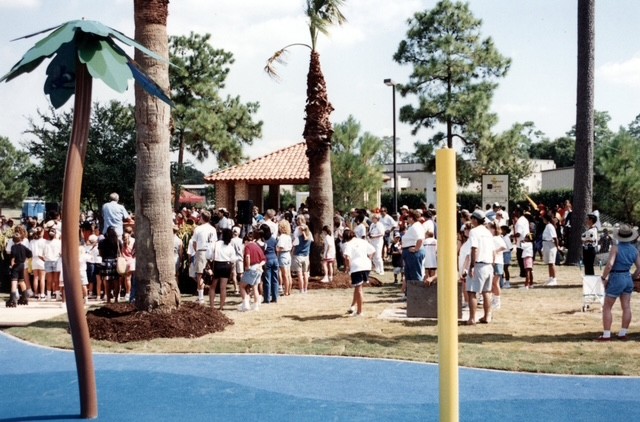
A group of attendees gathered for the opening of the Buddy Carruth Playground for All Children on Saturday, Aug. 26, 1995.
Yvonne Cormier
As our nation celebrates its 250th anniversary, I have been thinking about that famous quote from Patrick Henry at the Second Virginia Convention. No, not: “Give me liberty or give me death!”
His speech included another lesser-known line that nevertheless I’ve been stuck on: “I know of no way of judging of the future but by the past.”
READ THE LETTERS: Flying cars, robots, hope: What Houston children predicted over 30 years ago
Article continues below this ad
In 1995, I served as chair of the Hermann Park renovation, which included the creation of a “Playground for All Children.” As part of that project, we invited children to imagine their world decades into the future — “The Children’s Prediction Project 2020.” This collection recorded the imagination of children aged 8 to 13 years old about what life would be like a quarter of a century later. The catastrophic COVID-19 pandemic delayed their reveal, but now, the predictions have finally been opened in time for the Fourth of July.
Yvonne Cormier speaking at the opening of the Buddy Carruth Playground for All Children on Saturday Aug. 26, 1995.
Yvonne Cormier
The project collected nearly 800 predictions from those ‘90s-era children, representing the broad demographic of Houston: twelve public schools, four private schools and one rural school in Liberty, Texas. The hopes, dreams and fears written by these young minds became the foundation for this project and are a touching reminder of how deeply children can see into the heart of the future. Some pint-sized futurists were optimistic and filled with almost contagious euphoria about their vision of the future. Others were pessimistic naysayers.
It was no surprise that plenty of children growing up in Houston thought that living on the moon would be possible, and that no helmets would be needed for moonwalking. Some children said that colonies would be established on Mars due to overcrowding and pollution on Earth. With NASA’s successful mission to the far side of the moon and their plans to establish a moon base, these children’s imagination was not too far off from what could be possible today.
Article continues below this ad
Growing up amid the burgeoning digital revolution — they had just been introduced to Windows 95 — the children’s predictions mentioned some commonplace inventions we use today: smart watches where we could talk and see people on screens, robots doing every imaginable chore and electric driverless cars. Some brought up flying cars that would be soaring through traffic like the Jetsons, and although they’re not in our skies yet, companies are already initiating pilot programs to bring the idea to life.
Christina Monaha’s letter.
Yvonne Cormier
Other children’s predictions seemed to be influenced by their demographics and lived experiences regarding crime, poverty, illnesses and pollution. Stephanie Johnson wrote, “It seems like people can’t get along anymore.” Some optimists predicted that the crime rate would go down because of increased police, more jails and stricter punishment. One of the children, Scott W., said, “If we keep interfering with other countries’ problems, we are going to have a nuclear war.”
Another child believed that violence would come to a stop if communities got together and did something about it. Teresa Ortiz was convinced that there would be a “pill that is a regular meal.” There would be a cure for cancer and AIDS, which was a death sentence in the 1990s. Now millions can live normal lives with treatments for HIV.
Yvonne Cormier
Futurists who lived in the Deer Park area warned that rampant air pollution was destroying the ozone layer, creating the need for gas masks. Massive trash would destroy the land and eliminate the Earth because people “didn’t care.” Annette Demaret, on the other hand, wrote, “I think people are starting to see the light. We have hope. But we need your help!”
Article continues below this ad
Children pointed out the challenges, but not without offering solutions: recycle or leave for Mars.
With all of these predictions, the most important part is not what they thought the world would be like, but the substance of their thoughts and who they ended up becoming. The children who wrote about flying cars, the dangers of pollution and curing diseases grew up to become doctors, journalists, artists, educators, entrepreneurs and civic leaders. From a cardiologist caring for patients in Austin, a policy advisor in Chicago and artists of all kinds, from producers and sculptors, their childhood predictions remind us that many of our hopes and dreams start when we are young.
Looking back at these predictions nearly 30 years later, I am struck by the curiosity, optimism and sense of responsibility these children carried into adulthood. Patrick Henry believed that we should judge the future by the past, and when I look at these children’s predictions and what they have become, I am not worried about our future.
I believe we are in good hands.
Article continues below this ad