
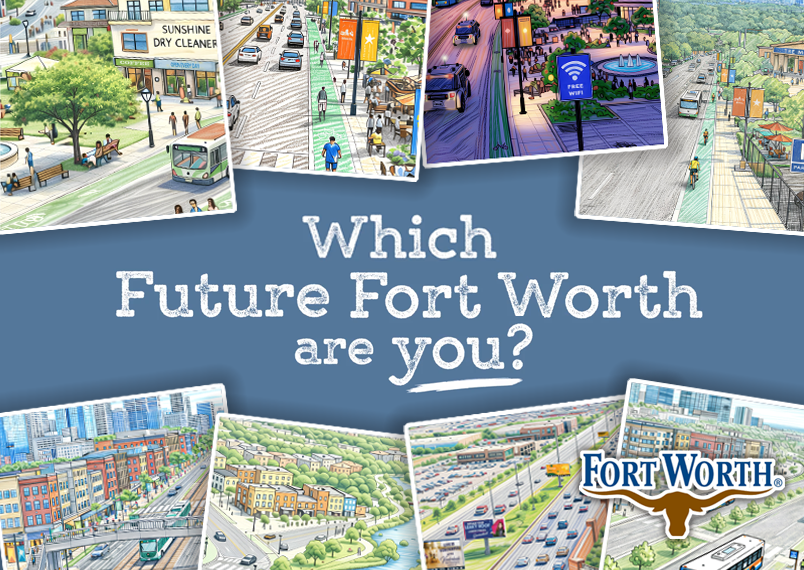
Fort Worth residents are sending a clear message about how they want the city to grow: build where infrastructure already exists, preserve open space, and create more walkable neighborhoods connected by parks, trails and transit.
Those themes emerged during the Fort Worth Zoning Commission work session June 10, with a status report from city staff on the city’s ongoing 2050 Comprehensive Plan update, a sweeping effort to create a new long-range blueprint for Fort Worth’s future. The update comes as Fort Worth continues to rank among the nation’s fastest-growing large cities and grapples with how to accommodate decades of anticipated population and job growth.
Planning officials said more than 9,700 people have participated in face-to-face engagement efforts as part of the plan update, and another 2,400-plus residents have completed online surveys. Among the strongest findings so far:
More than 9 in 10 respondents favor development in areas with existing infrastructure.
90% support preserving open space.
78% prefer infill development over expanding into undeveloped areas.
Survey participants also overwhelmingly favored living near parks, rivers and trails over living close to a traditional city center.
Eric Fladager, Fort Worth’s assistant director of planning and data analytics, said the draft plan proposes replacing the city’s traditional land-use framework with a new “place type” approach that focuses on creating distinct places where people can live, work and play.
Under the concept, future development would be organized into a series of place types ranging from neighborhood low, neighborhood medium and neighborhood high residential areas to neighborhood, community and regional mixed-use centers. Employment-focused place types would include commercial, campus, innovation flex, and manufacturing and logistics districts, while a separate category would emphasize “preserve and conserve” areas, parks and active open spaces.
2026 Fort Worth Zoning Commission
Documenter: Lou Chapman
Date: June 10, 2026
Learn more about this meeting by clicking here. For the agenda, click here.
Fladager said the goal is to create more connected, walkable environments with a mix of housing, jobs, services and recreation, rather than isolated single-use districts that require residents to drive for nearly every daily need. Current examples he cited as models are:
Fairmount, for neighborhood-scale walkability
South Main Street, for community mixed-use center
The Foundry District, as an “innovation flex” area, where former industrial land is evolving into a mix of employment, commercial and residential uses.
Public engagement on the 2050 Comprehensive Plan is far from over. The planning team continues to collect input through the reimagined city personality quiz and a virtual open house that is live. Residents can review growth scenarios and provide feedback.
Mulching operation near nature center draws opposition
Later in the public hearing, commissioners supported staff recommendations to recommend denial of a zoning request that would allow The Organic Recycler, a landscape supply and organic recycling operation, at 7640 Jacksboro Highway, nearly adjacent to the Fort Worth Nature Center & Refuge. It would be the company’s second Fort Worth facility.
The Organic Recycler sells landscape materials such as mulch, soil and aggregates while also accepting brush and tree debris for processing into mulch. Tim Sansone, founder and managing partner of The Organic Recycler, said during the commission’s public hearing on the zoning request that the site is well separated from homes and recreational areas and grinding operations would occur only once or twice a week.
Opponents, including representatives of Scenic Fort Worth and the nature center, raised concerns about compatibility with nearby natural areas, parks and a designated scenic corridor, noise, visual impacts and the possibility of airborne insect infestations into the nature center from the mulching operation. They questioned whether industrial-style grinding operations belonged adjacent to one of the city’s most environmentally sensitive areas.
After discussion, commissioners sided with staff and recommended that the Fort Worth City Council deny the request, citing concerns about the proposed use’s compatibility with the surrounding area and the nearby nature center.
Despite voting to recommend denial, zoning commission chair Jeremy Raines went out of his way to praise the applicant and separate the company from concerns about the location.
“I want you in Fort Worth,” Raines told Sansone, adding that the business is “a great company” doing “great work.” But, he said, the proposed location near the nature center posed too many long-term compatibility concerns. He encouraged the company to work with city staff to identify a different location elsewhere in the city.
Council members, at their June 23 meeting, voted unanimously to deny the rezoning request.
Auto repair project wins support after neighborhood outreach
Commissioners unanimously recommended approval of a revised site plan for an auto repair facility at 4213 Miller Ave., after the developer made a series of changes in response to neighborhood concerns and city staff comments.
The project had previously been approved as part of a planned development, but the applicant returned to amend the site plan and correct design issues identified during permitting. Jacob Petrie, whose company is developing the project, explained that the revised proposal reduces the building size, removes one service bay, consolidates two driveways into one, adds a 10-foot sidewalk, increases landscaping and buffering, and relocates site features to better protect nearby residential properties.
The company also negotiated directly with three neighborhood associations.
Eastland Neighborhood Association offered conditional support after the developer agreed to eliminate automotive detailing from the project.
Village Creek Neighborhood Association remained engaged in discussions with the developers.
Fairhaven Neighborhood Association continues to oppose automotive uses generally, though not necessarily the revised site design itself, Petrie said.
The updated site plan includes a binding restriction that limits the property to automotive repair use only and requires future approval for any car wash or detailing operation. The commission recommended approval by a 9-0 vote.
Council members at their June 23 meeting continued the case until Aug. 11 to ensure residents understand the project.
Commissioner Carmen Castro praised the outreach effort, saying the developer had done “their due diligence” in working with nearby neighborhoods before bringing the revised plan to the commission.
Lou Chapman is a member of the Fort Worth Report Documenters crew. If you believe anything in this account is inaccurate, please email us at news@fortworthreport.org with “Correction Request” in the subject line.
This <a target=”_blank” href=”https://fortworthreport.org/2026/07/04/fort-worth-zoning-commissions-2050-vision-takes-shape/”>article</a> first appeared on <a target=”_blank” href=”https://fortworthreport.org”>Fort Worth Report</a> and is republished here under a <a target=”_blank” href=”https://creativecommons.org/licenses/by-nd/4.0/”>Creative Commons Attribution-NoDerivatives 4.0 International License</a>.<img src=”https://i0.wp.com/fortworthreport.org/wp-content/uploads/2021/04/cropped-favicon.png?resize=150%2C150&ssl=1″ style=”width:1em;height:1em;margin-left:10px;”>
<img id=”republication-tracker-tool-source” src=”https://fortworthreport.org/?republication-pixel=true&post=638301&ga4=2820184429″ style=”width:1px;height:1px;”><script> PARSELY = { autotrack: false, onload: function() { PARSELY.beacon.trackPageView({ url: “https://fortworthreport.org/2026/07/04/fort-worth-zoning-commissions-2050-vision-takes-shape/”, urlref: window.location.href }); } } </script> <script id=”parsely-cfg” src=”//cdn.parsely.com/keys/fortworthreport.org/p.js”></script>