
Reminders of the family Terry Traugott and Sherry McCutcheon’s lost in last year’s Central Texas floods are everywhere in their Manor home.
Their momma’s pink cane, covered with dirt they can’t yet wipe off. The burnt-out living room light bulb because their brother, Gary, always changed it. An incomplete puzzle their mother worked on. The sisters can’t finish it without her.
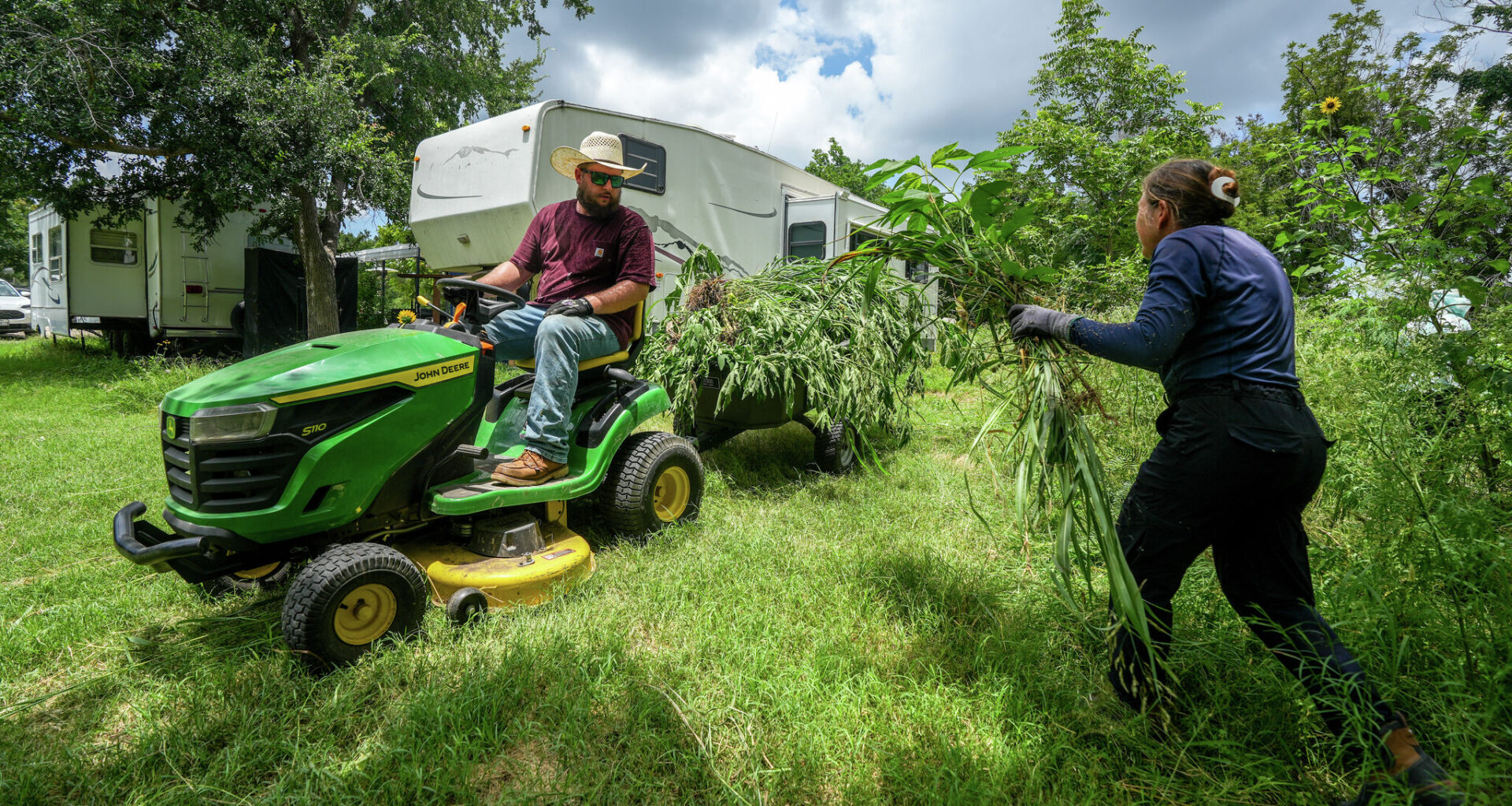
Brianna Hunter pulls her friend Ashlee Willis in a trailer after spending several hours removing invasive weeds and grasses from Willis’s mother Brandy Gerstner’s property on Sunday, June 14, 2026 in Leander. Weeds and invasive grasses are being cleared so new tree saplings can be planted along Sandy Creek.
Aaron E. Martinez/Austin American-Statesman
Attendees give a standing ovation at the dedication of Burnet County ESD No. 6 Station #2, Marble Falls Area Volunteer Fire Department’s new fire station on June 27, 2026. The fire station will be named the Michael E. Phillips Fire Station in honor of the former fire chief who went missing while responding to a call during the July 5 flooding last year.
Sara Diggins/Austin American-Statesman
Marble Falls Fire Chief Derrick Curtis speaks at the dedication of Burnet County ESD No. 6 Station #2, Marble Falls Area Volunteer Fire Department’s new fire station as the station is reflected in his glasses, June 27, 2026. The fire station will be named the Michael E. Phillips Fire Station in honor of the former fire chief who went missing while responding to a call during the July 5 flooding last year.
Sara Diggins/Austin American-Statesman
Ashlee Willis creates a pile of pulled weeds on her mother Brandy Gerstner’s property on Sunday, June 14, 2026 in Leander. Weeds and invasive grasses are being cleared so new tree saplings can be planted along Big Sandy Creek.
Aaron E. Martinez/Austin American-Statesman
Burnet County Sheriff’s Office Chief Deputy Alan Trevino talks to community members at the dedication of Burnet County ESD No. 6 Station #2, Marble Falls Area Volunteer Fire Department’s new fire station, June 27, 2026. The fire station will be named the Michael E. Phillips Fire Station in honor of the former fire chief who went missing while responding to a call during the July 5 flooding last year.
Sara Diggins/Austin American-Statesman
Gregg Gerstner moves a trailer of invasive grasses and weeds off of his and his wife Brandy Gerstner’s property on Sunday, June 14, 2026 in Leander. Weeds and invasive grasses are being cleared so new tree saplings can be planted along Sandy Creek.
Aaron E. Martinez/Austin American-Statesman
Ashlee Willis removes invasive weeds and grasses on her mother Brandy Gerstner’s property on Sunday, June 14, 2026 in Leander. Weeds and invasive grasses are being cleared so new tree saplings can be planted along Big Sandy Creek.
Aaron E. Martinez/Austin American-Statesman
On July 5, 2025, McCutcheon and Traugott lost their momma, Betty Massey West, 84, and brothers, Doug West, 54, and Gary Traugott, 60, when a raging flood in northwest Travis County destroyed their family home and claimed their lives.
Article continues below this ad
The sisters spent the day with their mom on July 4, eating Chinese food and drinking Diet Cokes, sharing memories and watching fireworks through the rain on their way home.
“The last day she spent with us. It was so weird, it was like magic. I felt love so thick, almost like you could cut it,” McCutcheon said. “I didn’t want her to leave.”
Hours after the sisters dropped their mom at home, water from Big Sandy Creek poured into the house. In the historic July 5, 2025, flood, 18 people in Central Texas died, including 10 in Travis County. A day before, a devastating flood killed more than 100 people in Kerr County, about 130 miles west of Austin.
Article continues below this ad
OPINION: The flood ended a year ago. Sandy Creek’s emergency continues
One year later, almost no one in Travis County has begun to rebuild. Roads and river banks are weaker than before July 5, 2025, and families are living in temporary housing closer to the flood zone as they wait for permit approval, insurance awards, safety measures and state and federal aid, multiple survivors told the American-Statesman.
Despite new emergency state legislation that requires counties to install warning sirens and flood gauges in flood-prone areas, the community is without those resources. It could be until 2027 before the county installs them.
A cross is placed near Big Sandy Creek on the property of Brandy Gerstner on Sunday, June 14, 2026 in Leander. On the morning of July 5, 2025, heavy rain caused flash flooding that destroyed and damaged homes in and around the Sandy Creek neighborhood in Leander. The cross was placed by a church group near the former homesite of residents that died in the flood.
Aaron E. Martinez/Austin American-Statesman
“We are still very much in triage,” said Ashlee Willis, a flood survivor. “Between cleanup, fighting with insurance, bullying the government and just trying to stay alive while glamping in campers that aren’t meant to be lived in 24/7 … bureaucracy does not move at the pace of crisis.”
Article continues below this ad
Traugott and McCutcheon said they couldn’t begin grieving until months later, consumed by cleanup, insurance claims, estate matters and funeral planning. They are selling their mother’s property, which they couldn’t afford to rebuild on — just like dozens of other homeowners in the region.
Willis, who helped form a group of survivors called the Sandy Creek Alliance, estimates only two of Sandy Creek’s 74 destroyed homes have been rebuilt. Only five of 12 infrastructure projects planned around Travis County crossings damaged during the disaster have been completed, leaving several low-water crossings vulnerable if another severe storm strikes.
“You think that living through a disaster is the worst thing you ever experience,” said Willis’ mom, Brandy Gerstner. “Surviving the disaster is the easy part. It’s a storm after the storm.”
‘All gone’
Sandy Creek is country through and through. It’s a low-income, gritty community near Leander, where families on multi-acre plots have lived for decades, drawn to the privacy provided by towering trees and the beauty of creekside views.
Article continues below this ad
But last July, that all changed.
What started as steady rain on the Fourth of July turned into a flash flood emergency just after midnight on July 5. The creek rose 15 feet in three hours, with water powerful enough to rip homes from their foundations and destroy vehicles.
Willis and her friends — who were in Willis’ home on her mother’s farm — survived by gripping to pool tables inside her floating house, as others clung to tree limbs and fences. Willis could not reach her mom, despite her house being only feet away, or her aunt, who lived across the creek.
COLUMN: One year after the flood, they’re taking Big Sandy Creek back
Article continues below this ad
By morning, three houses, five cars, the family spice business, livestock and nearly everything else on the property were destroyed. Only the greenhouse remained standing.
“In one night, in a matter of hours, it was all gone,” Gerstner said.
RVs and carports are set up on Brandy Gerstner’s property as temporary homes on Sunday, June 14, 2026 in Leander. On the morning of July 5, 2025, heavy rain caused flash flooding that destroyed and damaged homes in and around the Sandy Creek neighborhood in Leander.
Aaron E. Martinez/Austin American-Statesman
Traugott and McCutcheon arrived frantically to their mother’s house Saturday morning, as soon as first responders opened the roads. As they drove down the driveway, closer to the creek, they saw their mother’s house of 47 years completely destroyed, and to the left of it, her momma’s Cadillac standing straight up in the ground, thick with mud.
Article continues below this ad
One year later, rebuilding has progressed unevenly across Central Texas. In Kerr County, where the worst flooding occurred, 130 homes have been rebuilt, and 98 are on “active pathways” to rebuilding, according to a local community foundation. Through fundraising, more than $150 million has been donated toward the effort, with $82 million immediately directed to recovery.
Williamson County has seen a fraction of that community support, with just $1.8 million raised for recovery efforts. Of the initial 38 destroyed homes and 700 properties that needed repairs and rebuilding in Liberty Hill and Georgetown, only 5 cases remain open, Williamson County Judge Steven Snell said.
Travis County Road & Bridge workers talk about rebuilding Juniper Trail after it was washed out by Big Sandy Creek after heavy rain on Monday, June 15, 2026 in Leander, Texas.
Aaron E. Martinez/Austin American-Statesman
In Sandy Creek, life is not the same.
Article continues below this ad
Nearly 95% of the Travis County homes affected by the July 5 disaster did not have flood insurance, meaning homeowners have had to rely heavily on public assistance and donations, said Janis Bookout of the Travis County Recovery Alliance, a new group focused on helping meet long-term recovery needs in Big Sandy Creek.
Travis County officials estimate that, as of June 2026, 115 properties were affected by the flood, but the county has only received 19 permit applications to rebuild. Just 10 permits have been granted. Although the county waived permit fees, applications still require extensive paperwork and can take months to approve.
Some homeowners who didn’t have flood insurance are living in moldy, flood-soaked houses or RVs, Willis said.
State lawmakers rushed to pass emergency legislation weeks after the floods to mandate warning sirens and flood gauges, but Travis County has yet to install them and has until the end of 2027 to comply.
Article continues below this ad
Even with flood insurance, Willis and her family are still waiting for their payout. When it comes, she’s not sure the damaged road by her house will be wide enough for trucks to pass through. The county hasn’t given a timeline for to permanently fix that road. It’s the only way in or out of her property.
Willis and her family live in a camper that is closer to the water’s edge than their old houses — putting them in greater danger than before, she said.
“Bureaucracy is slow, but this is ridiculous,” Willis said. “You’re talking about two flood seasons through September 2027 before I get a siren or a gauge? It’s been a year, and I don’t have a low water crossing?”
Water flows across Old Spicewood Springs Road after heavy rain on Monday, June 15, 2026 in Austin.
Aaron E. Martinez/Austin American-Statesman
Why has no one rebuilt?
After county commissioners approved an emergency tax increase — the maximum allowed without voter approval — Travis County now has $42 million extra to spend on flood relief.
Article continues below this ad
About $28 million will cover infrastructure improvements and debris removal, Travis County Judge Andy Brown said. The county says the rest of the funding will be used to make infrastructure more resilient because it cannot give public money directly to flood survivors.
Federal rebuilding requirements remain a major obstacle, said Marc Corinth, a contractor who led volunteer operations in Sandy Creek. The Federal Emergency Management Agency requires houses that are more than half destroyed to be elevated to current standards when they rebuild — a cost of at least $100,000, he said.
“Who pays for that? The homeowner,” Sandy Creek resident Kaleena Schumaker said.“And then at the same time, the homeowner that’s replacing their home has to also pay higher taxes.”
The county set up a short-term recovery fund with the Central Texas Community Foundation, which distributed $6 million to about 200 residents who applied for relief. Everyone who applied received some award, and the maximum given was $100,000, executive director Amy Merida said.
Article continues below this ad
“Even $100,000 is not enough to rebuild a life when you’re looking at a $500,000 loss. It’s a fraction of what you might need,” Merida said.
Sandy Creek residents also received a total of $4.3 million in housing support from FEMA, said Bookout with the Travis County Recovery Alliance.
For months after July 5, Traugott and McCutcheon sat under a blue tent on their family’s destroyed property, recovering any items they could and making piles of soaked trash to throw away. They spent days waiting for their brothers to be found.
The sisters had to take leave from work for six months, drain their savings for recovery and funeral preparations and live off gift cards and donations until they could return to their jobs.
Article continues below this ad
They knew they could not afford to rebuild. But when a “For Sale” sign went up in front of her momma’s property in April — after the funerals, the cleanup and time spent removing debris and reworking the land — Traugott sobbed.
“My momma knows we’ll go broke doing this, trying to hang in,” Traugott said.
Marble Falls Fire Chief Derrick Curtis speaks at the dedication of Burnet County ESD No. 6 Station #2, Marble Falls Area Volunteer Fire Department’s new fire station, June 27, 2026. The fire station will be named the Michael E. Phillips Fire Station in honor of the former fire chief who went missing while responding to a call during the July 5 flooding last year.
Sara Diggins/Austin American-Statesman
What made the difference
Today in Sandy Creek, wildflowers bloom, and tall grasses cover the ripped-up earth. There is still debris, but it is fewer and farther between.
Article continues below this ad
In the early days, hundreds of volunteers took on the burden of recovery and cleanup work, residents said. With no timeline for county-installed warning systems, residents are building their own sirens, Willis said.
Schumacher said it’s the neighbors who make her want to stay. In the early days after the flood, Schumacher’s house became a waystation, with volunteers providing hot meals, supplies and relief for anyone who needed it under donated blue tents.
Her next-door neighbor moved, too scared of the creek when it rained. Although Schumacher is scared, too, she doesn’t doubt her decision to stay.
“It’s our safe place, and it shouldn’t have been flooded,” Schumacher said. “I’m committed to the rebuild because of the community that’s out here … I mean, this community is like no other.”
Article continues below this ad
With their mother’s property still on the market, Traugott and McCutcheon keep in touch with new loved ones, like Willis, who watches the land for them while they are gone.
“We lost so many, but yet we’ve gained a whole new family out there,” Traugott said. “The Bible says that what you lose, you’ll get doubled back, and it didn’t replace them by any means, but at the same time, it sort of put us back together. It’s helped us heal.”
A community member holds his hat during a closing prayer at the dedication of Burnet County ESD No. 6 Station #2, Marble Falls Area Volunteer Fire Department’s new fire station, June 27, 2026. The fire station will be named the Michael E. Phillips Fire Station in honor of the former fire chief who went missing while responding to a call during the July 5 flooding last year.
Sara Diggins/Austin American-Statesman
Vision for the future
Willis sits on the board of the new Travis County Recovery Alliance, a group working to coordinate rebuilding resources, raise money and support long-term recovery. The group is hosting a fundraiser on July 18 to support those efforts.
Article continues below this ad
Gerstner, terrified of public speaking, has delivered testimony before lawmakers in Washington, D.C. and Kerr County on the importance of investing in FEMA and flood warning sirens. She and Willis are advocating for the creation of the Texas Forever Fund, a $500 million state fund for disaster relief.
“We all see the glaring holes in the system, and we are stepping up to fill them, because this cannot be what it is,” Willis said. “We can’t take back what’s happened in Sandy Creek, we can’t go back in time and fix it, but we can make sure it doesn’t happen to anyone else.”
Travis County has learned important lessons over the past year, Brown, the county judge, said. Since the floods, the county has hired two case managers to help residents navigate recovery, expanded 24-hour mental health support, improved its existing alert system and identified infrastructure improvements.
“Residents feel very frustrated, and I completely understand why, because recovery is personal, and when your home or your livelihood is affected, every single delay feels significant,” Brown said. “And so my message is that we remain committed to supporting recovery efforts, listening to residents, and continuing the work until it’s complete.”
Article continues below this ad
Others are reclaiming the land in their own way. By sunup last July 5, the home Wren Bates and her mom, Robin, had evacuated was pushed against two trees. Two neighboring houses, with people still inside, had slammed into it.
Robin Bates, heartbroken over the lost memories of her husband, who died six months before the flooding, can’t come back to her farm. But thinking about the land and all the memories she built there, her daughter Wren had to.
Although the house, the vineyards and a shop where her father would work on airplanes were gone, the land remained.
As her mom moved to neighboring Jonestown, Wren retreated to an RV on the property and committed to staying and overseeing recovery. Despite the wreckage and the lingering smell of floodwater, she envisioned not a rebuild, but a renewal: repurposing the land as a gathering, communal space for peace.
Article continues below this ad
“I could feel the land weeping with us,” Wren said. “I felt so protective about everything that remained.”
A year later, Wren is gardening. Tall grass fills the property, dotted by yellow sunflowers. An Austin nonprofit will plant hundreds of trees in her yard later this year.
Without the house on the property, she can afford to buy the land from her mom. She has rebuilt her father’s shop, where she felt closest to him. Eventually, she’d like there to be a quilting studio, a food forest and a community garden.
“I really want to turn this land into somewhere where they can all enjoy it, and it can change that memory of the hardness, the smell of the flood, to something more positive, where they can again bond with and trust the land and not be so afraid to be near it,” Wren said. “I want people to be able to come here and make new memories.”
Article continues below this ad
It is a common sentiment. Gerstner came to Sandy Creek 36 years ago. A former foster kid and single mother, she dreamed of a place that her people could always depend on. In the decades since she arrived, she built Asher Acres, an oasis that visitors have called “Eden,” complete with gardens, an in-ground pool and gorgeous trees.
When she first bought the seven-acre plot, Gerstner dreamed of a greenhouse, something she joked would only happen “when pigs fly.” But in time, the family made it come true, and Willis got her a pig statue with wings to commemorate that moment.
“It actually made it through the storm,” Willis said about the statue.
Some days it’s hope that motivates her. Other days it’s anger. Often, it’s the purple “flags of hope” on the property that mark the outline of the houses they hope to rebuild.
Article continues below this ad
“I’m not going to stop dreaming,” Willis said.
“Pigs will fly again,” Gerstner said.
Willis nodded. “Pigs will fly.”