
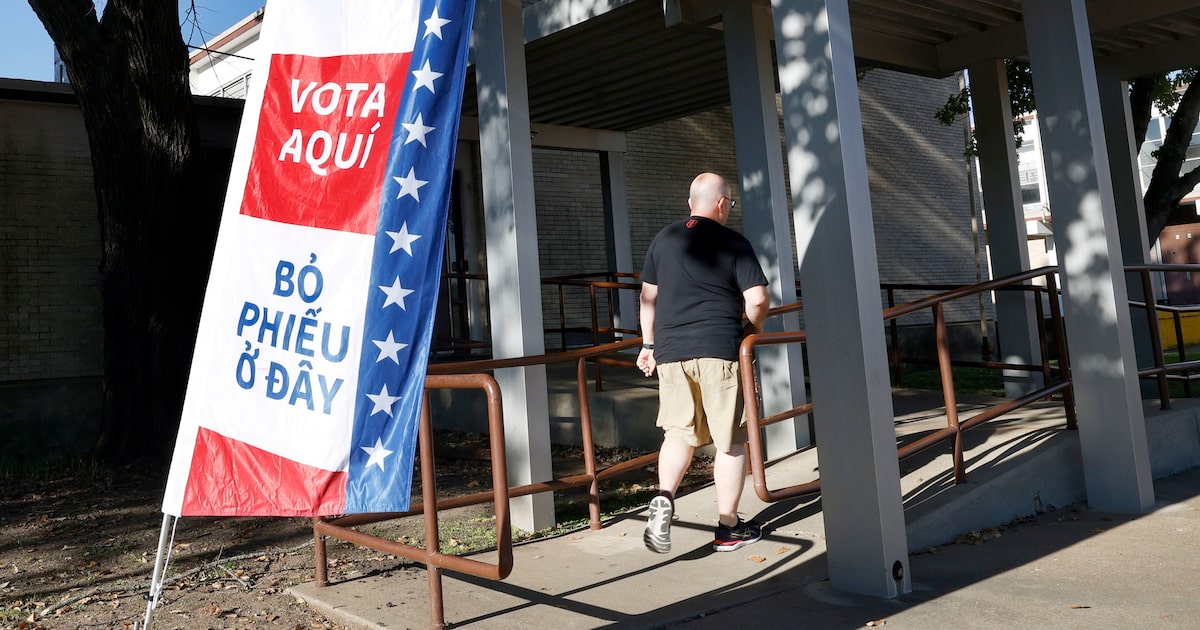
AUSTIN – Cutting property taxes and enshrining a ban on noncitizens voting in state elections were among the constitutional amendments that appeared headed toward passage Tuesday, according to early unofficial election returns.
On a night where turnout exceeded expectations in Dallas County, voters considered 17 changes to the Texas Constitution – the most on a single ballot in more than 20 years – with the majority of them dealing with tax cuts. That included a $40,000 increase in the homestead exemption, an even bigger cut for senior citizens, and an increase in the exemption for income-generating property aimed at helping small businesses.
Voters cast ballots on 17 changes to the state constitution on Tuesday, including significant property tax reductions. Also on the ballot were local bond issues, municipal office and one state Senate special election. Off-year elections often receive little attention, but have meaningful races that sometimes go unnoticed.
All of them were showing strong support Tuesday night.
Property tax cuts have been a cornerstone agenda item not only for state leaders but for the conservative grassroots, many of whom believe they should be eliminated altogether. Property taxes pay for public schools, among other services.
Breaking News
The tax cuts were headed toward passage – all 10 of them, early results show.
Related
So was Proposition 16, which adds “persons who are not citizens of the United States” to a list of those ineligible to vote in Texas.
Texas law already prohibits noncitizens from participating in elections. The state’s election code states that only U.S. citizens may vote or register to vote in Texas. It also provides a process for removing noncitizens from voter rolls. The state constitution’s section on suffrage also states that voters must be citizens and residents of Texas.
Here’s how all 17 amendments are faring with nearly 75% of the state’s voting precincts reporting, according to unofficial returns.
Proposition 1: Capital needs for the Texas State Technical College System
FOR 69%
The amendment creates the $850 million Technical Institution Infrastructure Fund and the Available Workforce Education Fund. The initial funding would come from existing state money and be housed in the state treasury, separate from general revenue, and the state comptroller would distribute up to 5.5% of the fund annually for construction, repairs, land acquisition and educational materials.
Proposition 2: Prohibiting taxes on realized or unrealized capital gains
FOR 66%
The amendment bars future lawmakers from imposing taxes on profits made from the sale of personal assets such as real estate, vehicles, or stocks and bonds, by individuals, trusts, families or estates. The state does not currently tax capital gains, so there would be no immediate change to state policy. The amendment would not affect sales tax or property taxes.
Proposition 3: Denial of bail under certain circumstances
FOR 62%
The amendment allows judges to deny bail to pre-trial defendants accused of certain crimes and if the state can prove they are flight risk or dangerous. Judges would have the ability to deny bail to people facing charges of murder, capital murder, aggravated assault if they caused serious bodily injury or used certain weapons like firearms or knives, aggravated kidnapping, aggravated robbery, aggravated sexual assault, indecency with a child, trafficking of persons or continuous trafficking of persons.
Proposition 4: Directing sales tax revenue to the Texas water fund
FOR 71%
This amendment funnels the first $1 billion in sales tax revenue exceeding $46.5 billion annually to the Texas Water Fund from 2027 to 2047. The fund finances water and wastewater projects, including fixing infrastructure, developing new sources of water and conservation efforts.
Proposition 5: Exemption of property taxes on animal feed for sale at retail
FOR 65%
This amendment authorizes a property tax exemption for livestock feed that retailers are storing. The exemption would reduce local property tax revenue, as does any property tax exemption, and the state would have to cover the costs. The costs aren’t expected to be significant, budget writers say.
Proposition 6: Prohibition on taxing certain entities that buy and sell securities or taxing securities transactions.
FOR 56%
This amendment prohibits taxes targeted specifically at levers of capital markets, including the stock exchanges themselves, broker-dealers and other market participants. It would also ban any transaction tax on the purchase or sale of securities.
Proposition 7: Allow for property tax exemption for surviving spouses of some veterans
FOR 87%
The amendment lowers taxes for the surviving spouses of veterans who died as a result of their service, including due to poor health conditions considered to be service related. The proposition allows them to claim all or part of their property for a homestead exemption on their property taxes.
Proposition 8: Prohibition of death taxes
FOR 73%
The amendment ties the hands of future lawmakers who may try to institute the so-called death taxes – taxes levied on estate transfers, inheritances and gifts – in state code, prohibiting such actions without voter approval. Ten years ago, lawmakers voted to eliminate the death tax but left future legislatures the leeway to reinstate it. This makes it illegal to do it without voter approval.
Proposition 9: Allow for property tax exemption on income-generating property.
FOR 66%
The amendment allows business owners to exempt up to $125,000 in computers, furniture and other company equipment from their taxes, up from the current $2,500 in exemptions. The tax cut will cost the state $700 million in general revenue in the current budget cycle and save businesses an average of $500 per site.
Proposition 10: Temporary property tax exemption for residences destroyed by fire.
FOR 90%
The amendment allows victims whose primary residence is destroyed by fire to apply for a property tax exemption on improvements or repairs made. The tax exemption may be claimed in the year the fire occurred, as long as the residence was uninhabitable for at least 30 days after the fire.
Proposition 11: Increased homestead exemption for elderly or disabled residents.
FOR 78%
The amendment raises the additional exemption for seniors, ages 65 and older, from an $10,000 to an $60,000 on top of regular homestead exemptions. That means they’ll see a total of $200,000 in property tax exemptions, which allows the average Texas senior citizen homeowner to receive zero-tax bills.
Proposition 12: Rules for the State Commission on Judicial Conduct.
FOR 63%
This amends the constitution to update the authority and membership of the State Commission on Judicial Conduct, increasing the number of citizens on the 13-member panel from five to seven and requiring Senate confirmation of the governor’s appointments to it. The amendment also gives commission review tribunals and the Texas Supreme Court more leeway in sanctioning judges for misconduct.
Proposition 13: Increase in homestead tax exemption for school district taxes.
FOR 80%
The amendment raises the homestead property tax exemption to $140,000 from $100,000 and will result in an average savings of $484 per year for Texas homeowners, bill authors predict.
Proposition 14: Creation of the Dementia Prevention and Research Institute of Texas
FOR 68%
The amendment allows the state to send $3 billion in state tax money collected from residents, mostly in sales taxes, to fund the Dementia Prevention and Research Institute of Texas and fund it for 10 years. The governor will appoint an oversight committee, which will award grants to attract, create or expand dementia research at universities and other public or private entities. Grants will fund research into causes, prevention, treatment and rehabilitation as well as the development of therapies and pharmaceuticals, facilities and equipment.
Proposition 15: Parental rights amendment
FOR 71%
The amendment codifies in the constitution a century of case law that gives the rights of Texas parents to raise their children without government interference. The amendment doesn’t change any current state laws. If passed, Texas would become the first state to add parental rights to its founding document, according to advocates. The amendment gathers up the parental rights that have already been established in individual court cases and by the U.S. Supreme Court, and enshrines them in the state’s bill of rights alongside freedom of speech and religion.
Proposition 16: Citizenship voting amendment
FOR 73%
The amendment means the Texas Constitution will add “persons who are not citizens of the United States” to a list of those ineligible to vote in Texas. Texas law already prohibits noncitizens from participating in elections. The state’s election code states that only U.S. citizens may vote or register to vote in Texas. It also provides a process for removing noncitizens from voter rolls. The state constitution’s section on suffrage also states that voters must be citizens and residents of Texas.
Proposition 17: Property tax exemption on land used for border security infrastructure.
FOR 59%
The amendment allows private property owners along Texas’ border with Mexico to deduct from their taxable property values any increase that comes as a result of border-security infrastructure – most notably the border wall under construction along the southern border – installed by the government on their property. Texas pays a fee to property owners at the Texas-Mexico border who voluntarily sign easement contracts to host the border wall, but there was no tax exemption available for it.