
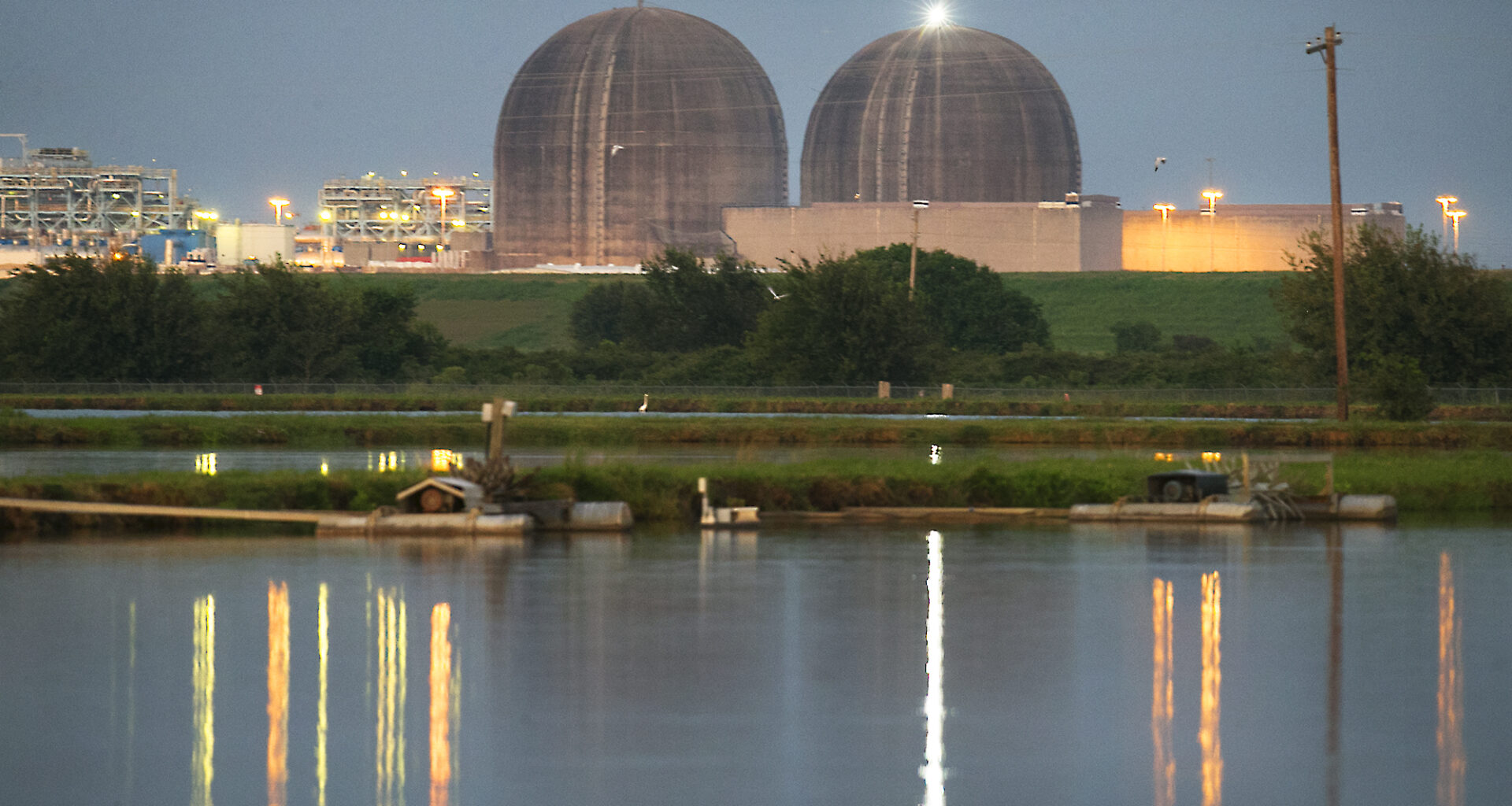
The South Texas Project Electric Generating Station, one of the largest nuclear power facilities in the nation, sits southwest of Bay City. CPS Energy aims to grow its South Texas Project stake, with future plans to explore nuclear microreactors as power demand rises.
Ralph Barrera/Austin American-Statesman
A new CPS Energy generation plan that amps up the utility’s reliance on natural gas also grows its footprint in another powerful yet controversial form of energy: nuclear energy.

The city-owned utility’s stake in the South Texas Project spans more than three decades. But now, CPS Chief Strategy Officer Elaina Ball said the utility is looking to increase its ownership of the plant, with future plans to own its own nuclear microreactors.
Article continues below this ad
“It hits sort of the trifecta of the things that we, as a utility, are focused on — which is having reliable, affordable and cleaner sources of energy,” Ball said about nuclear energy.
The utility is making progress on closing an $80 million deal to increase its ownership of the South Texas Project by 2%. The nuclear plant operates under three owners — CPS Energy, Constellation Energy and Austin Energy.
CPS increased its ownership of the Texas nuclear power plant in 2024, adding 52 megawatts of generating capacity to its portfolio. That deal increased CPS’ stake in the plant by 2% for a total of 42%, with part of the agreement including the utility purchasing 200 additional megawatts of power from Constellation Energy.
San Antonio Express News Logo
Make us a Preferred Source on Google to see more of us when you search.
Add Preferred Source
READ MORE: CPS Energy adds 250 megawatts of new generation in deal with Constellation Energy
Article continues below this ad
Nuclear energy is classified as a low-carbon power source, said Miltos Alamaniotis, an electrical engineering professor at the University of Texas at San Antonio, but it is distinct from wind and solar, which are dependent on time of day and weather. That’s because it’s considered dispatchable power — it can be turned on at any time, like coal. Unlike other dispatchable power sources, it produces almost zero greenhouse emissions.
“You can have nuclear energy anytime,” Alamaniotis said. “We can control it.”
That’s part of why CPS is looking to increase its nuclear footprint from 6% to 9% by 2040.
There are currently four nuclear reactors across the state, with CPS owning a stake in the two reactors at the South Texas Project, located near Bay City. The large reactors at the South Texas Project were built in the 1970s and became operational in the ’80s.
Article continues below this ad
The state’s other two reactors are part of the Comanche Peak Nuclear Power Plant near the Dallas Fort-Worth area.
“Those style reactors are very expensive,” Ball said. “They can exceed five to eight times the cost of construction of fossil power plants.”
Two nuclear reactors built by Georgia Power Co. marked the first reactors built from scratch in decades. But the two-unit project — with the first completed in 2023 and the second in 2024 — was delayed seven years and went $17 billion over budget. The Associated Press estimated the capital and financing costs at $31 billion.
Ball pointed out that while investment costs are high for nuclear power, operational costs are low.
Article continues below this ad
RELATED: CPS Energy approves power plan leaning on natural gas amid public concerns
Smaller reactors could shape CPS’ future
But a new nuclear technology is on the rise — nuclear microreactors — which are smaller and cheaper to build, although they produce less energy. While a large nuclear reactor may produce 1 gigawatt of energy, a microreactor may produce 50 to 300 megawatts.
While it is not a commercial technology yet, Alamaniotis expects the trend to shift toward acquiring microreactors, which can reduce investment costs, rather than investing large sums for one large plant.
Article continues below this ad
Once a microreactor is operating and bringing in revenue, utilities could invest that money into gradually growing their fleet.
Ball said CPS is looking into microreactors but plans to wait until the late 2030s, which should allow the utility to benefit from declining costs. As the technology becomes more accessible, Alamaniotis estimates the cost could fall by 30%.
Growing power demand fuels nuclear interest
The focus on nuclear energy comes as energy demand grows across the city and state. The state’s grid operator is bracing for the potential of its peak demand quadrupling by 2032, with energy demand on a local level experiencing similar growth.
Article continues below this ad
Artificial intelligence, and the data centers that support it, is driving much of that surging demand, as AI programs like ChatGPT grow in popularity.
READ MORE: Texas power demand to more than quadruple by 2032 as data center boom rolls on, ERCOT says
Yet Alamaniotis sees data centers in the future having their own small modular reactors to maintain constant power for their energy-hungry operations. This could alleviate some of the strain on the grid by having a separate source of power serving the facilities.
“Even a single query uses a lot of energy,” Alamaniotis said. “All these data centers have very high demand, so that’s why they need nuclear power.”
Article continues below this ad
The data center-driven demand is one reason why Texas is investing more in nuclear energy.
Gov. Greg Abbott said in December that Texas is striving to become the “headquarters of the American Nuclear Renaissance.”
He launched the Texas Advanced Nuclear Reactor Working Group around three years ago, and the Legislature last year allotted $350 million to build the state’s nuclear power infrastructure.
Texas isn’t alone in looking to nuclear.
Article continues below this ad
The U.S. Department of Energy’s Office of Energy Dominance Financing announced in June a $17.5 billion conditional loan commitment to support long-lead projects in the nation’s nuclear supply chain.
In April, the Pentagon announced that Joint Base San Antonio would be the first military base in Texas to be powered by its own nuclear reactor. While the prototype nuclear microreactor won’t run the whole base, the project likely will grow if the prototype works as expected.
RELATED: Joint Base San Antonio lands nuclear reactor, a first for a Texas military base
“This gives us and CPS an opportunity to really explore the possibility for commercial nuclear production and leveraging this microreactor into something bigger for our community over the mid to long term,” Bexar County Commissioner Grant Moody said at the time.
Article continues below this ad
The military also is developing reactors at three other bases across the nation.
Public skepticism remains
Despite nuclear energy’s effectiveness, there is public skepticism about the energy source. Radioactive waste — which requires special handling, transportation, storage and disposal — can pose a danger to human health for thousands of years.
Nuclear power also is infamous for reactor accidents — like the partial reactor meltdown at Pennsylvania’s Three Mile Island nuclear plant in 1979 and the explosion of a reactor at the Chernobyl Nuclear Power Plant in 1986. The most recent disaster occurred in Japan in 2011.
Article continues below this ad
But Alamaniotis said those accidents have helped drive development of the smaller and safer nuclear energy technology that is being manufactured today.
“The accidents brought the negative opinion about nuclear energy, but at the same time they gave us a lot of lessons,” he said. “We learned a lot through those, so now all the safety systems are advanced. So I would say that (nuclear is) very safe right now.”