
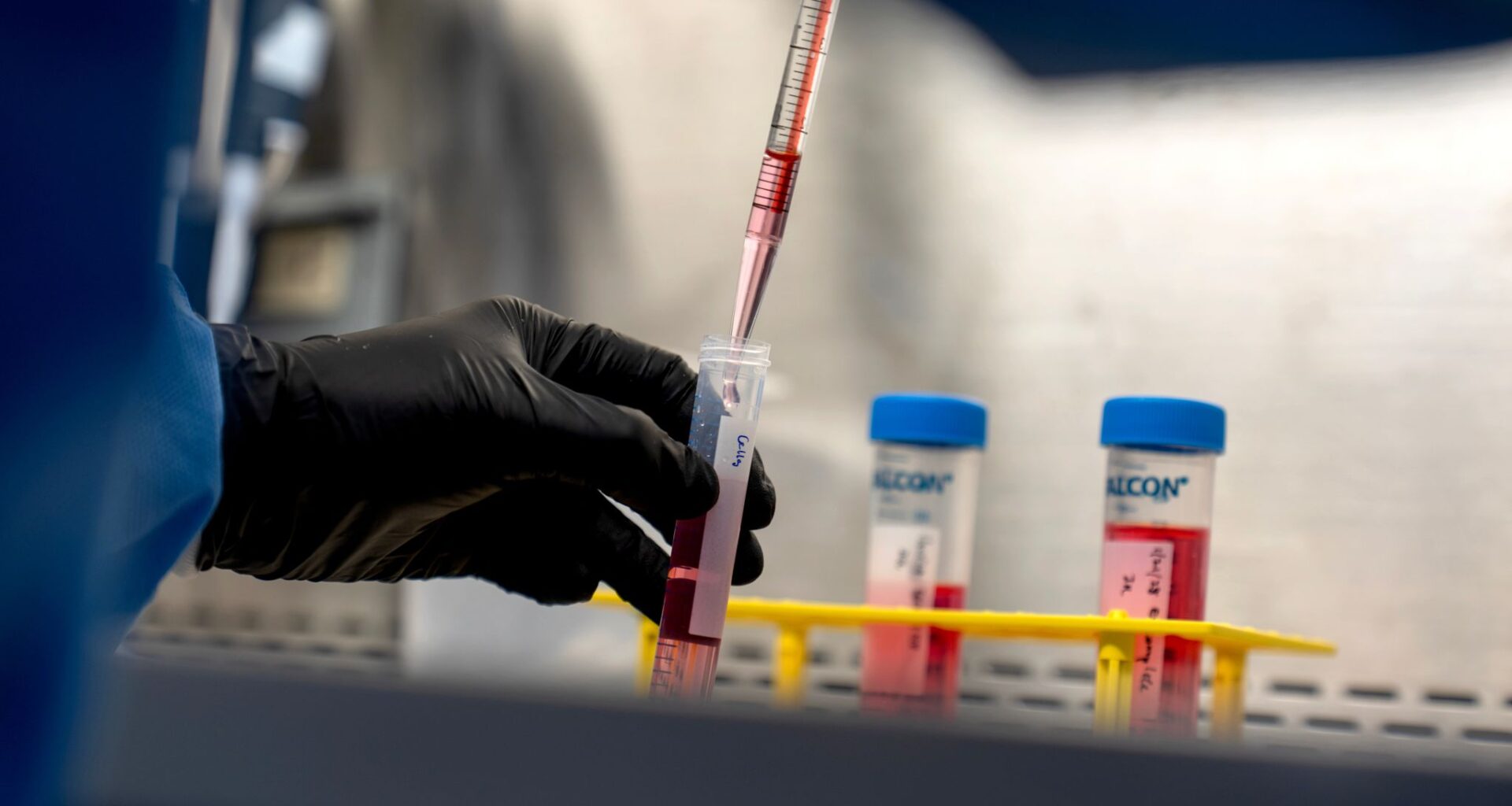
A research fellow works in a lab at the National Institutes of Health, Tuesday, Jan 21, 2025, in Bethesda, Md.
David Goldman/AP
The Trump administration is delaying tens of millions of dollars in federal research grants to some of Texas’ biggest universities.
While many institutions said they hope to eventually receive approval for the money, the administration’s plans remain unclear amid a larger overhaul of the system by which grant applications are evaluated. Experts warn the holdup is leaving some universities to put research plans on hold.
READ MORE: These two Texas GOP congressmen are pushing a larger federal role in AI development
Article continues below this ad
“The problem is uncertainty. These universities are trying to plan,” said Dr. Sudip Parikh, CEO of the American Association for the Advancement of Science, which represents scientists and researchers. “How many graduate students is the University of Texas or A&M going to accept? You base that on how much grant money you’re going to get.”
Texas A&M University in College Station saw direct grants from the National Science Foundation drop from $11.7 million over the first nine months of the 2025 fiscal year to $2.4 million over the same period this year, according to federal data compiled by the non-profit Grant Witness, which tracks federal research spending.
In Houston, Rice University’s NSF funding dropped from $14.1 million to $4.2 million over the same period, and the University of Houston’s funding declined from $7.6 million to $2.8 million.
National Institutes of Health funding going to MD Anderson Cancer Center in Houston dropped by 26% to $73 million this fiscal year. And Baylor College of Medicine has received $125 million in grants so far this fiscal year, down from $147 million the previous year.
Article continues below this ad
Those delays reflect a nationwide trend, with NSF awards down 39% so far this fiscal year and NIH awards down 24%, according to federal research spending tracker ScienceSpending.org. Those two programs represent close to one third of federal research dollars, with the rest largely coming from the Departments of Defense and Energy and the National Aeronautics and Space Administration.
A spokesperson for the National Science Foundation, which distributed $7 billion in research funding in 2024, attributed the delay to the government shutdown earlier this year that persisted for more than two months after Congress failed to reach a budget deal.
“With full-year funding now in place, NSF expects award activity to proceed while continuing to support critical research through its rigorous, merit-based review process,” the foundation said.
The exact impact on research in Texas is difficult to gauge.
Article continues below this ad
Universities and research centers contacted for this story generally declined interview requests. Some offered their own count of how much research funding they’d been approved for, saying the federal databases can be slow to update and might not capture the full range of grant spending.
Others offered statements acknowledging the funding decline, but said they are hopeful awards will pick up through the last three months of the fiscal year, which ends Sept. 30.
“Until the distribution of funds for the year is complete, we won’t know where we stand,” Lori Williams, vice president of communications and community outreach at Baylor College of Medicine, wrote in an email. “We are confident the numbers for the current year will go up.”
But others are not so sure. Last month, the Massachusetts Institute of Technology announced it was reducing the number of graduate students it would take on due to the delay.
There is a palpable concern within many Texas universities regarding the future of federal research dollars, which represent the majority of funding for academic research in this country.
Article continues below this ad
In May, the Office of Management and Budget released a proposed rule that would overhaul how the money is distributed. The Association of American Universities said the change would require political appointees to decide whether research grants represent “Gold Standard Science” or promote “anti-American values,” shifting decision making away from the independent boards that currently make those decisions.
David Sholl, executive vice president for research of chemical and biomolecular engineering at Rice University, the only university to agree to an interview for this story, said the changes stood to “harm American competitiveness.”
“We’re fortunate (in the United States) to be the number place in the world for technology development and science,” he said. “Congress appropriated a very health budget for the NSF and it’s a great service to the nation when the NSF can actually spend that money.”
Not all Texas universities are feeling the pinch.
The University of Texas-Austin has received $207.3 million in NSF funding so far this year, almost triple what the school got last year, according to federal data.
Article continues below this ad
The spike came almost entirely from two research grants from NSF’s Office of Advanced Cyberinfrastructure, for the construction of of the largest supercomputer for academic research in the country, a project first announced in 2024.
Since returning to the White House last year, Trump has identified supercomputing — along with artificial intelligence, biotechnology and other fields with clear commercial applications — as priorities for federal research spending.
That is likely to mean less money for scientists in fields like mathematics and physics, so-called pure sciences, experts say.
“The impacts are challenging to quantify because its hard to say what would have happened with a new discovery or technological innovation,” said Sara Partridge, associate director for higher education policy at the liberal think tank Center for American Progress. “We may never know the full scale, but in some fields it could set us back years and not decades.”