
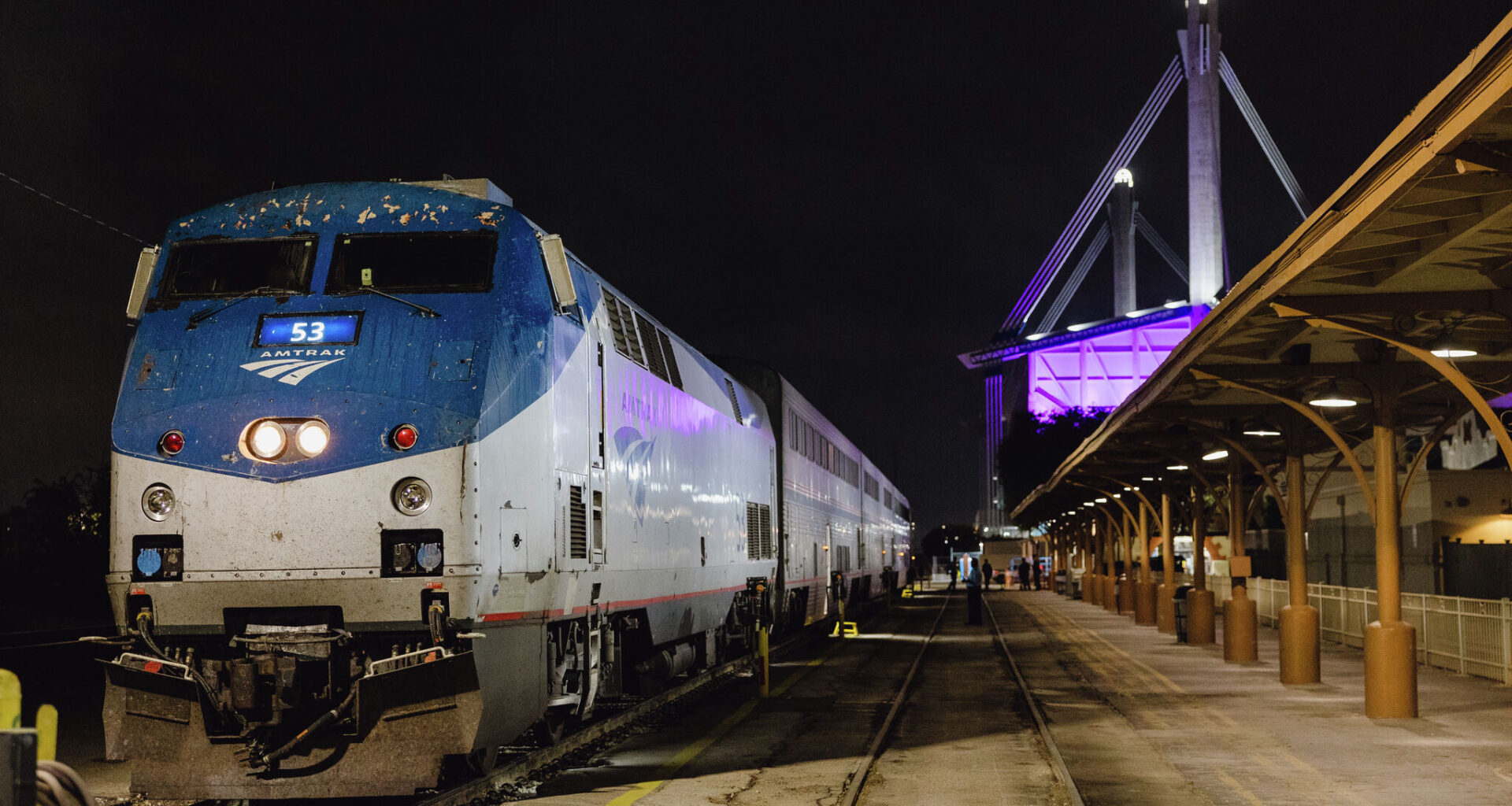
Passengers board the Texas Eagle train in San Antonio, Texas. Passenger numbers continue to grow on this line, showing it’s time to build a service designed for the San Antonio-Austin corridor.
Christopher Lee / Staff Photogra
Traffic proceeds along Interstate 35 on the North Side. It’s not always so smooth. A desire for rail between San Antonio to Austin isn’t pretending it will empty I-35. It will not. Rail and road are complements, not substitutes.
Tom Reel, Staff / San Antonio Express-News
San Antonio is planning a $750 million expansion of the Henry B. González Convention Center, alongside a new downtown sports and entertainment district.

Austin is spending $1.6 billion to rebuild its convention center, a project expected to lift the building’s estimated annual economic impact from $458 million to more than $753 million.
Article continues below this ad
Both cities are betting their economic future on tourism and conventions.
However, there are already plenty of people to connect.
The Texas Department of Transportation counts 266,000 trips on a typical weekday between the two cities. About 5 million people live along the corridor, and that number is expected to reach 8 million by 2050.
For now, the only practical way between the two downtowns is by road. Even so, Texans are already choosing rail, despite having almost no rail to choose.
Article continues below this ad
Amtrak’s Texas Eagle runs through here once a day, at an inconvenient hour and chronically short on cars. Yet its ridership rose 14.3% last year to 372,135, and in fiscal 2025 the Austin and San Antonio stations logged about 47,000 and 64,000 boardings and alightings, with another 10,000 at San Marcos in between.
Those are the numbers one bad daily train produces. Build a service designed for this corridor and that readiness has somewhere to go.
This spring, the Texas Passenger Rail Advisory Committee, formed in 2024 by Bexar County Judge Peter Sakai and Travis County Judge Andy Brown, studied two routes.
One follows the Union Pacific freight line beside Interstate 35 into both downtowns at up to 79 mph, roughly 95 minutes city center to city center, for about $2.3 billion.
Article continues below this ad
The other runs the SH-130 and I-10 corridors to the airport at up to 125 mph for around $13.5 billion.
The freight-line option is the place to start, landing riders steps from the River Walk on one end and downtown Austin on the other. A rail line is worth more here because of what sits at each end: restaurants and shops that surround both downtowns.
The hard part is the track, owned by Union Pacific, whose freight gets priority and whose dispatching is why the Eagle runs late. The passing track the HNTB study modeled eases that conflict but does not erase it.
Critics will be quick to say a train that takes 95 minutes is no different from the drive. A car covers the distance in 75 minutes at 2 a.m. and well over two hours in Friday traffic. A scheduled train is built around a timetable. A freeway offers no timetable to hold at all.
Article continues below this ad
For the business traveler, the convention attendee or event-goer this corridor is built to serve, the difference is sharper still: On the train you open a laptop and work or relax the whole way, while behind the wheel that time is simply gone.
None of this asks anyone to pretend rail empties I-35. It will not. They are complements, not substitutes.
The state is spending $4.5 billion to rebuild 8 miles of I-35 through downtown Austin, work its own director says will never conclude.
Rail would carry an operating subsidy, as every mile of the interstate already does. The public pays for the corridor either way. The only question is whether it buys one mode or two.
Article continues below this ad
San Antonio committed to its downtown bet on a tight timeline because losing ground in a fast-growing Texas was worse than the cost. Rail to Austin is the same kind of calculation, and the payoff runs both ways.
Every dollar spent downtown works harder the moment a visitor can use both ends of the corridor in one trip, when a convention in one city becomes a reason to spend a day in the other.
Jakob W. Schmidt is an Austin community liaison for Texas Rail Advocates, an all-volunteer freight and passenger rail advocacy organization. The views are his own.