
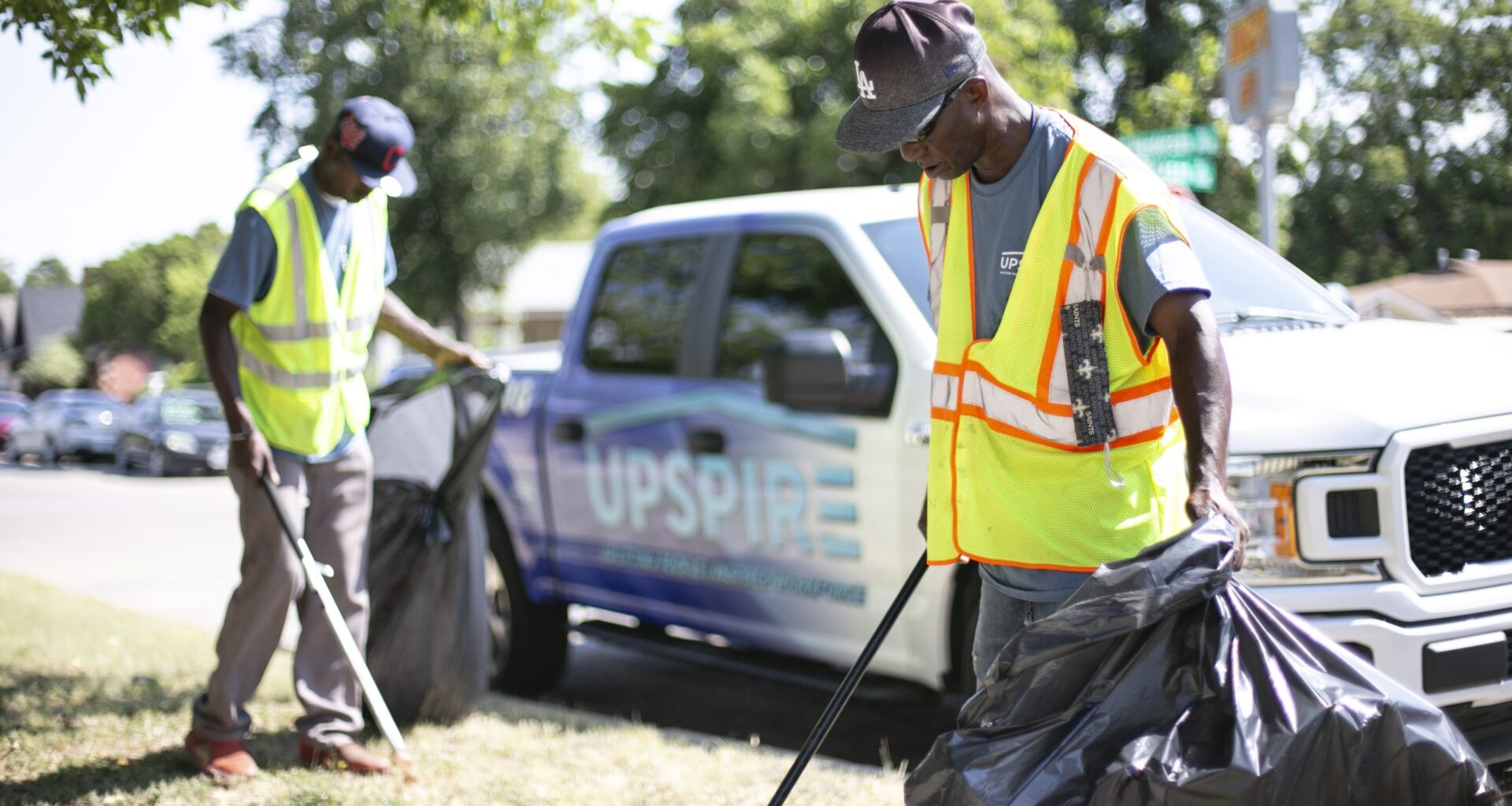
Presbyterian Night Shelter started UpSpire 10 years ago. The social enterprise initiative, which employs homeless people through contracting work with other agencies, began with two people cleaning up Lancaster Avenue.
Now, UpSpire employs over 260 people in services ranging from litter abatement to janitorial and landscaping services. Since 2016, 400 people have escaped homelessness and received employment through the program, said Daryl R. Davis II, vice president of workforce and career development for the program.
“It’s all about putting people to work,” he said.
UpSpire’s social benefit is clear. What is less known is the program’s success on the business side — Davis said UpSpire is approaching $10 million in gross revenue over the project’s lifetime. Such financial success for nonprofits in Tarrant County is not unusual. An increasing number rely on earned revenue streams to help fund their missions.
“UpSpire not only helps us put people to work and help them get out of homelessness, but it also returns our net revenue back to the agency to take care of many of the things that we need to take care of,” Davis said.
Nationwide, nonprofits make about $3.7 trillion in revenue each year, according to Candid, a nonprofit support organization. And despite a common perception that nonprofits don’t earn profits and that foundations are their primary financial support, 71% of that $3.7 trillion comes from earned revenue.
The majority of nonprofits gaining revenue through earned income are larger organizations, according to a Candid survey from this year. About 36% of smaller nonprofits reported earned income as a revenue stream compared to over 54% of larger organizations.
Earned revenue has become increasingly important in an era of federal funding cuts — nearly 32% of annual total revenue earned by the charitable nonprofit community came from government grants, according to a 2019 survey by the National Council of Nonprofits. In North Texas alone, $127 million was lost due to federal funding cuts in the first half of 2025.
Some organizations are looking to help nonprofit leaders with the tools needed to earn money while staying true to their missions. An example is the Changemakers cohort created by Community Frontline, a nonprofit dedicated to issues like racial justice and neighborhood beautification in east Fort Worth.
Community Frontline created Changemakers this year alongside University of Texas at Arlington and Social Impact Architects to show local leaders that nonprofit and business tactics can be done in tandem with creating social good, said Ben Travis, director of development for the nonprofit.
The first cohort of 40 Changemakers began the no-cost program in January.
“They started a nonprofit on a particular service route, or they started their business thinking about profitability, but now they’re starting to see how it all merges together as far as their business being catapulted toward them being able to do social service,” said Quinton Phillips, executive director and co-founder of Community Frontline.
The program teaches community members applicable tactics to help change business models to improve specific systems and strengthen their financial picture, Travis said.
Applying those skills while keeping core missions intact is important, Phillips said.
“It’s about ensuring that we keep people and community first,” he added. “That’s the best part, that’s of utmost importance, because we’re talking about building community, the community supporting your nonprofit, and then how that reciprocal relationship looks like.”
For many nonprofits, earned revenue comes from renting or leasing out spaces. Blank Space Fort Worth, an event venue owned and operated by Community Frontline president and co-founder Dante Williams, channels revenue from bookings into the nonprofit.
Cornerstone Assistance Network is also using its space for income. Besides renting out its kitchen to fellow nonprofit Catering to Love, Cornerstone is looking to find tenants for office and warehouse space at the organization’s building in Riverside.
Cornerstone CEO Scott Charbonneau said the organization is “using these spaces and maximizing it through another organization that has the same kind of core values and beliefs.
“We’re in this for the same reasons,” Charbonneau said. “It just makes all the sense.”
The Welman Project is an example of a nonprofit diversifying revenue streams, including direct service income.
The nonprofit’s primary mission is to provide teachers with free school supplies. However, to help offset this mission, Welman Project’s Curiosity Shop lets people purchase reused vintage items. The nonprofit also has a 7,500-square-foot makerspace — opening July 7— which will be available for use by other organizations and will be used by The Welman Project for camps and programming.
Much of this work was being done at their former location, co-founder Taylor Willis said. As the nonprofit expanded, the organization looked for new income streams while also keeping intact their mission of supporting teachers and reducing waste.
Their new location allows for their growth to continue, Willis said.
“I expect with our new space and the continued growth of these programs that they’re going to become even more important,” said Willis of earned revenue streams such as those from the Curiosity Shop and the makerspace.
Presbyterian Night Shelter is trying to expand the UpSpire program by providing jobs that are less labor-intensive, especially for female clients. The shelter will begin operating The Greater Good Collective in the coming months to offer those kinds of jobs.
The initiative will be headquartered in west Fort Worth, in a building that includes a coffee shop, thrift and vintage store, and a donation station.
The shelter’s primary goal remains helping the unhoused, Davis said, but the new efforts go beyond that.
“It creates an additional opportunity for us to put even more people to work and make more money that we can return to the overall agency,” he added.
Ismael M. Belkoura is the nonprofit editor for the Fort Worth Report. His position is supported by a grant from North Texas Community Foundation. Contact him at ismael.belkoura@fortworthreport.org.
At the Fort Worth Report, news decisions are made independently of our board members and financial supporters. Read more about our editorial independence policy here.
This <a target=”_blank” href=”https://fortworthreport.org/2026/07/06/tarrant-nonprofits-lead-the-charge-as-earned-income-importance-increases/”>article</a> first appeared on <a target=”_blank” href=”https://fortworthreport.org”>Fort Worth Report</a> and is republished here under a <a target=”_blank” href=”https://creativecommons.org/licenses/by-nd/4.0/”>Creative Commons Attribution-NoDerivatives 4.0 International License</a>.<img src=”https://i0.wp.com/fortworthreport.org/wp-content/uploads/2021/04/cropped-favicon.png?resize=150%2C150&ssl=1″ style=”width:1em;height:1em;margin-left:10px;”>
<img id=”republication-tracker-tool-source” src=”https://fortworthreport.org/?republication-pixel=true&post=645341&ga4=2820184429″ style=”width:1px;height:1px;”><script> PARSELY = { autotrack: false, onload: function() { PARSELY.beacon.trackPageView({ url: “https://fortworthreport.org/2026/07/06/tarrant-nonprofits-lead-the-charge-as-earned-income-importance-increases/”, urlref: window.location.href }); } } </script> <script id=”parsely-cfg” src=”//cdn.parsely.com/keys/fortworthreport.org/p.js”></script>