
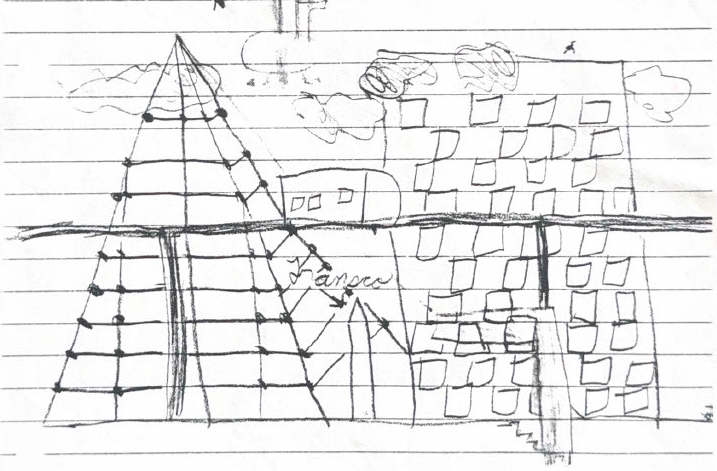
A 1995 drawing by Evan Mintz, then 9-years-old, predicting Houston’s future.
Courtesy of Yvonne Cormier
Over the weekend, letters editor Cindy Rivas Alfaro published several predictions written by Houston children back in 1995 that had been part of a time capsule at Hermann Park. Among the optimistic visions of flying cars or youthful doomer forecasts of nuclear war, one message grabbed my attention: My own.
“I believe Houston will be a giant city in 2020. With a giant transportation system,” I wrote as a precocious 9-year-old. “Huge monorails, really big subway systems. And instead of houses we’ll live in humongous buildings and flying cars.”
I even drew the then-Transco Tower for scale.
Article continues below this ad
Clearly my predictions didn’t come true, but nevertheless there are a few lessons to be learned from the letter.
RELATED: I asked Houston children to predict the future over 30 years ago. Here’s what they said.
READ THE LETTERS: Flying cars, robots, hope: What Houston children predicted over 30 years ago
The first lesson: I’ve always been like this. My obsession with Houston’s urban design and overall passion for living in a growing city is not some newfound trait or airs I put on for the job. I was biased for Houston from the very beginning. Admittedly this is more thanks to video game designers Will Wright and Sid Meier than urbanists Donald Shoup and Jane Jacobs. Long Saturday nights spent playing SimCity 2000 and Civilization II provided an elementary-school-aged foundation for thinking critically about the places where we live and an ambition for building great cities.
Article continues below this ad
The second lesson is that even though that 20th century sci-fi vision of the future didn’t exactly come to fruition, we shouldn’t dismiss youthful ambition. Yes, Houston never built a massive monorail, despite Kathy Whitmire’s best efforts. Nor did we construct super-massive arcologies. In fact, Houston doesn’t even have the tallest tower in Texas anymore, as Noah M. Horwitz lamented last week. But cities aren’t just the sum of their buildings — they’re the spaces between the buildings. They’re the people in those buildings. And the ambitious wonders we have built meet the needs of those people — sometimes bluntly, cheaply or unimaginatively, but better than so many other metropolises. Rings of loop roads that transformed the prairie into housing are themselves megastructures, ones that bring the American dream within reach for millions.
In ways I didn’t imagine as a kid, Houston has done big things. The bayous have been transformed into linear greenways. We built a landbridge over Memorial Drive. We’re starting to put freeways below grade to reconnect downtown with Midtown, the Museum District and EaDo. Those are Houston’s ambitions fulfilled. (And we should all happily thank Rich and Nancy Kinder for their contributions.)
Another sort of ambition my kid self didn’t fully grasp was that of being a city with a dynamic and growing population. Back in the 1990s, Houston’s watchword was “world class” — we simply had to build mass transit, attract the Olympics and show that we weren’t some backwater port town that got lucky on oil. Turns out that Houston didn’t need monorail or spectacle to become a global city. We just needed the people. A city’s diversity and vitality doesn’t come from the buildings, it comes from the women and men who live there, their own personal aspirations and efforts to build a better future. Immigration has been our city’s most successful megaproject of the past 30 years.
“I believe Houston will be a giant city in 2020. With a giant transportation system,” Evan Mintz wrote as a precocious 9-year-old. “Huge monorails, really big subway systems. And instead of houses we’ll live in humongous buildings and flying cars.”
Courtesy of Yvonne Cormier
Finally, there’s the lesson about how I can at least partially blame regulatory barriers and a stultifying status quo for snuffing out my imagined future for Houston. After all, it isn’t the lack of child-like imagination that makes it hard for Houston to urbanize. It’s the way that America can’t build mass transit as affordably or quickly as our peer nations. It’s because Texas has a constitutionally dedicated fund for freeways, but not for rail or buses. It’s the local setback requirements, drainage rules, parking minimums, unnecessarily wide streets and a hundred other bureaucratic cuts that help kill the vision drawn by 9-year-old Evan. SimCity never had to deal with those issues, and that was by design.
Article continues below this ad
“We were originally just going to model real cities, but we quickly realized there were way too many parking lots in the real world,” Stone Librande, one of the creators of SimCity, once said in an interview with the Atlantic. “Our game was going to be really boring if it was proportional in terms of parking lots.”
But rather than getting hung up on the dashed youthful vision of this city, I find myself doodling an updated vision of Houston’s future. Maybe when I’m done, I’ll stuff it away for another 30 years and see if it comes to fruition this time. It’ll probably be more grounded, more realistic — influenced either by cynicism or wisdom, depending on how you want to frame it. But there are some childhood dreams I’ll hold onto.
I still think Houston could use a subway.