
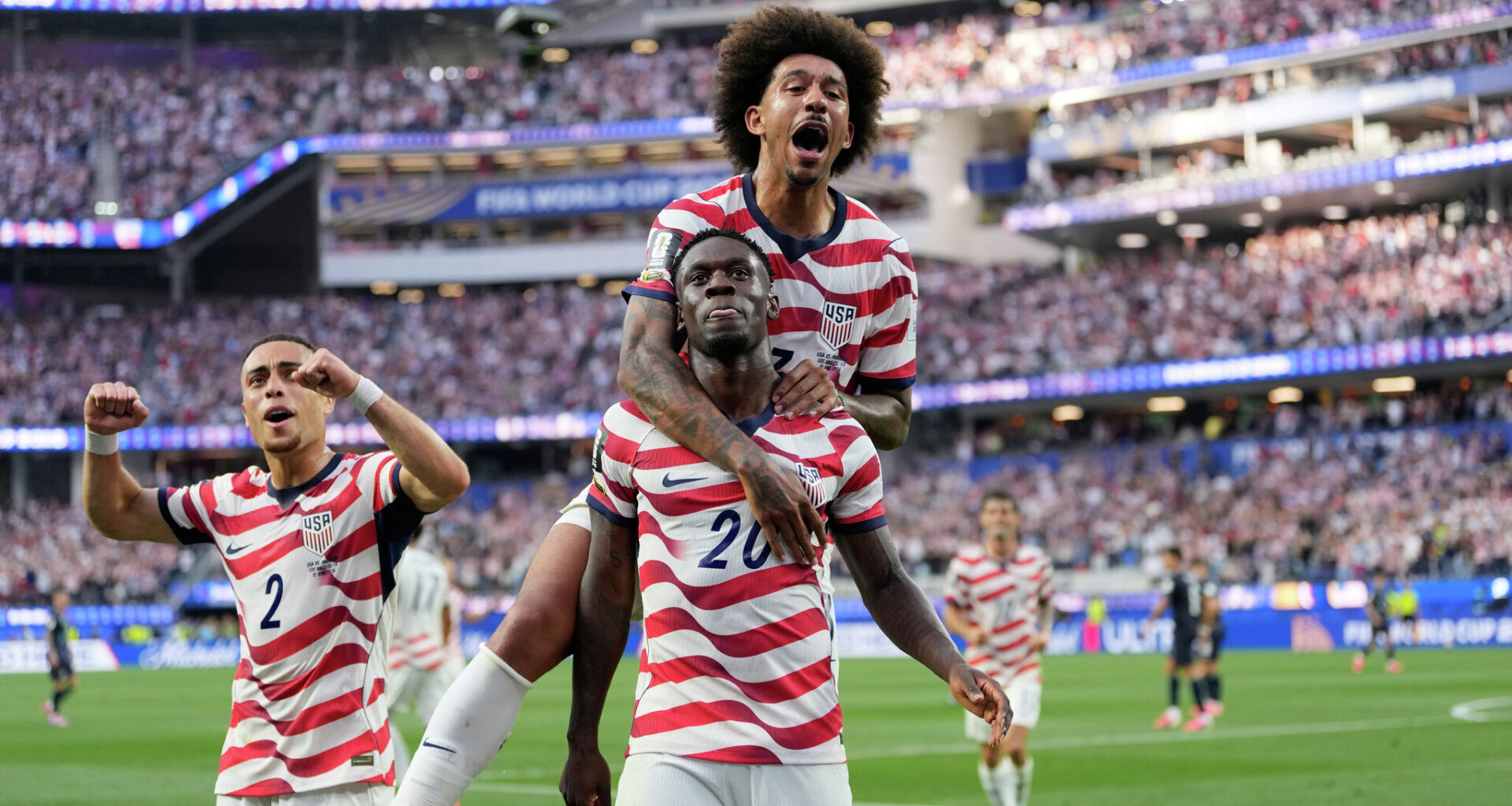
United States’ Folarin Balogun (20) celebrates scoring his side’s third goal against Paraguay with teamates during the World Cup Group D soccer match in Inglewood, Calif., near Los Angeles, Friday, June 12, 2026. (AP Photo/Andre Penner)
Andre Penner/AP Photo/Andre Penner
ARLINGTON — I tread lightly into the waters of soccer controversy, but I feel quite comfortable wading into any sporting mess in which one side — the winning side, essentially — argues everything is OK because the end justifies the means.

On top of that, while I may not understand every nuance of the five World Cup games I have attended here, including Monday’s 1-0 Spain victory over rival Portugal, I can say without hesitation that soccer is every bit as good as the NBA or the NFL at screwing up its game with the use of replay officiating, which is the real culprit in the Folarin Balogun saga.
In case you missed it — nearly impossible to even think that could happen in today’s world — Team USA got its best scoring weapon back in time for Monday’s huge Round of 16 game against Belgium when FIFA arbitrarily chose to suspend his automatic one-game ban for receiving a red card during last week’s game against Bosnia-Herzegovina. The move came after President Donald Trump acknowledged that he asked FIFA President Gianni Infantino to review the striker’s suspension.
Article continues below this ad
What was a nice break for Team USA was a terrible precedent for the World Cup, an awful look for using political influence to change the outcome, or at least enhance, one team’s chances in a sporting event. It doesn’t matter if it’s Trump, Barack Obama or the governor of Ohio calling the head of the College Football Playoff to reinstate a Buckeye who’s been suspended for targeting. It can’t happen.
And, yes, terrible precedent is the correct phrase here. Much was immediately made of Portugal’s longtime star, Cristiano Ronaldo — I’m watching him perform on the Dallas Stadium (AT&T Stadium) pitch as I type this — having had his ban shortened by FIFA so he could play in two group-stage games for his country.
Article continues below this ad
There are two major differences between what happened with Ronaldo and what FIFA did for the U.S. following the political phone call. Ronaldo was given a red card in a game with Ireland last November, and a disciplinary body then ruled that he would be suspended for three games. Ronaldo served the one-game suspension that is mandatory following a red card, but FIFA later postponed the extra two games into next year. It was without doubt a blatant attempt to make sure one of the game’s superstars would be available for the start of the World Cup.
But the initial one-game suspension was, in fact, served. And the lifting of the ban did not come after a phone call from the most powerful figure of the World Cup’s host country. It came after a more predictable FIFA thought process that involved keeping star players available for the biggest sporting event on the planet.
Those who didn’t lead with the “Ronaldo got the same treatment” argument Monday invariably fell back on the more time-honored “it was a terrible call anyway” line of thinking. Frankly, it was a questionable call, one that never would have received a red card if FIFA had not adopted video assistant referee, or VAR, to slow down plays and make what amounts to wrong-headed decisions that turn goals into offside calls and, in this case, an attempt to make a play on the ball by Balogun into slow-motion stomping on the leg of a Bosnian player.
It wasn’t so much the fault of the referee that night (one the president suggested can’t be trusted, anyway) as the system that all but requires one to make that call.
Related: Integrity of World Cup is questioned as Trump, FIFA defend actions surrounding Balogun suspension
Article continues below this ad
Once that call is made — questionable or not — it needs to be carried out if a sport is to have any rules at all. I recognize that politics have an impact on all sports at some point, but it’s different when it’s this direct. The president of Portugal did not get involved to shorten the Ronaldo suspension last November. The president of the United States made himself heavily involved to make this one happen.
UEFA condemned the move in no uncertain terms, saying, “A minimum automatic suspension of one match following a red card is not a discretionary option and does not require the decision of a competent body to be enacted.”
In other words, FIFA not only made an incorrect decision but one it had no authority to make. That’s one view, anyway. And former FIFA President Sepp Blatter (whose corrupt regime led to Infantino’s rise to power a decade ago) wrote, “Red cards are not overturned by political phone calls. They are overturned by rules, evidence and independent bodies. Quo vadis, FIFA?”
The question of where FIFA is going was answered when Balogun dressed for the United States on Monday night. It’s not like U.S. coach Mauricio Pochettino did anything wrong by adding him to the lineup. You play the cards you’re dealt and, until a phone call and behind-the-scenes maneuvering by U.S. officials outside the realm of soccer took place, that would have meant playing without Balogun.
Initially, Balogun may have been the victim of a poor call, but it was a judgment call. We have all seen more outrageous calls made, the ones that were fundamentally wrong — the ball touched the ground (or didn’t), the man was out of bounds. We have been able to live with those mistakes and get on with the business of sports as entertainment for more than a century.
Article continues below this ad
Related: A red card means trouble and controversy at the World Cup: Here’s what to know
Politicians weighing in at the last second is never a good thing. It was reported that England Prime Minister Keir Starmer expressed to FIFA his displeasure with the kickoff of the Mexico-England game possibly being moved up Sunday, thinking the players needed those extra hours to adjust to altitude. That’s not really his business, either, but a kickoff that did not get moved is hardly comparable to a star player being reinstated against all normal procedures.
It’s not a reason to cheer against the U.S. or against Balogun. To say otherwise is to place blame where it does not belong. This one is on FIFA and will have implications on rules and how they are interpreted or challenged for years to come.