
It’s a good thing Tuesday night’s College Football Playoff rankings show was only the fourth day of my free five-day trial of an inferior streaming service that I signed up for Saturday morning to watch games.
I really hope this stalemate is resolved by this Saturday, or I might just listen to LSU-Alabama on the radio.
Shouldn’t Notre Dame be worried about making the CFP? If USC loses badly to Oregon, does Notre Dame have a Top 25 win by the end of the season? — Leo
I said from the moment they started 0-2 that the Irish would have nothing to worry about if they turned around and won 10 straight games. I stand by that now. In fact, as of Tuesday night, they’re already “in” at No. 10, the highest two-loss team in the rankings.
Notre Dame was one of three teams, along with No. 9 Oregon (No. 6 in AP) and No. 13 Utah (No. 17 in AP), that showed me the committee is paying closer attention to schedule-strength metrics this year. Committee chairman Mack Rhoades specifically mentioned the Ducks’ strength of record as being the lowest of their top-10 teams. Unfortunately, the CFP does not publish its metrics, but The Athletic’s Austin Mock has Oregon at No. 21 in his SOR, which measures how likely a generic top-12 team would have the same record against that team’s schedule.
Meanwhile, I was not surprised to see 7-2 Utah higher than in the AP poll because efficiency ratings love the Utes. They are No. 4 in FEI, No. 6 in SP+ and No. 7 in FPI because they have outscored their opponents 356-128 and lost a close game to a top-10 team in BYU.
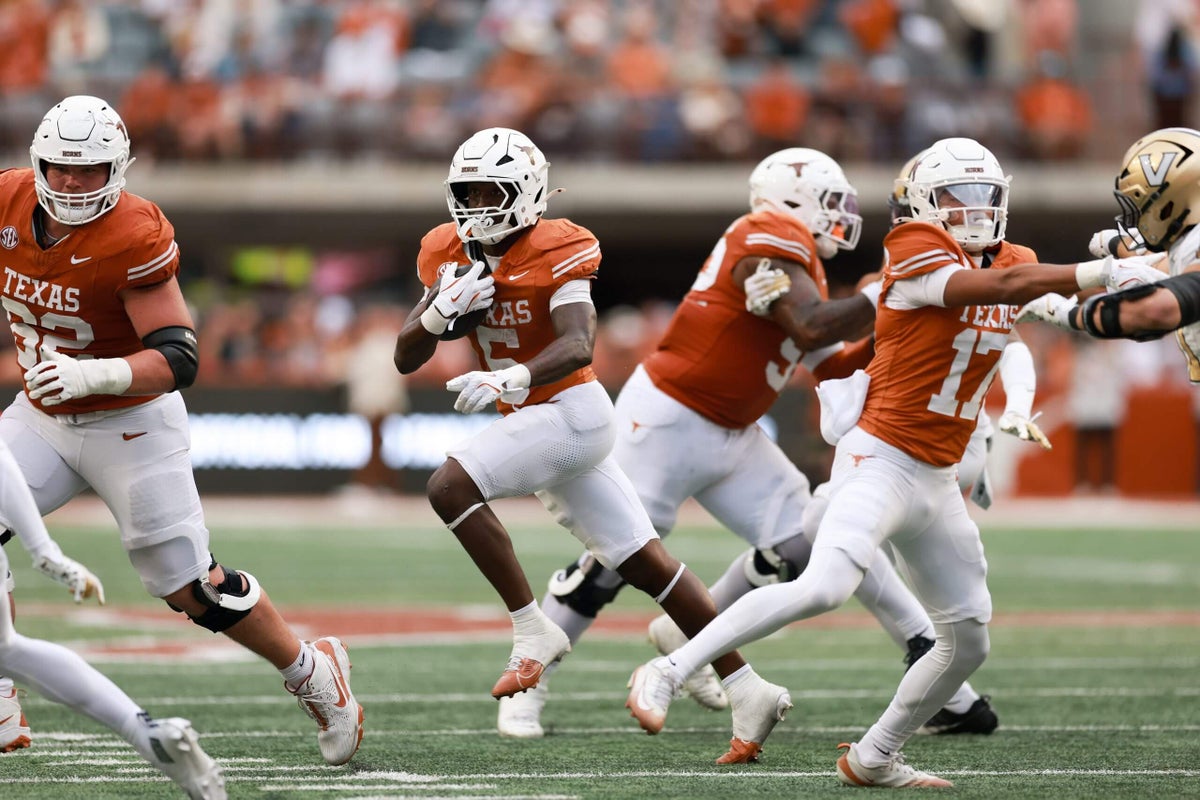
As for the Irish, they are No. 5 in FPI, and No. 7 in SP+ and FEI. From a resume standpoint, I’m not sure there’s a compelling reason why ND, with one Top-25 win (No. 19 USC), is above 7-2 Texas (No. 12 Oklahoma and No. 16 Vanderbilt) and the 6-2 Sooners (No. 21 Michigan and No. 25 Tennessee), with two ranked wins each. But even if you drop the Irish two spots, they’re still in great shape.
I suppose the committee could reevaluate the Irish if USC implodes down the stretch, but in 11 years following this stuff, I haven’t seen them drop a team precipitously without a loss. And they do face another current Top 25 team, Pittsburgh, on Nov. 15.
You keep assuming 10-2 in the SEC or Big Ten will get you into the Playoff. Why? Compare potential 10-2 Ole Miss to potential 9-3 Texas. Ole Miss’ best win will be Oklahoma. Texas beat Oklahoma more soundly. Texas would also have additional better wins over Vanderbilt and either Georgia or Texas A&M. Why should Ole Miss go ahead of Texas? Because it was smart enough to schedule Tulane instead of Ohio State? —Patrick H.
I must confess, I had never considered whether a 10-2 SEC team could get bumped by a 9-3 team from its own conference. But in that scenario, I would predict both Ole Miss and Texas get in.
Yes, I said it: A 9-3 Texas team that adds a top-5 win over Georgia or Texas A&M to a resume that already includes two top 10-15 wins over Oklahoma and Vanderbilt is probably getting in. The first rankings affirmed that Texas, as of today, would be the first team out. Most of the teams above the Longhorns will lose at least one more game as well, but few will be able to add as big a win as Georgia or A&M. With just one bad loss, at Florida, the Longhorns would have a better resume than last year’s 9-3 Alabama team.
If the committee leaves them out for, say, 10-2 Texas Tech, which played Arkansas-Pine Bluff, Kent State and Oregon State out of conference, why would any SEC or Big Ten program ever schedule another game like Texas-Ohio State?
To be clear, I said that a 9-3 Texas team “probably” gets in. There’s no way to say that with certainty without seeing how the remaining games play out. Just wanted to warn you, though, that debate may be coming.
These are pretty fun times to be an Ohio State fan. However, I can’t help but remember the 2006 and ’07 seasons. Back-to-back championship game losses by Ohio State to Florida and LSU proved those teams were fool’s gold, exposed by superior teams with worse records playing in a tougher conference. Are the 2025 Buckeyes as good as they look, maybe even better than last year’s team? Or is it all a mirage generated by a mediocre schedule? — Matt
I took a lot of flak from Buckeyes fans a couple of weeks ago for daring to suggest that maybe, possibly, you shouldn’t go ahead and start engraving their trophy already, for exactly that reason: I’ve seen many supposedly unbeatable teams get exposed over the years when they got to the biggest stage.
But as of this moment, there is nothing to suggest the 2025 Buckeyes are in any way fraudulent. Their quarterback, Julian Sayin, is completing 80 percent of his passes. He has arguably the two best receivers in the country in Jeremiah Smith and Carnell Tate. His offensive line has allowed three sacks all season. And Ohio State’s defense, which is allowing the fewest yards per play (3.75) of any team in the last decade, is an NFL scout’s dream with Caleb Downs, Arvell Reese, Sonny Styles and Co.
But no, we have not seen the Buckeyes tested by a fellow national championship contender, and we won’t until the Big Ten championship game, presumably against Indiana. Texas may still get into the CFP, but the Longhorns weren’t playing at nearly that level at the time they met. Michigan will be a big challenge, as always, but the Wolverines probably aren’t getting to the Playoff. The Buckeyes will enter the CFP having been battle-tested far less frequently than the top SEC teams.
But neither the Big Ten nor the SEC is in the same place they were in 2006-07. Ohio State was the class of the conference under Jim Tressel, but at that time, it was still largely an in-state/regional recruiting school, as was the rest of the conference. Urban Meyer changed that. And while the SEC is clearly deeper than the Big Ten, Michigan in 2023 and Ohio State in ’24 proved on the field they were better than the best the SEC had to offer in those seasons.
If they get exposed in the postseason, it would have to be by a team with a dominant defensive front that can get after Sayin like no one has to this point. And of course, any great defense can get exposed on a given day by an elite QB — see Bryce Young against Georgia’s otherwise impenetrable 2021 defense. Someone like Alabama’s Ty Simpson or Texas A&M’s Marcel Reed, both of whom have great receivers as well.
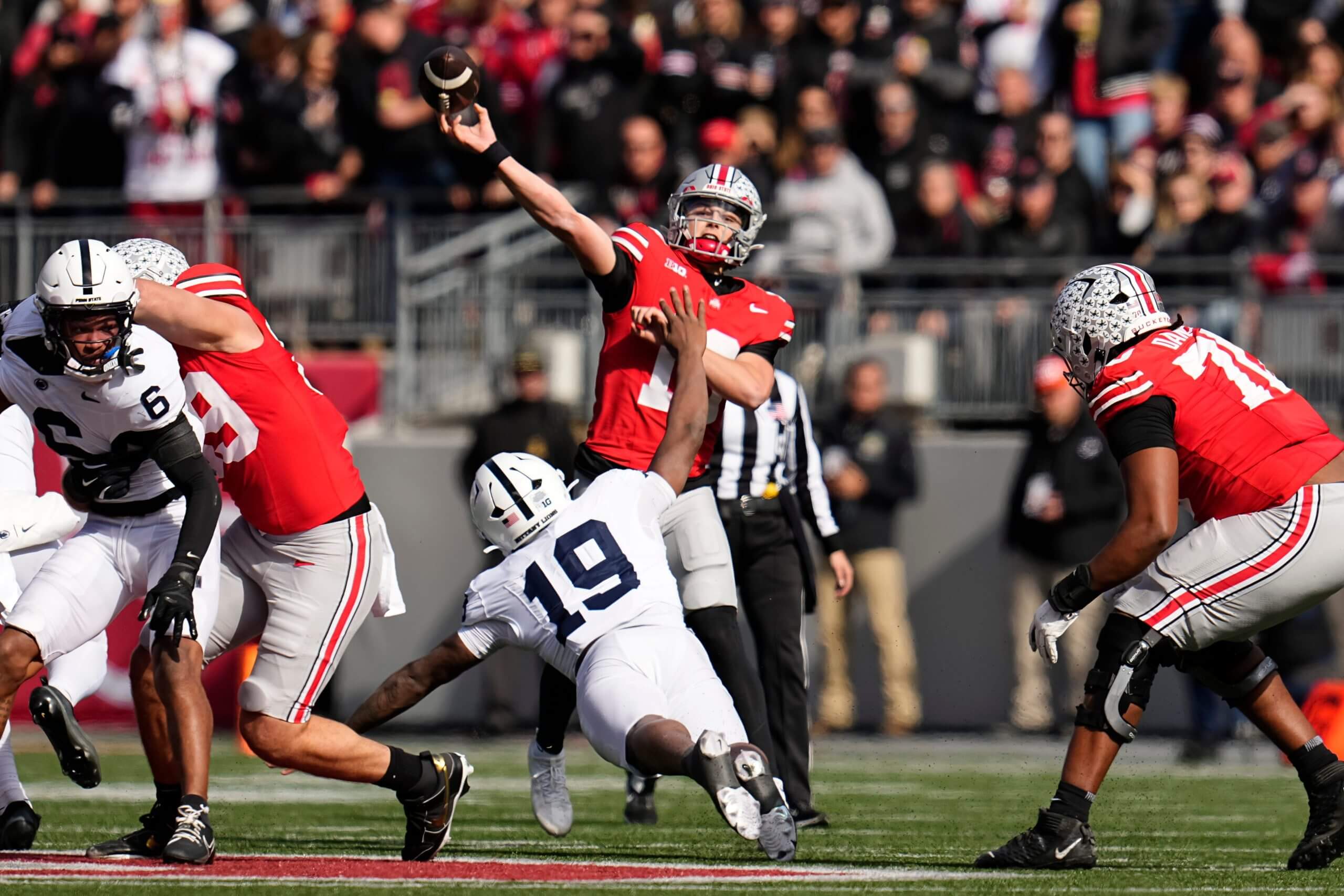
Julian Sayin has continued to develop throughout Ohio State’s season. (Adam Cairns / USA Today via Imagn Images)
It’s currently possible for the ACC to have four one-loss teams tie for first in the regular season (Virginia, Duke, Louisville-SMU winner and Pitt-Georgia Tech winner). The tiebreaker scenario gets down several levels, the last of which is a random draw. How does this reconcile with the argument that having no divisions was a good thing and that one of the goals of all this reorganization was to “settle it on the field”? — Bo H.
And that’s not even the biggest chaos scenario. I’m rooting for all those teams to pick up a second loss, while 2-2 Miami wins out, to create a seven-way tie at 6-2.
I was surprised we didn’t hear much angst last year when the Big 12 finished with a four-way tie of 7-2 teams (Arizona State, Iowa State, Colorado and BYU), since there was no chance of anyone getting an at-large berth. The difference between the CFP play-in game (ASU and ISU) and the Alamo Bowl (Colorado and BYU) came down to opponents’ combined win percentage. Looking back, it helped that everyone knew going into the weekend what the matchup would be if all four teams won (which they did). It wasn’t like we were up late that last Saturday waiting for a computer to spit out the results.
But it will happen at some point. Which is why I’ve said before and will say again — that these conferences will rue the day they got rid of divisions, right at the same time their conferences got bigger.
Unbalanced divisions/schedules are unavoidable, but at least with divisions everyone knows from Day 1 exactly what they need to do to get to their title game. You know that each division will, in fact, “decide it on the field.” And if the champion of one division has an easier road than the other, it at least has to prove itself against the best team in the other division to win the conference title.
In the ACC’s tiebreaker policy, you would have to get through six steps without resolving the tie before it goes to a drawing, so, not likely. If it does, though, ESPN should definitely televise it. I’d even pay for an inferior streaming service to watch it.
Which college(s) won’t fire their head coach this season? — Stephen
Georgia seems pretty set. Indiana. Iowa. BYU. Vandy. Ole Miss. Texas A&M. Louisville. Georgia Tech. Arizona State. Iowa State. Virginia.
Everyone else is fair game, including the coach of the No. 1 team in the country, because, well, Michigan.
What is the realistic expectation for Auburn football in this day and age? Historically, the Tigers have had some sporadic SEC/national championship-contending seasons mixed in with a lot of 8-5-type seasons. They’ve had some high highs, but are surrounded by the likes of Alabama and Georgia. Is it realistic to still expect them to be one of the SEC’s best or have those days passed? — Kyle L.
The reflexive answer would be national championships. It’s not like Auburn is chasing ghosts from 40 years ago. (Looking at you, Penn State.) They won one in 2010 and played for another one three years later. Why not another one now?
But looking back, those teams were almost complete outliers in the sport.
Every other program that’s won a national title in the BCS/CFP era built and sustained a foundation (some for longer than others) and kept reloading it year after year. Whereas Auburn basically produced two separate perfect-storm teams, neither of which was loaded like an Alabama or Georgia. The 2010 team rode the wings of a truly generational quarterback (Cam Newton), and the 2013 team pulled off not one, but two miracle wins over teams ranked No. 1 in the country.
To figure out Auburn’s ceiling, I divided the SEC into three tiers based on reasonable expectation level.
The top tier (Tier 1) has six teams: Alabama, Georgia, Florida, LSU, Oklahoma and Texas. These programs can absolutely contend regularly for national titles with the right coach in place.
The bottom tier (Tier 3) has four teams: Kentucky, South Carolina, Vanderbilt and Mississippi State.
That leaves six teams in the middle that I would group as such. Tier 2A: Auburn, Ole Miss, Tennessee and Texas A&M. Tier 2B: Arkansas and Missouri.
Those Tier 2A teams can all rise up and contend for a natty every so often, as Texas A&M may well do this year. But short of that, they should at least strive to be a regular CFP team. If Auburn was able to reach two BCS title games in which you had to finish the regular season ranked No. 1 or 2, it could surely reach 12-team Playoffs more frequently.
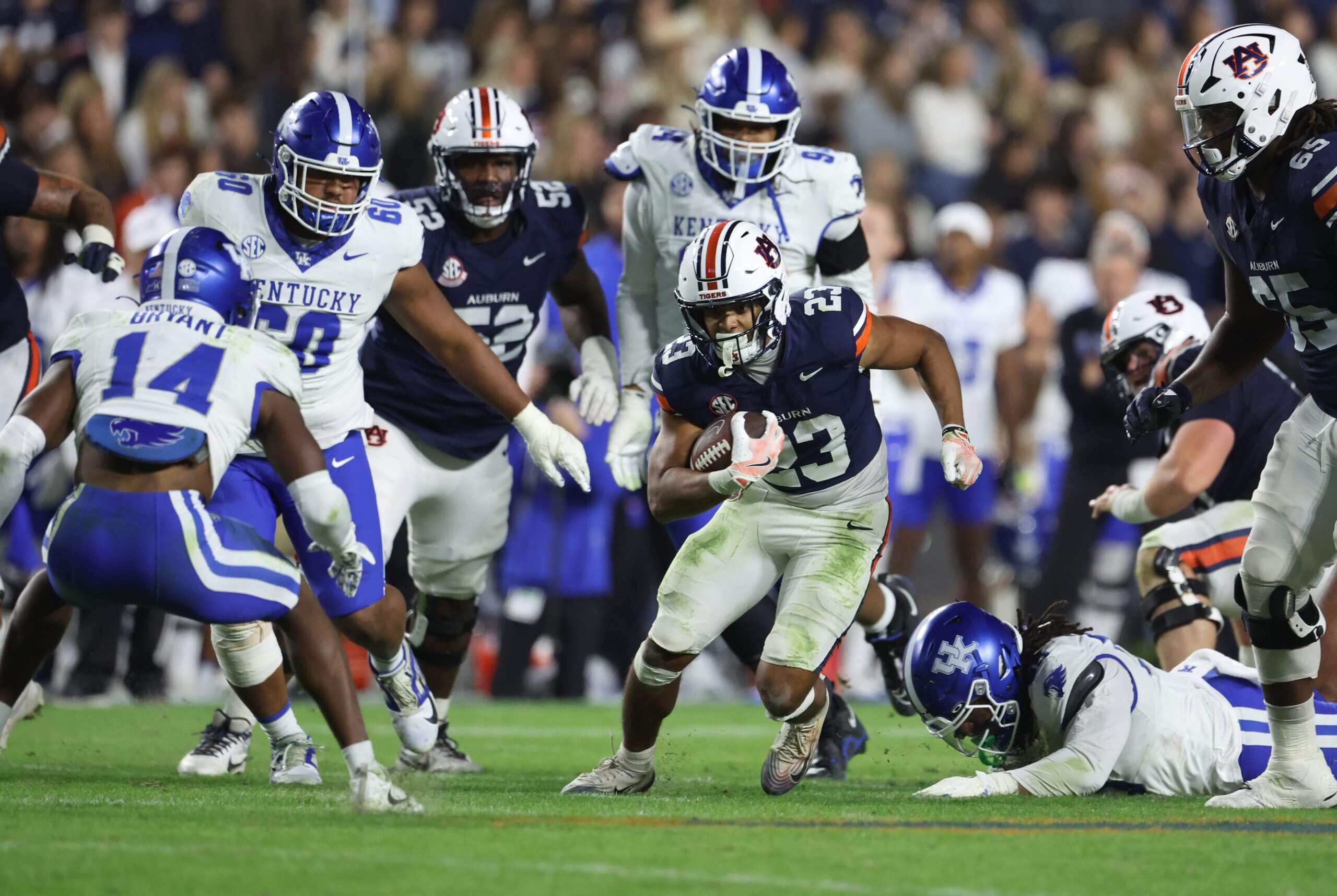
While Auburn played in two national championships in the early 2010s, it was more a result of good timing and momentum than a great foundation. (John Reed / Imagn Images)
Not if but when does Miami pull the plug on Mario Cristobal? They got all that money and no trophies to show. Schools are showing buyouts are nothing now. — Jeff H.
While I agree that Cristobal deserves some heat for continuing to lose games he should win in the same excruciating fashion — think about this for a second. Has any coach in the history of major college football been fired after a 10-win regular season? Much less back-to-back 10-win regular seasons? I’m not saying it could never happen, but it would say a lot about how truly CFP-or-bust the sport is now for major programs.
Given Cristobal is a native son with a $60 million buyout and has the program in better shape than before he got there, I’m going to go ahead and declare he’s back in 2026, even if Miami loses another game. But he would go into next season at or near the top of the hot-seat power rankings. The school can’t expect its donors to keep forking over the millions to land the next Cam Ward or Carson Beck without a Playoff appearance to show for it.
The Big Ten seems to have an inventory problem. It doesn’t have many compelling matchups week-to-week and this is reflected by point spreads and low ratings*. And when it does have a good game, it’s on at 9 a.m. in part because of its conference. So what can it do to fix this? And what are the long-term implications if it can’t? — Jason D.
I threw in the * to note that the Big Ten still gets great ratings relative to most things on TV, but they’re well behind the SEC’s ABC games, and certainly not what CBS and NBC envisioned when they paid all those hundreds of millions. There have been 30 games so far to get five million viewers (as of Week 9). The participants included 38 SEC teams, compared with just 12 Big Ten teams. This despite the fact both conferences usually have three games on over-the-air networks every Saturday.
The Big Ten’s problem is simple: It got too big. While it sounded enticing at the time to add USC and Oregon to go with Ohio State, Michigan and Penn State, they don’t all play each other every year. There’s been no Michigan-Penn State these past two years, and no Ohio State-USC. Both of those would get blockbuster ratings. And let’s be honest, it’s just not as deep a conference as the SEC, either on the field or in terms of brand power.
It doesn’t help that many Big Ten matchups now feel unnatural. Oregon has been one of the top programs in the country since joining the Big Ten, but you can’t force people to care when the Ducks face Northwestern, Rutgers and Wisconsin. I’d be more likely to tune in if it were against Washington State or Stanford.
Contrast that with the SEC, where Oklahoma and Texas already feel like they’ve always been there, and if anything, have created more, not fewer, interesting matchups. At no point during the Sooners’ past two games against Ole Miss and Tennessee did I think to myself I’d rather be watching them play Baylor today.
I’m not sure there’s anything to “fix” in the short term. The checks from the networks will be cashed regardless of the matchups, and those deals run for another five years. It’s just sad that the conference turned into a less compelling product.
The Big Ten looks like it is poised to have three teams finish winless in conference play this year in Purdue, Wisconsin and Michigan State. If that happens, it has to be the first time in college football something so dubious has occurred. I get Purdue being that bad, but Wisconsin and Michigan State? Ouch. — David H.
@David H. The 1932 Southern Conference pulled off this feat, with Clemson (0-4), Mississippi State (0-4) and Sewanee (0-6) all failing to win a game. Of course, there were 23 teams in this conference at the time. — Joe H.
I’m sure there are other 1932-type oddities out there, but I can’t imagine it has ever happened since conferences began playing at least six or seven games against each other. Chalk that up as another byproduct of the Big Ten getting too big.
I’d also note that Purdue is arguably the best of the three teams. The Boilermakers have been competitive in three of their last four games, including their 21-16 loss at Michigan last week. But with two of their last three games against No. 1 Ohio State and No. 2 Indiana, plus a trip to No. 23 Washington, it’s not looking good. And Wisconsin is truly awful.
Michigan State almost got one last week, losing at Minnesota in overtime. The Spartans are the best bets to avoid a shutout, given they still face 3-5 Penn State and 4-4 Maryland. If Penn State loses that game, they may fire the interim coach, too.