
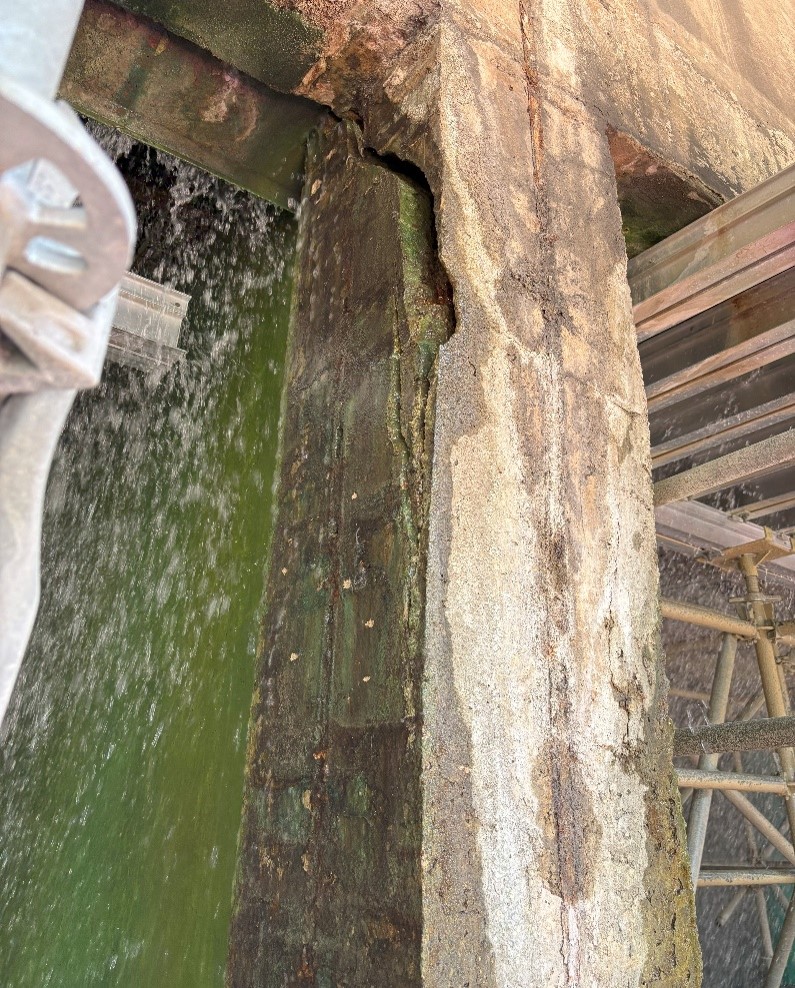
San Antonio Water System is working to repair damage at its downtown cooling plant, including cracked columns like the one pictured here. SAWS said the damage to the columns wasn’t visible until a contractor removed exterior brick on the cooling towers.
Courtesy San Antonio Water System
Water moves through cooling towers at SAWS’ central cooling plant downtown. During recent repair work on the towers, a contractor discovered significant structural issues in the cooling towers that need repairs within the next year, the utility said.
Josie Norris/San Antonio Express-News
Temporary structural support was installed at the San Antonio Water System’s downtown cooling plant earlier this year after a contractor found damage to the cooling towers.
Courtesy San Antonio Water System
San Antonio Water System is spending another $3.6 million to shore up its aging downtown chilled water plant, after utility and city officials recently agreed not to relocate the plant to make room for Project Marvel.

The Commerce Street plant, which was built in 1968, provides cold water that is pumped to downtown buildings, including the Convention Center, Alamodome and several hotels. The water runs through the system, returns to the plant warmer, and is chilled again and reused.
Article continues below this ad
Last year, the city asked SAWS to study the cost of moving the plant to make room for a new hotel on the property, which sits directly across the street from the convention center.
READ MORE: City, SAWS drop plan to move water plant for Project Marvel hotel
That study found that it would cost more than $300 million, an amount that both SAWS and the city have agreed wasn’t feasible.
“That issue is dead,” SAWS president and CEO Robert Puente said last month. “We’re not going to move it because it’s too expensive.”
Article continues below this ad
Instead, the utility is now looking into expanding the plant, increasing its capacity to serve the new development expected as part of the downtown sports and entertainment district, including a new Spurs arena.
In the meantime, the 58-year-old facility needs structural repairs, SAWS said. That work started late last year, when the board approved about $1 million in work by contractor JT Vaughn Construction to repair failed horizontal concrete beams, cracks and damaged surfaces.
When Vaughn crews started removing exterior brick on the plant’s cooling towers for that work, they discovered “a significant amount of cracking and damage to the vertical columns,” said Chris Wilcut, director of the district cooling system. The work was immediately stopped because of “significant safety and operational hazards,” he said.
The utility spent about $94,000 on temporary shoring, which was installed in April and lasts about 12 months.
Article continues below this ad
On Tuesday, the board voted unanimously to approve a $3.6 million change order to repair those columns.
The towers are a key part of the system.After chillers remove heat from the water, the towers use evaporative cooling to remove that heat from the system.
READ MORE: City of San Antonio buys Hemisfair sites for Project Marvel plan
“Oftentimes you hear us focus on chillers, but cooling towers are equally as important, because you have to be able to reject just as much heat as you capture from the space,” Wilcut said. Without functioning towers, the system can’t remove heat from buildings, which is its purpose.
Article continues below this ad
Most of the cost is not from the repair work, but from the costs of renting temporary cooling towers to use while the work is done.
The district cooling system runs 24 hours a day and cannot be shut down during the repairs. The repair work requires shutting down two cooling tower cells at time, which would create a “significant risk” of not being able to meet demand, Wilcut said.
Renting towers is necessary to keep the system running while the work is completed, he said — but it will cost about $2.6 million.
The column repairs themselves are expected to cost about $686,000.
Article continues below this ad
The work at the Commerce Street plant is part of a $50 million capital program for the district cooling system, which is funded solely by users of that system. Chilled water rates are separate from the utility’s rate structure for regular water and sewer customers.
The additional costs for the structural repairs are still coming from that budget; money was reallocated from savings from other projects in the plan.
The repairs will shore up the facility for now, but the cooling towers will ultimately need to be replaced, because much of the structure is original from 1968, Wilcut said.
A consultant said the repairs will be sufficient for at least seven years, and “probably up to 10 or 15,” he said.
Article continues below this ad
Wilcut said SAWS can’t just skip the repairs and move forward with replacement because that will take too long: in the best case scenario, design and construction of the replacement towers would take two to three years, and the temporary shoring installed this spring is only good for another nine months.
The current chilled water rates also aren’t sufficient to pay for that project, he said.
Board chairwoman Jelynne LeBlanc Jamison said she was supportive of the repair work, but said she has “a lot of questions” about the future of the cooling system and how it will serve expected growth in the downtown area.
Article continues below this ad
“I’m looking forward to a future staff presentation,” she said.
Wilcut said the utility is “actively studying” that issue and hopes to have “a firm plan direction by the end of the calendar year.”