
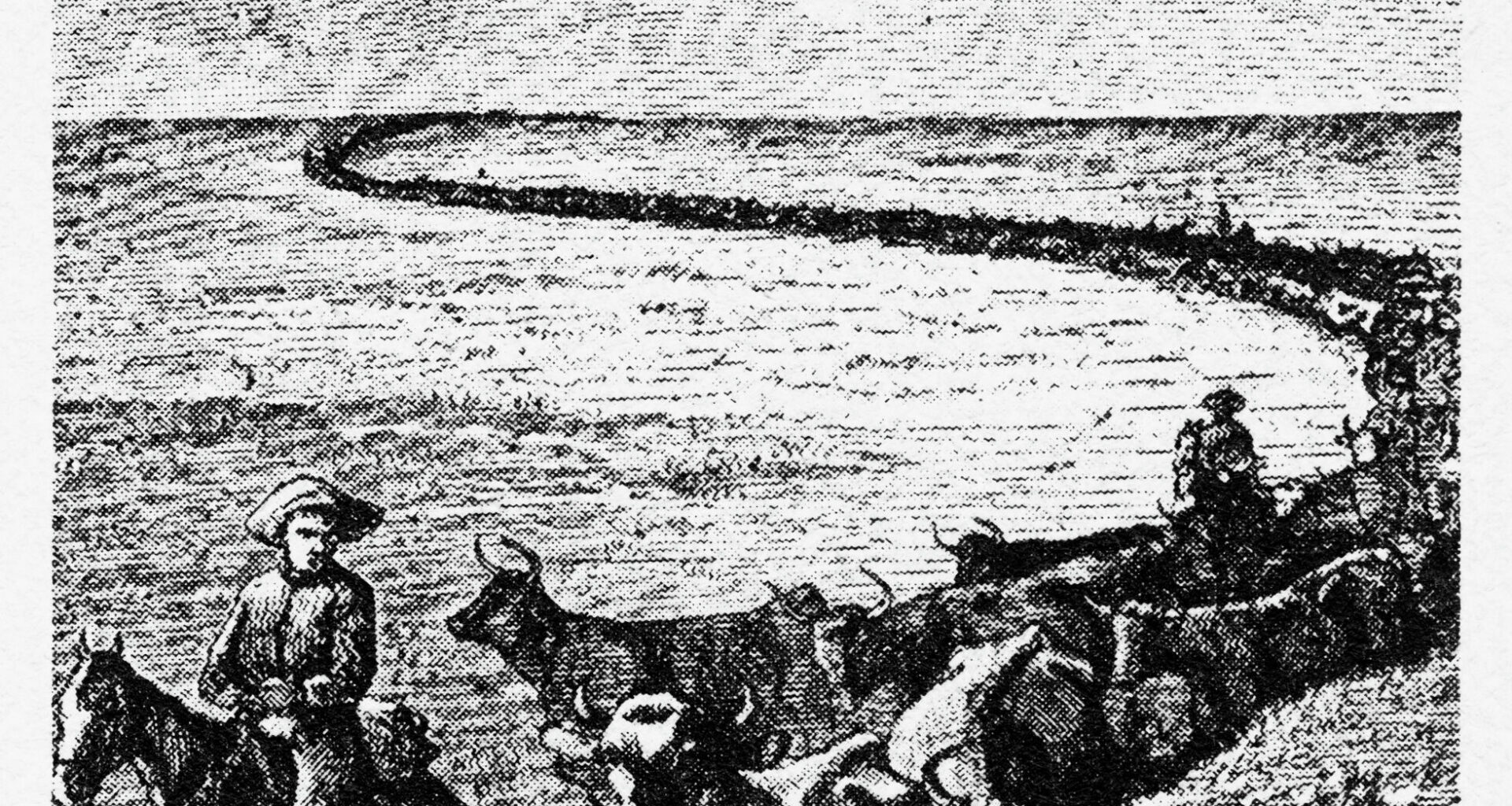
An antique engraved Victorian illustration shows early American Texas cowboys driving cattle in 1883. The first cattle drive occurred more than 100 years prior to support the Spanish army during the Revolutionary War.
bauhaus1000/Getty Images
A monument in Pensacola, Florida depicts General Bernardo Galvez and the Siege of Pensacola.
felixmizioznikov/Getty Images
Though Laredo did not become part of the United States until 1848 following the Mexican-American War, it has been part of the nation’s story since its founding, including contributing to the Revolutionary War.

According to research by local history enthusiast Fidel Santos and books by multiple Texas historians, Laredo contributed both cattle and cash, which directly aided Spain’s efforts in the Revolutionary War.
Article continues below this ad
Santos, a retired petroleum engineer, serves as governor of the Laredo chapter of The Order of the Granaderos y Damas de Gálvez. The organization celebrates Spain’s participation in the American Revolution and meets monthly for presentations by special guests from around the world.
The first Texas cattle drives feed the army
According to The Texas Connection by Robert H. Thonhoff, Teodoro de Croix visited Texas on an inspection tour in 1778 while serving as the first commandant general of the Interior Provinces of New Spain. With cattle ranching becoming increasingly important in Texas, he decided Spain needed to regulate the industry and issued a decree that all unbranded cattle belonged to the Crown.
Ranchers were given time to gather and brand their livestock. After that grace period, anyone claiming an unbranded animal had to pay the Crown. Fees included one peso per head of cattle and six reales per horse.
Article continues below this ad
“Spain wanted to regulate trade, even between its own provinces, and especially wanted to prevent unauthorized trade with France or anyone else,” Santos said.
Around that time, Bernardo de Gálvez arrived in Louisiana as a military officer, then replaced the governor.
According to Santos, the Spanish were allowing supplies to move up the Mississippi River to American rebels before officially entering the war, despite agreeing not to allow contraband through. Gálvez had previously served in Texas and knew about the cattle.
“He understood that an army marches on its stomach,” Santos said. “If you want an army to fight, you have to feed it. So he immediately began making arrangements to secure cattle.”
Article continues below this ad
An emissary named Francisco García delivered orders to San Antonio to obtain cattle for Louisiana, but Gov. Domingo Cabello said they couldn’t do that, claiming they needed the cattle to feed their people. Gálvez then appealed directly to Teodoro de Croix, who issued new orders directing Cabello to comply and release between 1,500 and 2,000 head of cattle.
Franciscan missions and ranchers were contacted to begin gathering cattle, and eventually about 2,000 head of cattle were assembled. This became the first legally authorized cattle drive out of Texas. It did not go off without a hitch, as the drive was attacked by Native Americans along the trail, and it is unknown exactly how many cattle completed the journey.
It was the first of several cattle drives. Thonhoff’s research says between 10,000 and 15,000 head of cattle were sent from Texas to Louisiana during the American Revolution, with most going to Opelousas, Louisiana. This occurred over an estimated 10 cattle drives. Spanish soldiers helped escort the drives to ensure their safe passage.
While the cattle were intended to feed the Spanish army, Santos said they were also used to rebuild Louisiana’s cattle industry after it was devastated by hurricanes. Officials requested that bulls accompany the herds to help reestablish the livestock population.
Article continues below this ad
During this time, cattle were already being traded between Nuevo Santander and neighboring provinces, as well as with settlements in Coahuila and Texas centered around San Antonio and Goliad.
The historical record doesn’t specify that cattle from Laredo were included in the drives to Louisiana. However, Santos said that because of extensive trading between the provinces, it is probable that cattle from Laredo were traded to the San Antonio region and then became part of the drives.
“We simply don’t have documentation proving that directly,” Santos said. “Several historians have told me there was certainly cattle trading between Nuevo Santander and Texas. The indirect connection is well supported. The direct connection — that cattle specifically from Laredo were part of those documented drives — still hasn’t been proven.”
Article continues below this ad
After Spain declared war on Great Britain, the king ordered a donativo to help finance the war. Every Spaniard was ordered to contribute two pesos, and people who were not full Spaniards had to contribute one peso. The donativos were assessed per person, not per household.
The money collected went through Cuba, which served as a financial center for the Spanish Empire, and was then distributed to support Spain’s military campaign.
All financial contributors are recognized as Patriots by the Daughters of the American Revolution and the Sons of the American Revolution because they directly supported the Revolutionary War effort. However, many of the original Texas donation records have not been located.
Article continues below this ad
Santos said researcher Jesse Villarreal observed that the people listed in the 1779 Texas census closely matched the amount of money Thonhoff calculated should have been collected under the king’s decree. Villarreal argues the correlation means everyone listed should be considered a Patriot, but the Daughters of the American Revolution and the Sons of the American Revolution require individual documentation showing contributions.
For more information about Laredo’s chapter of The Order of the Granaderos y Damas de Gálvez, email Santos at afidelsantos@gmail.com.