
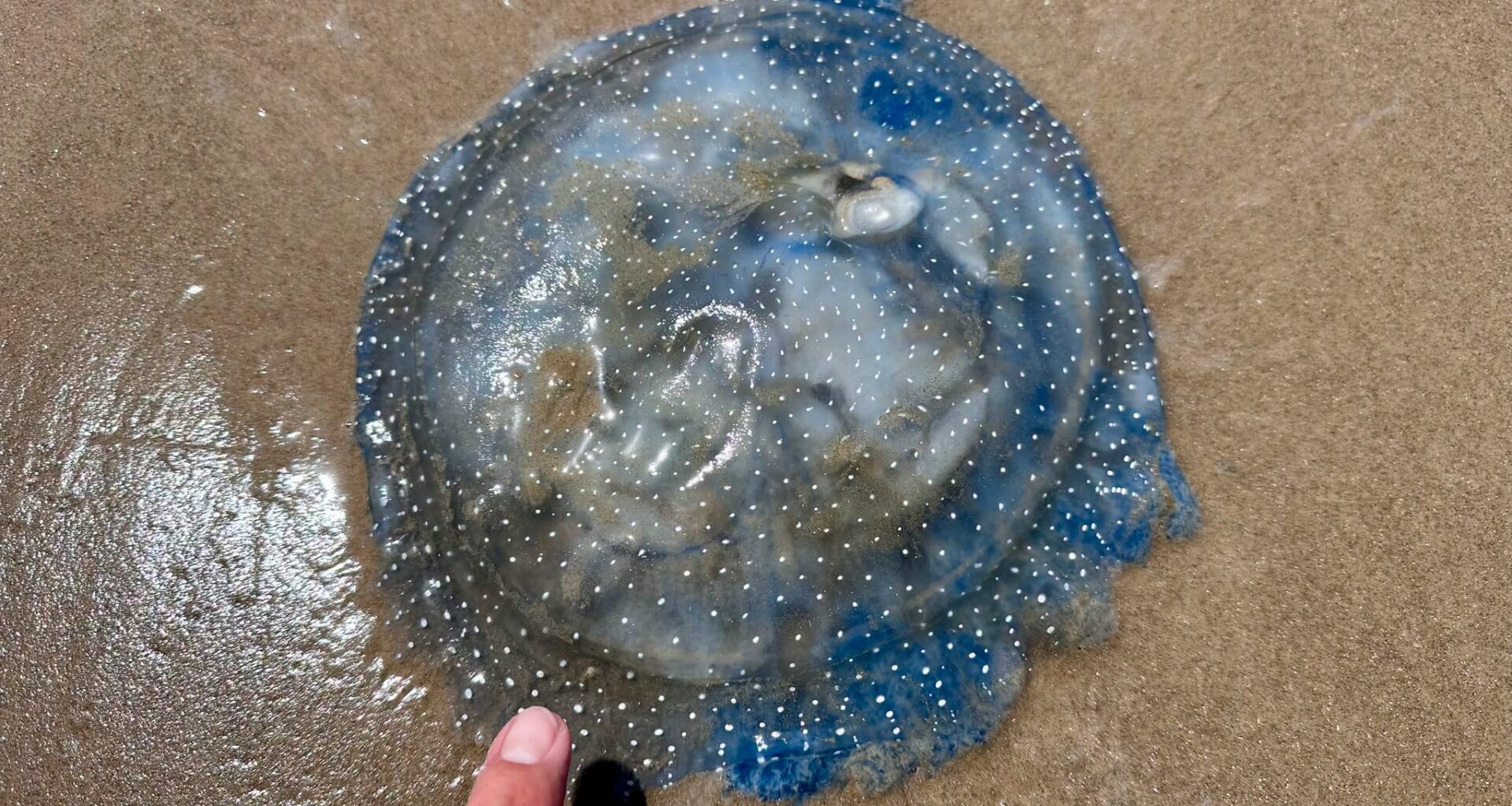
The jellyfish were hard to miss. Some appeared nearly crystal clear, while others were brown or took on shades of blue in the sunlight, Tunnell wrote in a beachcombing report this week.
“Last summer was the first time I had personally seen them, so it was a surprise to see so many of them this last week,” he said.
Native to the western Pacific, Australian white-spotted jellyfish, scientifically known as Phyllorhiza punctata, are named for the small reflective spots covering their rounded, gelatinous bells. They typically measure 18 to 20 inches across, though those in Gulf waters can grow beyond 24 inches.
The species was first documented in the Gulf of Mexico in the early 2000s, likely arriving through ballast water discharged by cargo ships. The Texas Invasive Species Institute reports that the jellyfish have appeared in larger, denser swarms in recent years.
“They’re primarily an offshore species, but winds, waves, tides, and surface currents can push them toward the beaches,” Tunnell said.
Despite their size, the jellyfish are considered largely harmless to people. Their sting is mild and often goes unfelt.
“I didn’t feel any pain at all with all the ones I was handling,” Tunnell said. “I’d recommend not handling them with bare hands, unless folks know for certain what type of jellyfish it is.”
Their potential impact on Texas’ coastal ecosystems is a bigger concern. Australian white-spotted jellyfish consume large amounts of plankton and other tiny organisms, potentially competing with shrimp and juvenile fish for food.
“Each jellyfish can clear 50 cubic meters of water filled with plankton in one day,” the Texas Invasive Species Institute reports, adding that dense swarms can disrupt marine food webs and clog fishing gear. Tunnell said researchers are still studying their long-term ecological impacts.
The jellyfish can also spread during their polyp stage by attaching to ship hulls before budding into free-swimming jellyfish. Unlike in parts of the Pacific, North American waters lack snails that feed on the polyps and help keep populations in check.
“As with any jellyfish, it’s best to admire them, take a photo if you’d like, and leave them where you found them,” Tunnell said. “They provide food for scavengers and eventually return nutrients back into the coastal environment.”