
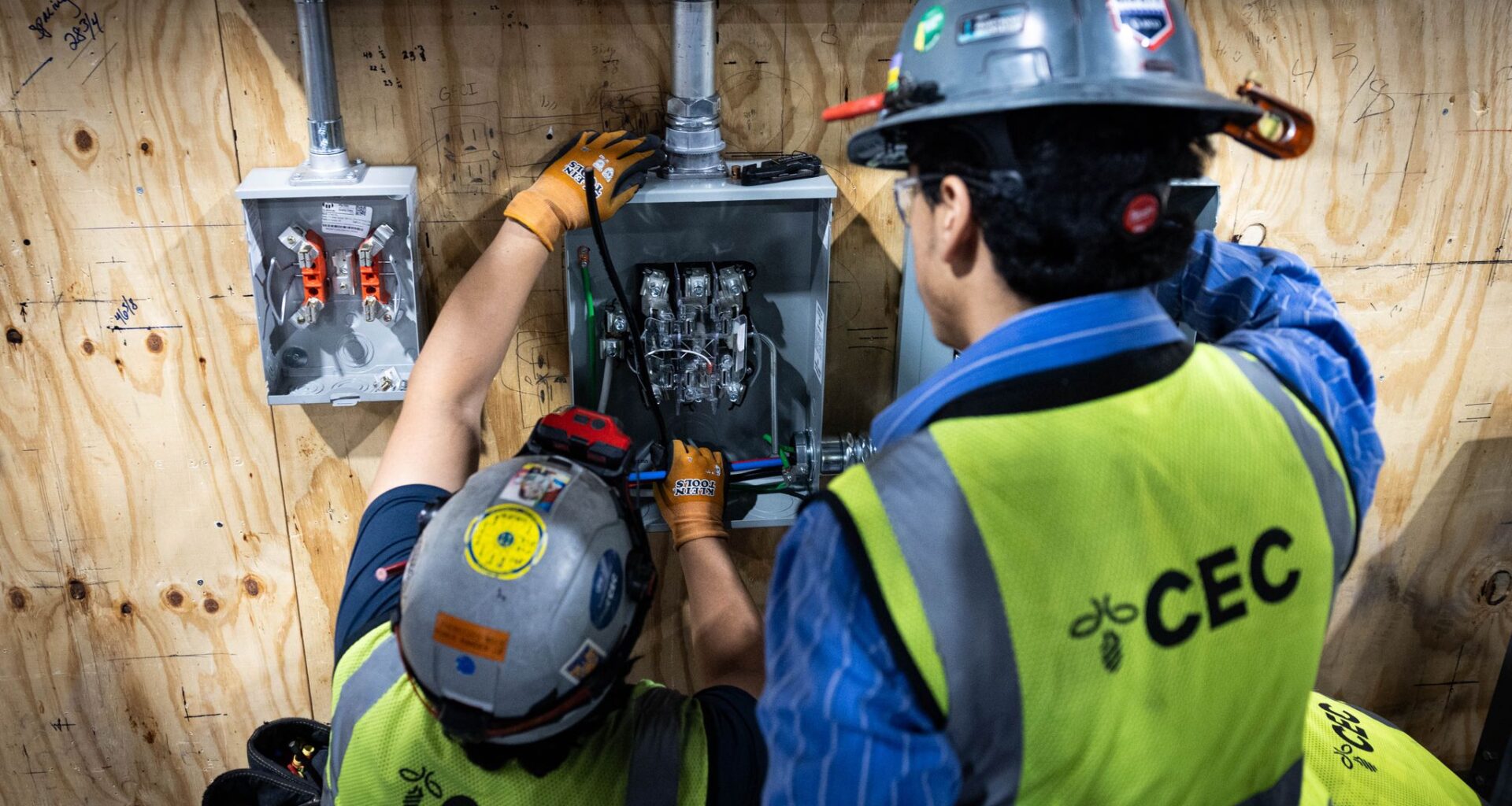
Inside CEC Facilities’ apprenticeship school in Irving, the 31-year-old electrical apprentice walks through a control panel he built for a statewide skills competition, tracing wires and relays as if explaining his own career pivot from odd jobs into one of the region’s fastest-growing trades.
CEC Facilities, an electrical contractor that builds infrastructure for data centers and other large industrial projects, created CEC University to train the electricians.
North Texas’ race to build AI infrastructure is colliding with a shortage of skilled workers. Economists and business leaders warn labor shortages in skilled trades could hinder North Texas’ ability to expand data centers and advanced manufacturing capacity fast enough to meet demand.
The Texas Workforce Commission projects the Dallas, Tarrant and North Central workforce regions will need nearly 3,000 additional electricians by 2032, a roughly 15% increase from 2026 staffing levels. In the Dallas region alone, the state projects roughly 1,035 electrician openings annually, driven less by explosive growth than by retirements and worker turnover.
North Texas AI boom increases demand in skilled trades
The shortage extends beyond electricians. Welders, HVAC technicians, plumbers and other skilled trades are also needed to build and maintain North Texas’ fast-growing infrastructure economy, contractors and workforce leaders say. Data centers, semiconductor plants and advanced manufacturing campuses all require large numbers of specialized workers. Yet older workers are retiring faster than younger people are entering the field.
“This boom is definitely increasing the demand for craft workers within the industry,” said Matt Terry, president of construction at Dallas-based TDIndustries. “The core of that business is heavy mechanical, heavy electrical, and heavy controls.”
Terry said data centers and other high-tech industrial projects require large numbers of pipe fitters, welders, plumbers and HVAC specialists, intensifying what has long been a shortage of experienced craft workers. Companies are responding by expanding apprenticeships, internships and partnerships with schools to recruit and train the next generation of tradespeople.
That means companies have to work diligently to find enough skilled workers to keep up with demand to build and maintain data centers and other critical infrastructure across North Texas.
Few employers see that crunch as clearly as CEC Facilities, whose work spans data centers, semiconductor plants and other power-hungry projects across Texas and the broader Sun Belt. CEC President Daniel Williams told a recent Dallas Regional Chamber Leadership Dallas cohort that AI and digital infrastructure are reshaping the company’s trajectory.
A backlog of work from data centers in Texas
Each large data center campus can require hundreds of electricians, Williams said. On one West Texas campus alone, CEC expects to log nearly 1.9 million electrical labor hours over 14 to 16 months.
“The demand and the backlog of work that we have today, especially from data centers, requires that we double our workforce in the next 18 months, so that we go from 2,200 to nearly 4,000 to handle the work that we have in front of us,” Williams said.
CEC University opened in 2021 as a dedicated apprenticeship and training center in Irving that combines classrooms, a lab designed to mimic real job sites, and a connection to the company’s nearby prefabrication plant and headquarters.
CEC founder Ray Waddell pushed the company to open the university because he knew a U.S. Department of Labor-accredited four-year apprenticeship could create future superintendents and project managers, said CEC University Dean Fred McHugh.
“It was an early, extremely risky investment by our company,” McHugh said. The idea was that in 10 years, “we’re going to have 300 people that we produced through this program in our company that will be leaders.”
CEC recruits 30 to 40 apprentices a year, largely from Career and Technical Education programs in the Grand Prairie, Fort Worth and Lewisville school districts. The company donates $5,000 to $7,000 in tools and materials to each partner program annually and cultivates students as early as eighth and ninth grade at career fairs, because McHugh says, “kids can’t be what they don’t see.”
That relationship continues through their junior year, where students solidify their internships through CEC’s signing day. Upon completion of their internship and senior year, select graduates come on as full-time first-year apprentices.
Apprentices spend one day a week at CEC University and the rest of their time on job sites. Pay starts at around $20 an hour, with raises built into the federally registered program. McHugh said licensed journeymen can earn roughly $35 to $40 an hour, while experienced superintendents on major projects can make six figures.
“We want the Navy SEALs of electricians,” he said. “Graduates aren’t just going to be journeymen from CEC University. We want future leaders of our company.”
Apprentices in high demand
The approach is an answer to what Williams calls a “workforce war.” Third-year apprentices in high demand are already being targeted by competitors who promise immediate raises and quick promotions. CEC responded by pairing fourth-year apprentices with mentors in project management or field leadership so they can map a path beyond the tools.
Andrews, a CEC apprentice, describes past jobs at Walmart, hotels and towing companies before finally committing to electrical work. The steady raises and combination of theory in the classroom and hands-on training in the field, he said, gives him a sense of momentum he wants his children to see.
His classmates see the same opportunity.
“There are tons of entry-level positions. Everybody needs an electrician, everybody needs a plumber,” said apprentice Niko Serafy, a 43-year-old who moved to Dallas from South Texas and came into the trade after landscaping CEC properties. “People are going out faster than they’re coming in.”
Mario Lopez, 23, left college after two years and followed an uncle into electrical work.
“Some people come into the trade and they’re there for the check,” Lopez said. “Of course money is important to me, it’s going to keep me up. But I actually just wanted the experience, I wanted to be able to learn.”
Instructor Ronnie Cope, who spent decades teaching high school electrical students before joining CEC, says the university can elevate how people view trades. He said the curriculum is packed with math, physics, and code work that many outsiders do not associate with construction.
“To know them when they’re in a second and third year that they’re learning these calculations, and then they pass that journeyman test,” Cope said, is proof to him apprentices are reaching a level he believes is “equal to a college program.”
This reporting is part of the Future of North Texas, a community-funded journalism initiative supported by the Commit Partnership, Communities Foundation of Texas, The Dallas Foundation, the Dallas Mavericks, the Dallas Regional Chamber, Deedie Rose, Lisa and Charles Siegel, the McCune-Losinger Family Fund, The Meadows Foundation, the Perot Foundation, the United Way of Metropolitan Dallas and the University of Texas at Dallas. The News retains full editorial control of this coverage.