
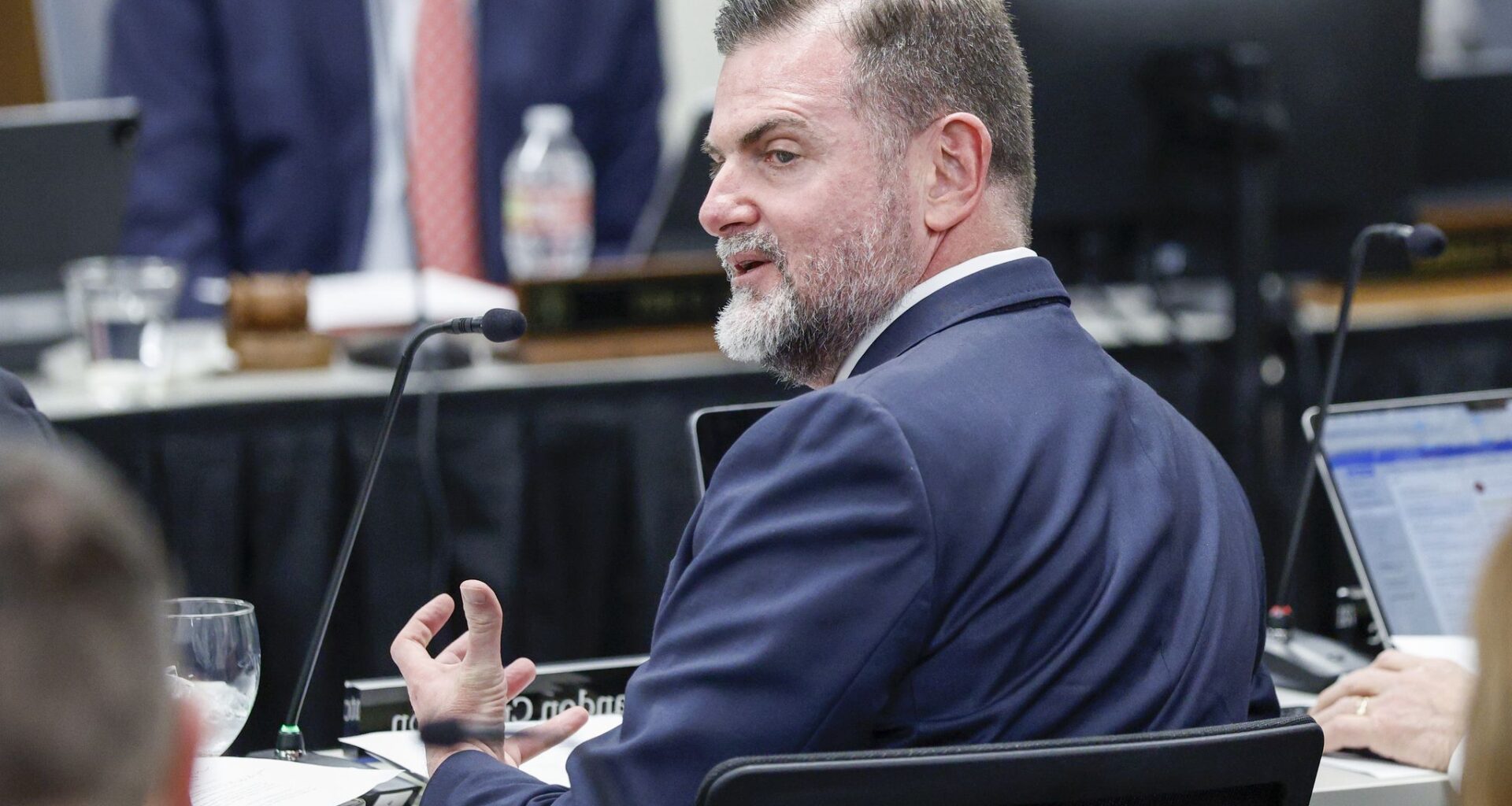
Chancellor Brandon Creighton speaks during a Texas Tech University System Board of Regents meeting at Texas Tech University Health Sciences Center Dallas Campus on Thursday, Feb. 26, 2026, in Dallas.
Elias Valverde II/Dallas Morning News
A professors’ union sued Texas Tech University System leaders on Wednesday over policies that it believes censor certain topics in the classroom —race, gender identity and sexual orientation.
The lawsuit marks the first major legal challenge to Texas’ recent efforts to restrict instruction in higher education. The changes, already taking hold at universities including Texas Tech, Texas A&M and the University of Texas, have pitted professors concerned about academic freedom against conservative lawmakers who argue universities need greater oversight.
The Texas American Association of University Professors-American Federation of Teachers filed the lawsuit on behalf of members at the system’s three universities and two health science centers, claiming that several of Chancellor Brandon Creighton’s directives violate the First and Fourteenth amendments and target Black faculty.
Article continues below this ad
The suit’s defendants include Creighton, a former GOP lawmaker influential in higher education, and the system’s regents, who are appointed by Republican Gov. Greg Abbott. A spokesperson with the Texas Tech University System did not immediately respond to a request for comment.
Higher ed: A battle over ‘indoctrination,’ workforce is reshaping core curricula at Texas colleges
Creighton, who authored the state’s anti-diversity, equity and inclusion bill, issued a memorandum in April that instructed core and lower-level courses to remove topics of sexual orientation or gender identity from their materials and imposed a high bar for including the topics in upper-level courses.
Attorneys for the faculty group said the memo, coupled with another directive in December, triggered a mandatory review that made faculty disclose whether they used course materials that touched on prohibited subject matter including race, sex and gender identity. If content was flagged, professors said they had to stop teaching the materials until a ruling from the state system’s board of regents.
Article continues below this ad
The lawyers said that administrators used an AI tool to scan syllabi and reading lists for prohibited content. As a result, Plato’s “Republic” was removed from a philosophy course, law students were not able to learn information about race related to the landmark Dred Scott v. Sandford case, and some students were not able to learn about treating certain racial and sexual demographics in healthcare settings.
“If allowed to stand, the Creighton Memoranda marks the end of free, thoughtful college curriculum developed by experts in the field,” said TJ Geiger, vice president of Texas Tech’s chapter of the Texas AAUP-AFT. “The world around us exists as it is, whether Chancellor Creighton likes it or not. Bending to politicians’ preferred viewpoints over what the experts know to be true and right sets a dangerous precedent for higher education nationwide.”
The federal lawsuit, filed in the Western District of Texas, asks the court to declare Creighton’s memoranda unconstitutional and block their enforcement. It alleges the directives employ viewpoint discrimination, barring faculty from teaching certain ideas about race or gender but not others, and it alleges that the directives are vague, violating due process rights under the 14th Amendment.
When Creighton announced the new rules in April, he framed them as offering courses that are “rigorous, relevant, and directly tied to preparing students for success in a 21st-century workforce.”
Article continues below this ad
“It is about reinforcing the integrity of our curriculum, strengthening public trust, and maintaining our competitiveness as institutions of higher education,” Creighton said in a letter to the system’s presidents and provosts at the time.