
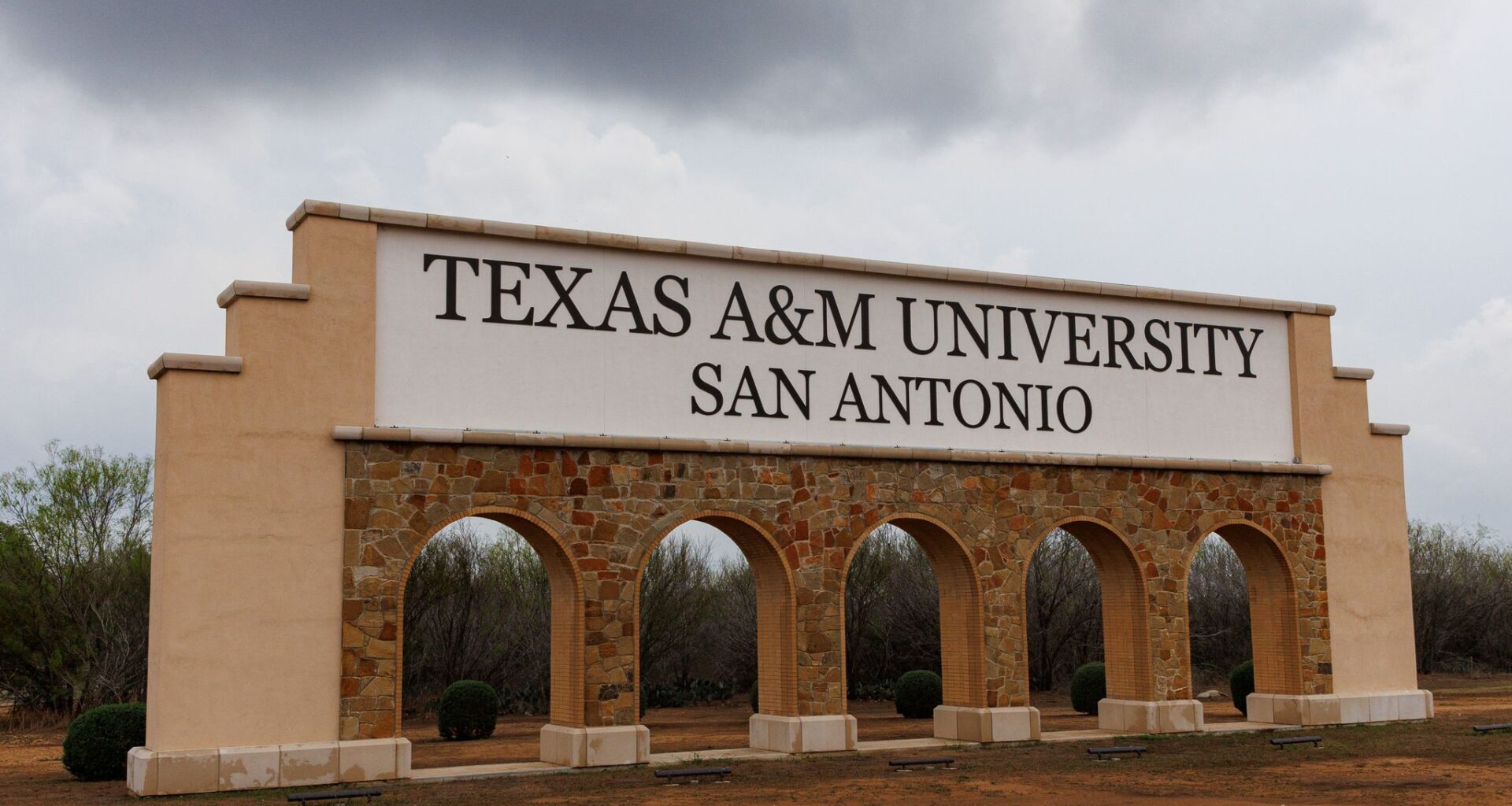
A Texas A&M University-San Antonio sign is located near the campus entrance at the corner of the I-410 Access Road and University Way in San Antonio, on Monday, March 9, 2026. The 17-year-old university is launching its first doctoral program with 15 graduate students seeking a three-year doctor of education degree in school leadership.
Sam Owens/San Antonio Express-News
Texas A&M University-San Antonio has launched its first doctoral program since it was founded 17 years ago. The university’s goal is to mold the next generation of school leaders. The first class will start their studies this fall.

The new three-year doctor of education degree in educational leadership is designed to train superintendents, principals and academic coordinators. Classes will be led by instructors who have practical experience in education and know today’s challenges, including declining enrollment, school closures and debates over use of artificial intelligence.
Article continues below this ad
Elisabeth Krimbill, an associate professor who helped design the program, said it will explore real-world scenarios playing out in Texas schools, with professors who have a professional background in school leadership. The program is intended to equip “creative leaders” for a “tough job.”
RELATED: Study says TAMUSA’s economic impact nearly doubled in four years
Elisabeth Krimbill, former principal at Stone Oak Elementary School in the North East ISD, helped develop Texas A&M University-San Antonio’s first doctoral program. Before she joined TAMU-SA in 2017, Kimbrill supported health nutrition initiatives at Stone Oak, which received a National Healthy Schools Silver Award from the Alliance for a Healthier Generation.
Billy Calzada
“Our goal is to prepare our students to be ready on day one when they get that job of being a school leader, to have all the tools and knowledge they need to address the challenges in the school. Nobody gets an easy ride these days,” said Krimbill, a former elementary school principal who teaches education leadership in TAMU-SA’s College of Education and Human Development.
Article continues below this ad
More than 60 people from across the state have applied, and TAMU-SA is only accepting 15 students in the first cohort. Some applicants may be placed on a wait list for next year. Online classes begin Aug. 25.
For the first group, the college required applicants to have a master’s degree and state principal certification. The program, designed with evening and weekend virtual classes, allows flexibility if someone needs to take a semester off “because life happens to people from time to time,” Krimbill said.
When the Texas Higher Education Coordinating Board unanimously approved the program a year ago, following a year of development and design, TAMU-SA President Salvador Hector Ochoa said it would prepare graduate students for “pivotal leadership roles” in education and enhance workforce pipelines.
Article continues below this ad
In surveys conducted over the past five years, between 55% and 85% of alumni from the college said they’d be “very interested” in a doctoral program at TAMU-SA.
Salvador Hector Ochoa, president of Texas A&M University-San Antonio, has hailed the university’s first doctoral program as an example of the institution’s contributions to education and workforce development in the region.
Christopher Lee / Staff Photographer
Assistant professor Wowek Kearney, a former director of principal certification who joined TAMU-SA during its inaugural year in 2009, and associate professor Lawrence Scott, a TAMUSA faculty member since 2016 who previously served more than 16 years in San Antonio ISD, helped design the courses for the program.
The university has two former school superintendents among its adjunct faculty members: Juan Antonio Jasso, who worked for 14 years leading the Sabinal, Van Vleck and Southside ISDs, and Richard Alvarado, a former vice principal and principal at a San Antonio ISD elementary school and assistant superintendent at Southside ISD.
Article continues below this ad
Krimbill said the college prepares school leaders to develop relationships with school boards and make difficult decisions under a web of Texas laws, regulations and local policies. For the new program, the university is hiring a methodologist to guide the dissertation process and an administrator with experience in setting benchmarks to better gauge the graduate students’ progress.
“The students will be researching real issues that they’re facing in their schools and developing their dissertation off of that ‘problem of practice’ that they identify,” Krimbill said.
Other likely focus areas of the program will be bilingual education, early childhood education and special education, Krimbill said.
RELATED: New A&M chancellor said growth will continue on South Side campus
Article continues below this ad
The Central Academic Building, located at the center of Texas A&M University-San Antonio’s campus, is shown on Monday, March 9, 2026.
Sam Owens/San Antonio Express-News
Superintendent certification, the highest credential offered by the Texas Education Agency, is a “rigorous program” of five classes that will be embedded into the doctoral coursework, helping students examine their leadership style and understand ethical, legal and fiduciary responsibilities, Krimbill said.
“In our superintendency classes, we’re already talking about the process of closing schools and how that is so hard on a community,” she said. “We’re going to take a look at how changes in funding are impacting the practices in our schools and the decisions they’re making.”
Article continues below this ad
Artificial intelligence is also a topic at the forefront of education today.
“We’re really going to take a proactive, forward-leaning stance on how AI can (be) beneficial — supplementing, not supplanting research,” Krimbill said. “For us, it’s a positive tool that we want to help them to harness and use appropriately.”