
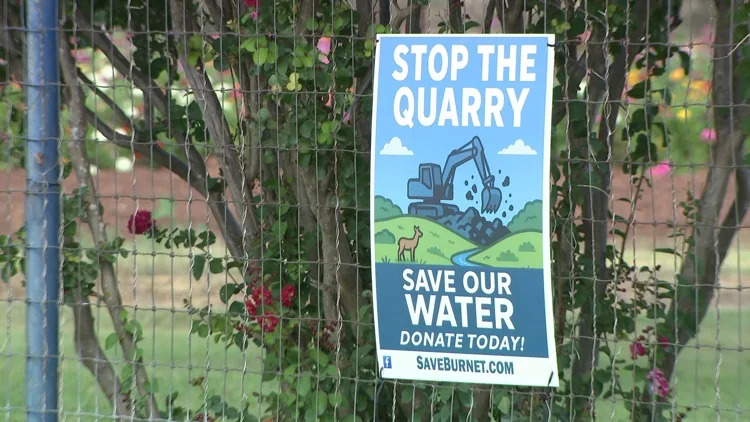
Leaders at two longtime Texas Hill Country camps are raising concerns about a proposed rock-crushing quarry in Burnet County, saying they worry that the project could change the landscape that has drawn generations of campers.
The proposed 700-acre quarry would be located off Hoover Valley Road, a few miles from Camp Buckner and along the property line of Camp Longhorn Indian Springs. The project, proposed by Asphalt Inc., has received key permits from the Lower Colorado River Authority )LCRA) and the Texas Commission on Environmental Quality (TCEQ). However, the company is still seeking a groundwater permit from the Central Texas Groundwater Conservation District before operations can begin.
“We have a quality of life here. We love it here, and that’s about to change,” said Andrea Sparks, director of government relations for Buckner International.
Camp Buckner leaders say they are concerned about how the proposed quarry could affect the surrounding environment and the experience campers have each summer.
“We are very concerned about a rock quarry coming in this close,” Sparks said. “As you can see this is beautiful land.”
Just down the road, Camp Longhorn leaders say the proposed quarry would share a fence line with the camp, heightening their concerns.
“We’re all outdoors. Having a rock crushing quarry is something that could be devastating for children,” Nan Manning, director of Camp Longhorn Indian Springs, said. “I mean, we are talking about the health and safety of children.”
The Central Texas Groundwater Conservation District said it has received the groundwater permit application and is reviewing it to determine whether it is administratively complete under the district’s rules. If the application is deemed complete, the district will move forward with the permitting process required under the Texas Water Code.
The district said its role is limited to regulating groundwater production within its jurisdiction. It does not regulate quarry operations, mining activities, air quality, noise, traffic, blasting, land use or other permits that may be required by local, state or federal agencies.
As part of its review, the district said it will evaluate whether the requested groundwater production is reasonably necessary for the project, whether it could unreasonably affect surrounding landowners and whether the application complies with the district’s permitting requirements.
The Lower Colorado River Authority issued a quarry permit for the Burnet Quarry project under the Highland Lakes Watershed Ordinance on June 18, 2025. The agency noted that additional permits from other entities, including the state, county, groundwater conservation district or local jurisdiction, may still be required before construction begins.
LCRA said it reviews permit applications to ensure they comply with the Highland Lakes Watershed Ordinance and considers only water-related issues within its jurisdiction. The agency said concerns related to groundwater use, air quality and traffic fall outside its authority. It also said it accepted public comments during the permitting process and considered those comments while reviewing the application.
In a statement to KVUE, Asphalt Inc., doing business as Lone Star Paving, said it remains committed to operating responsibly in Burnet County.
“Asphalt Inc., LLC, doing business as Lone Star Paving, joined the Construction Partners family of companies in 2024 but continues to be led and operated by Texans. We take seriously our responsibility to be good neighbors in the communities where we live and work, including Burnet County. We are committed to operating responsibly by using proven technologies and industry best practices, while complying with applicable environmental regulations. Our goal is to provide the materials needed to support the growing infrastructure demands of central Texas while mitigating impacts on our local community.”
Despite those assurances, camp leaders say they plan to continue opposing the project.
“All camps in Texas are really focused on keeping camps safe for children,” Sparks said. “It is not lost on me that now we are fighting a different battle. You know, now we are fighting a different kind of threat to that safety.”