
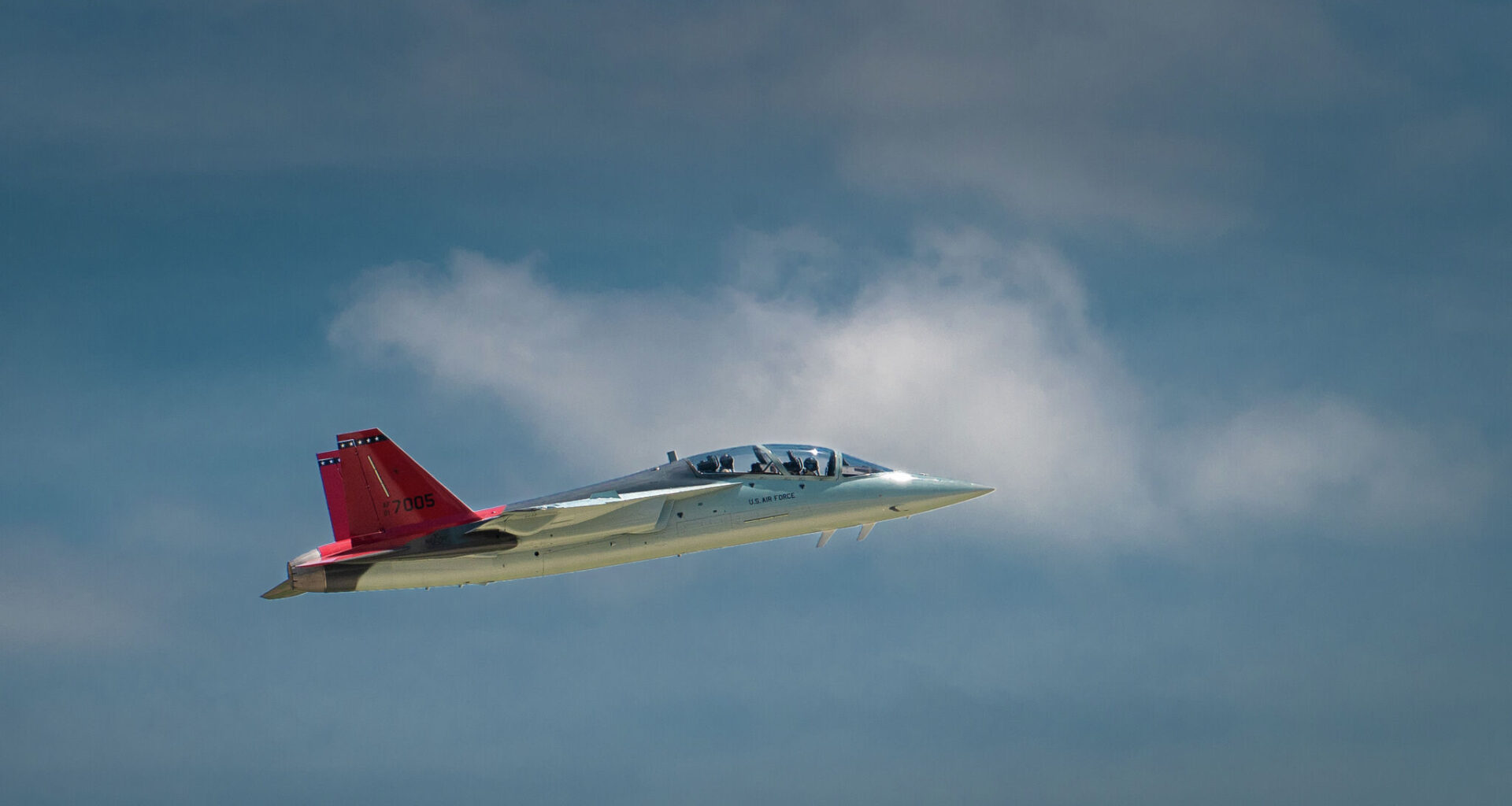
A T-7A Red Hawk takes off from Joint Base San Antonio-Randolph.
Benjamin Faske/U.S. Air Force
A new report about the Pentagon’s costliest weapons programs highlights delays, testing issues and schedule uncertainty in several high-profile Air Force projects that are connected to San Antonio.

The Government Accountability Office’s annual report to Congress found that despite a $2.4 trillion budget for weapons development, the Pentagon “continues to struggle to deliver technologies quickly and within budget,” and that it currently takes more than 12 years to field new systems.
Article continues below this ad
The GAO said the 12-year average is likely to increase without policy changes. It called on the Pentagon to revise its acquisition policies for new capabilities so that programs start with “mature technologies or develop associated immature technologies separately” from the main project.
Included in the review of 104 programs are several underway at Port San Antonio, including Boeing Co.’s work to build two new Air Force Ones and to upgrade the nation’s B-52 bomber fleet.
RELATED:Retrofitted Qatari jet takes flight as Air Force One for Trump’s trip to North Dakota
San Antonio Express News Logo
Make us a Preferred Source on Google to see more of us when you search.
Add Preferred Source
It also assessed Boeing’s T-7 trainer jet program. The new trainers are expected to replace the old T-38 jets that fly from Joint Base San Antonio-Randolph and other Air Force training bases across Texas and the nation.
Article continues below this ad
One of the VC-25s in the Air Force One fleet is seen at Boeing’s Port San Antonio maintenance facility in this 2023 photo.
San Antonio Express-News file photo
VC-25B
While President Donald Trump is now using a gifted-Qatari luxury jet turned temporary Air Force One for some of his travel, Boeing continues its work at the port on two 747-8i planes it’s converting into presidential jets.
The program is at least four years behind schedule and now $2.7 billion over the original deal worth about $4 billion. Costs grew 7% over the last year, according to the GAO.
Article continues below this ad
The jets now are expected to be delivered in mid-2028 and mid-2029, respectively.
READ MORE: Boeing shaves a year off ETA for first Air Force One from San Antonio
Trump’s frustration with the slow progress on those jets led him to order the Pentagon to fix up the Qatari plane now known as the Bridge aircraft since it’s filling in until the new jets are ready.
The GAO found that in addition to delays, the biggest risk to the program is whether the Air Force and Boeing can complete necessary certifications and testing on a tight schedule. Only seven of 80 plans to certify the jets’ airworthiness are complete, according to the GAO.
Article continues below this ad
The Air Force hasn’t said when it will begin testing the new presidential jets.
The GAO did not review the Pentagon’s upgrade of the Qatari jet, which the Air Force has said would cost around $400 million. The actual amount of the makeover hasn’t been released.
Thirteen Democratic senators led by Sen. Chris Murphy, D-Conn., sent a letter this week to Air Force Secretary Troy Meink and L3Harris CEO Christopher Kubasik seeking answers about the hasty upgrade of the Qatari jet.
They want answers on the cost of the project as well as the details about the contract and the “surge of Air Force and L3Harris personnel and resources” to meet Trump’s July 4 deadline to deliver the jet.
Article continues below this ad
“For over a year, the administration has stonewalled congressional requests for information about Qatar’s luxury jet gift to President Trump,” it said. “Congress and the American public have expressed due outrage about this corrupt, illegal exchange, but Pentagon officials have mostly deflected questions or claimed inability to share classified details about the luxury jet, the memorandum of understanding with Qatar, and the program to modify it for use by the president.”
The B-52 that crashed June 15 at Edwards AFB is seen arriving at the California base after a flight from Port San Antonio on Dec. 8.
Courtesy of James West
B-52
Another Boeing project at the port is upgrading the nation’s aging B-52 bomber fleet with new engines and radars that are expected to keep the jets flying into the 2050s.
Article continues below this ad
RELATED: B-52 crash complicates Boeing’s work at Port San Antonio
The nearly $3 billion radar modernization program to replace radars on 76 B-52s is three years behind schedule and nearly 20% over cost. The roughly $229 million overrun identified last year was considered a “significant breach” of the Nunn-McCurdy Act, which requires the Pentagon to notify Congress of increased costs on major weapon systems.
The GAO found costs had increased another 7% over the last year.
Early flight testing began this year, but the program took another hit last month when its test aircraft crashed at Edwards AFB, Calif., killing its eight-person crew. The jet had spent about two years at the port getting the new radar system and was the first of two flight-test aircraft for the program.
Article continues below this ad
The retrofit of the second test jet is still underway, and further flight testing is stalled until work on that bomber is complete.
Two U.S. Air Force B-52H Stratofortress long-range strategic bombers, two F-15E Strike Eagles and two Iraqi Air Force F-16IQ Fighting Falcons fly in formation during a 2025 bomber task force mission over Iraq.
Staff Sgt. Gerald Willis/United States Air Forces Central
A decision on initial production was expected by June, nearly 31 months later than planned, according to the GAO. That decision remains pending.
“Program officials attributed the delays to longer lead time on radars, late deliveries of essential integration lab components, and underestimating kit complexity and installation time,” it said.
Article continues below this ad
The GAO found problems with the program’s software development that it said is “delayed and contributed to cost increases.”
READ MORE: Boeing at Port San Antonio in $2B deal to keep 1950s-era bombers flying
Also at the port, a separate $2 billion program to replace engines on B-52s is two years behind schedule, according to the GAO.
An initial production decision is expected in late 2028, “after two test aircraft are delivered,” the report said.
Article continues below this ad
Also, for both programs, the GAO found that two critical cybersecurity tests will be performed after the production decision, which “is out of line with (Department of Defense) guidance … and increases software risk during production,” the report said.
Air Force Lt. Col. Michael Trott, 99th Flying Training Squadron commander, prepares for a sortie in the cockpit of a T-7A Red Hawk at Joint Base San Antonio-Randolph.
Benjamin Faske/U.S. Air Force
T-7A
The Boeing-Saab T-7A Red Hawk is expected to replace the Air Force’s fleet of 1960s-era T-38C trainers that fly from Randolph and other training bases across Texas and the country.
Article continues below this ad
The first T-7 arrived at Randolph in December, and the Air Force has said some of the jets would be ready for training by August 2027.
Last month, two pilots from the 99th Flying Training Squadron qualified to fly the jet. They’ll help train other instructor pilots.
But despite the progress at Randolph, the $9.8 billion program for 351 jets, 46 simulators and ground-based training systems is two years behind schedule and nearly $1 billion over original cost estimates. The GAO found costs rose 11% in the last year alone.
RELATED: Air Force allows trainer jet back to the sky after 10-day grounding
Article continues below this ad
“Since our last assessment, the T-7A program reported that it is experiencing significant delays in the completion of developmental testing,” the GAO said.
The testing has been slowed by a need for more engineering analysis, a lack of available aircraft due to maintenance personnel and parts issues, and delays in software development. As a result, testing timelines have been pushed back more than a year.
The delays have forced the Air Force to push its decision to start full-rate production by two years, from January 2027 to January 2029, the report shows.
Article continues below this ad
The service said it is using “a phased production start strategy to optimize the programmatic risk of the T-7 against the operational risks of continuing to fly and sustain a 60-year-old T-38C.”
The Air Force recently grounded its fleet of T-38s for 10 days after one of the jets crashed in Alabama.