
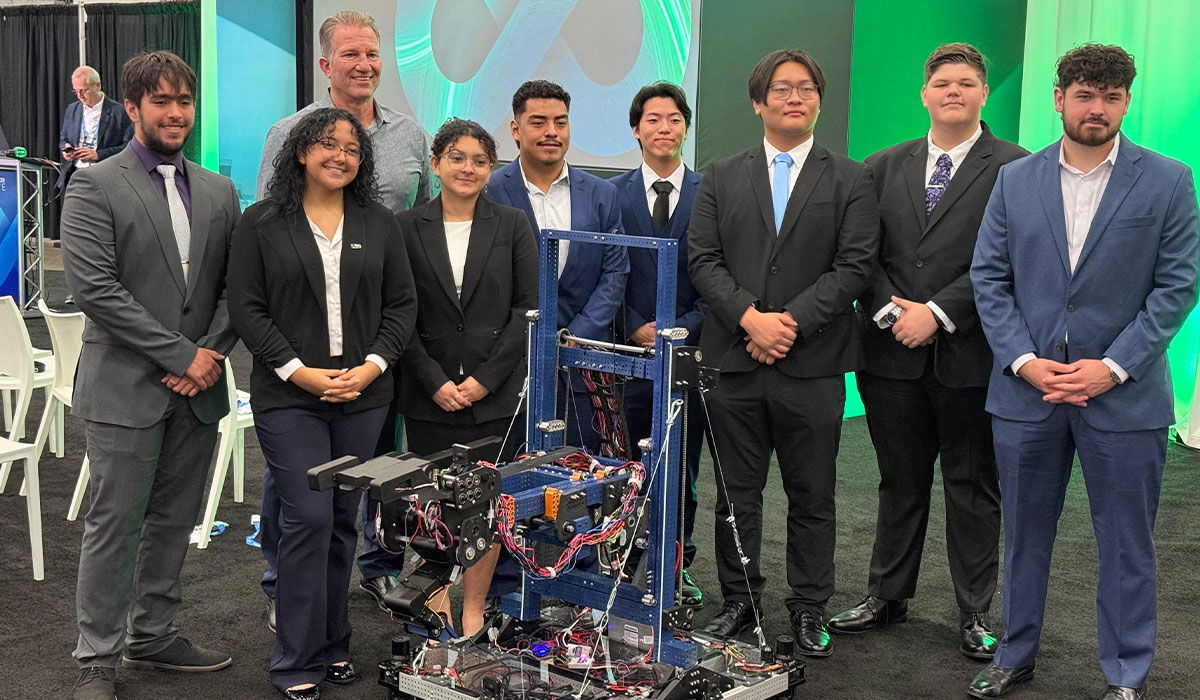
Nine first-year UT San Antonio students are the new champions of the Siemens Immersive Design Challenge. This global engineering competition began with more than 1,900 participants, and after three rounds of competition the all-freshman team stood out from the rest.
Competing as Team 210 Robotics, the students met the competition’s challenge with an innovative sustainability solution that uses immersive engineering—a technique that connects the virtual and physical worlds.
“Placing first in the Siemens global Immersive Design Challenge is more than just an award. It represents the countless hours, dedication, creativity, and the growth our team experienced throughout the challenge,” co-team founder Jacob White said. “This is only the beginning for 210 Robotics, and I couldn’t be prouder of each and every member and for how far we have come!”
The students gave one final presentation to an executive judging panel today, demonstrating their autonomous robotic project, RoboRowdy. The robot aims to improve mid- to large-scale 3D print farms by automating part removal and building plate cleaning and print restarts.
In April, their project earned the team a spot as a finalist in this global competition, a historic feat, as they became the first and only United States university team to reach this level of the competition.
Learn why Team 210 Robotics designed RoboRowdy.
As finalists, the students earned invitations in June to attend the Siemens annual convention in Detroit, MI, Realize LIVE 2026. The event draws global technology companies, giving the students prime exposure to future professional pathways.
“When we first started this challenge, none of us knew what to expect. We had two main goals: to create something we could learn from and something we were ultimately proud of. Looking back today, I can confidently say we shattered both,” co-team founder Israel Elizondo said. “This experience challenged us to grow as students, teammates, and as friends. I am honored to have worked alongside such a passionate and committed group, and we are incredibly grateful to everyone who supported us and helped us turn this idea into reality. Birds Up!”
Founded by White and Elizondo, the team came together in the Honors College’s Guadalupe Hall. Other members of the team include Andrew Romo, Darik Pratt, Jiseo Chon, Dyshana Torres Rivera, Vian Chen, Roman Benavides and Gray Samiengo.
As the undergraduates prepare for next year’s competition, they’re turning this achievement into a foundation for the future by creating a multidisciplinary student organization that will foster collaboration, encourage innovation, and support the next generation of robotics leaders.