
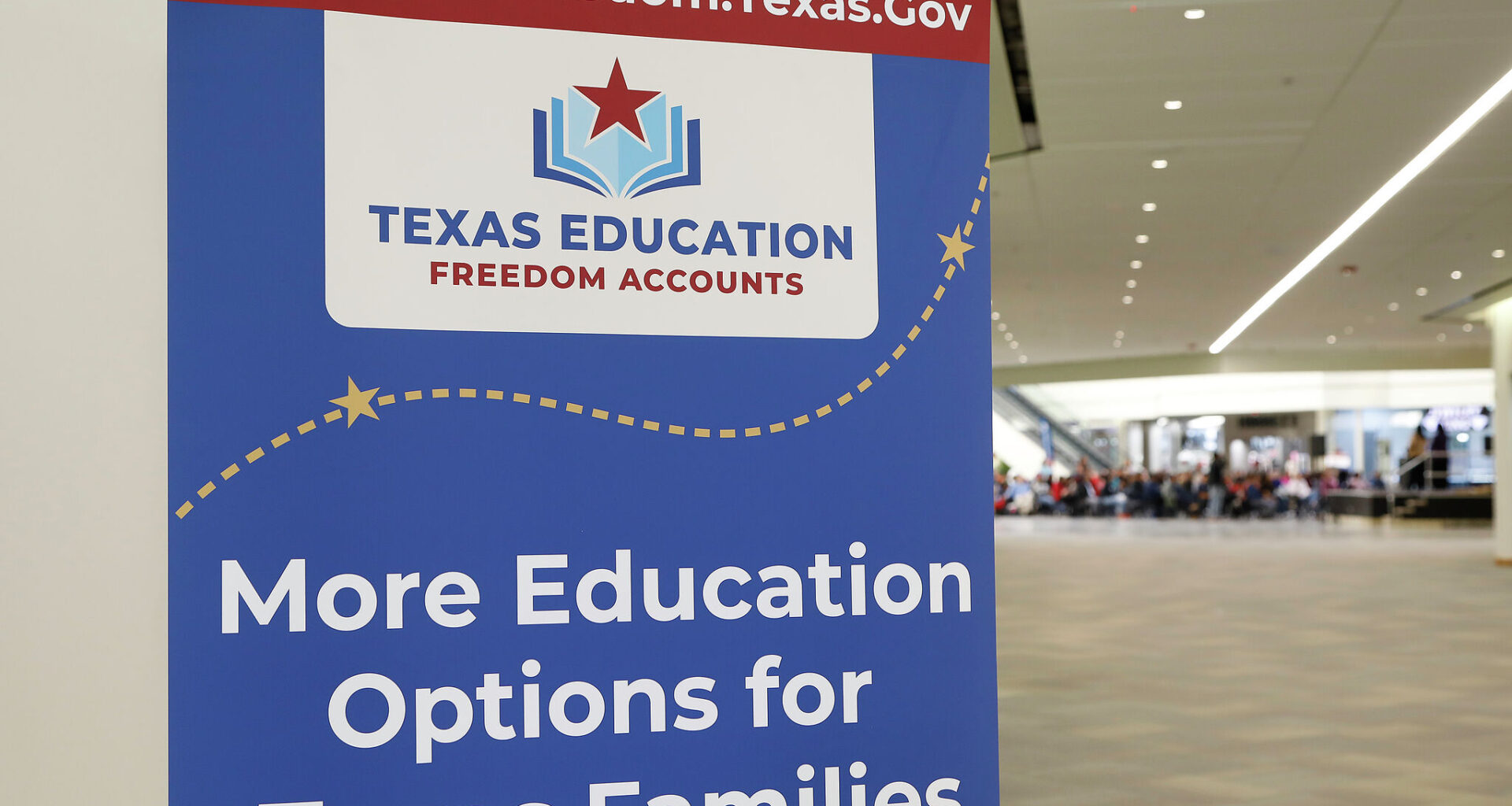
The Texas Comptroller’s office hosted an informational session on the Texas Education Freedom Account program at the Shops at RedBird in Dallas on Feb. 7, 2026.
Stewart F. House/Dallas Morning News
Texas’ $1 billion school choice program offered bold promises for its first year. Preliminary data casts doubt on whether those promises will be fully met, experts say.

The Texas Freedom Education Accounts, which passed in 2025 after years of effort, distributes taxpayer dollars to families looking to put their children in private schools. Students are eligible for $10,474 while disabled students can receive up to $30,000. Homeschool students can get $2,000.
Gov. Greg Abbott touted the program as a way for families to move out of public schools that don’t work for them. Yet, most applicants were already in private schools.
Article continues below this ad
Lawmakers said it would serve children who need the help most. But poorer districts saw fewer applications.
The program said students with disabilities could receive up to $30,000 to meet their needs. But less than 30 students ended up getting that much.
The first year of TEFA has exposed key challenges voucher programs have faced nationwide: insufficient funding for some families to make the move to expensive private schools, difficulties for special education students finding private schools that can support their needs, and minimal benefits for lower-income and rural families.
Article continues below this ad
Out of nearly 275,000 applicants statewide, barely a quarter were enrolled in public schools, with Dallas-Fort Worth-area districts following similar trends. Some non-public school applications came from families with children in pre-K or kindergarten, who might never have been enrolled in public schools.
Experts largely attributed the disparity to the fact that $10,500 is generally not enough to pay for private school. Median private school tuition in Texas is about $9,400, according to the Texas Private School Association, but that often does not include transportation, books and other supplies.
Related: These Dallas private schools serve mostly low-income families. Will TEFA deliver?
“[TEFA] could be a subsidy for a family that can afford that, but it’s not going to make it affordable for a family that is currently receiving free school,” said Meredith Richards, an associate professor of education policy at Southern Methodist University.
Article continues below this ad
TEFA spokesperson Travis Pillow said the program’s goal is not to “lure away” public school students but make private school affordable across the board. Many families with children in private school make major sacrifices to keep them there, Pillow said, and TEFA eases that burden.
Out of 5.45 million public school students in Texas, only about 68,000 even applied for TEFA — barely one percent. Half of those students were awarded funds, as of June 16 records provided to The Dallas Morning News, but more could drop out of the program if they can’t find a school to fit their needs.
Although relatively few students will switch to private schools, experts warn that even a small drop in public school enrollment could tighten the state’s public education budget, as it has in other states.
Related: Why top D-FW private schools are sitting out Texas school choice program
Article continues below this ad
Florida’s voucher program has ballooned to more than $4 billion dollars since it was implemented in 2023, taking up nearly a quarter of the state’s public school fund. In Arizona, which has the country’s oldest universal school choice program, vouchers contributed to a $1.4 billion budget shortfall in 2024.
Southwest Christian Academy (Dallas) representatives Violet Dean (seated center) and David Turner talk with attendees as the Texas Education Freedom Account program hosted a free school fair for Dallas area families at the Erik Jonsson Public Library in Dallas on May 17, 2026.
Steve Hamm/The Dallas Morning News
In Texas, public school districts receive a $6,215 allotment per student from the state, meaning fewer public school students directly translates to less funding.
Richards estimates that a decrease of 1% to 3% of public school students statewide could easily spiral into a public school funding crisis. About 98,000 students will leave public schools for private schools in fiscal year 2030, according to an analysis by the Texas Legislature. That’s about 1.8% of Texas’ public school enrollment last year.
If the state’s public education budget becomes strained, said Daniel DeMatthews, an educational policy professor at the University of Texas at Austin, lower-income and rural districts would likely be hit hardest.
Article continues below this ad
Imagine a small elementary school in a rural district with 25 students per class, DeMatthews said. Each child is worth $10,000 — the basic allotment and then some extra. If one child from each grade migrates to a private school under TEFA, that’s $60,000 gone in state funding.
“That’s a teacher salary that’s no longer there, but do you need one less teacher? No, you still need the same amount of teachers,” DeMatthews said.
Low-income families making less than 200% of the federal poverty level — about $66,000 for a family of four — were second in line to receive TEFA funds, preceded only by special education students.
Although lower-income families made up a majority of the awardees, they were the least likely to apply to the program. The more economically disadvantaged a district was, data from the Texas Education Agency shows, the fewer families from that district applied.
Article continues below this ad
The TEA defines a student as “economically disadvantaged” if they qualify for free or reduced price meals under the National School Lunch and Child Nutrition Program or other public assistance.
Rural districts made up only 11% of applications, while more than half came from large cities and suburbs. Due to privacy law, the state cannot release data for districts with fewer than 30 applicants. As a result, analysis by The News does not include about 5,200 applications from over 540 districts, mostly rural. These account for less than 2% of applications.
DeMatthews said this trend among lower-income, rural communities is common in other states with voucher programs. Oftentimes there are few, if any, private school options in rural areas, and the lower a family’s income, the less likely a $10,474 award will be able to cover private school tuition and other costs. As a result, school voucher programs are often the least accessible to the people they most aim to serve.
Jeremias Malagon (right) listens to a program presentation from a Global Online representative as the Texas Education Freedom Account program hosted a school fair for Dallas area families that have been awarded funds in the voucher-like program that connects with private schools with available seats. The event was designed to connect qualified parents with private schools in the area to meet and discuss possibilities in person at the Erik Jonsson Public Library in Dallas on May 17, 2026.
Steve Hamm/The Dallas Morning News
Pillow acknowledged this gap and said TEFA needs to strengthen its outreach to lower income, rural communities to raise awareness about the program. He anticipates in subsequent years, more private schools serving low- and middle-income communities will pop up, making TEFA viable for more families. For a private school to be eligible for TEFA funds, it must have been open for at least two years.
“Gaps in the marketplace hopefully can be filled by creative educators, the philanthropic community, and other people who want to make sure that these kids have great opportunities,” Pillow said.
In the approval process, TEFA gave top priority to students with disabilities, who can receive up to $30,000. On top of the $10,474 base level funding, TEFA awards additional funding based on a student’s individualized education plan, which details how a school accommodates a child’s needs.
Pillow said the weighted funding system was a “wise move” from the Texas Legislature that takes into account the additional costs to accommodate disabled students, such as therapy.
However, only 20 students across the state received $25,000 to $30,000, which was the maximum funding amount, according to June 23 records provided to The News. Most students received between $10,500 and $20,000, and over 7,000 students with disabilities received the base level funding, which experts agree is not enough.
“Even with $30,000, it’s very unlikely that students with more moderate and severe disabilities are going to be able to find a place they can afford if they’re not already enrolled in a private school,” DeMatthews said.
Pillow told The News that TEFA did its best to communicate to parents that not everyone would receive the full funding amount.
A Houston Chronicle analysis found district size played a big factor in how funds were awarded to special education students. When awarding money, TEFA uses a state funding formula that includes subsidies for smaller districts – students from larger districts receive less funding as a result.
For example, a Dallas ISD student that spends less than 21% of class time in a separate resource room would receive $15,681. But a similar student from Lindsay ISD, a rural district about 80 miles north of D-FW, would get over $20,000.
About 1 in 4 students who were awarded funds are students with disabilities. That number looks good on paper, but experts said just because a family received funding does not mean they will be able to use it. Since private schools do not have to follow the same civil rights regulations as public schools, Richards said, they can deny disabled students admission or refuse to accommodate them.
As a result, DeMatthews expects many students with disabilities will not actually participate in the program despite being awarded funds. Nearly 3,000 people have opted out of the program already, and DeMatthews expects that number to significantly increase as the new school year approaches.
By July 15, families awarded funds must choose which school their child will attend. If they do not meet this deadline, as will likely be the case for many disabled students, they will be cycled out of the program.
Staff writer Jessica Ma contributed to this report.
The DMN Education Lab deepens the coverage and conversation about urgent education issues critical to the future of North Texas.
The DMN Education Lab is a community-funded journalism initiative, with support from Bobby and Lottye Lyle, Communities Foundation of Texas, The Dallas Foundation, Dallas Regional Chamber, Deedie Rose, Garrett and Cecilia Boone, Judy and Jim Gibbs, The Meadows Foundation, The Murrell Foundation, Ron Steinhart, Solutions Journalism Network, Southern Methodist University, Sydney Smith Hicks, and the University of Texas at Dallas. The Dallas Morning News retains full editorial control of the Education Lab’s journalism.