
TEXAS — Texas deposited the first of the funding for nearly 73,000 educational savings accounts (ESA) that will provide money for families to send their children to private school or homeschool.
At the same time, a marketplace opened up, giving parents an idea of what they could buy with the money.
“Definitely a few glitches to work out, but hopefully it’s going to get better,” said Catherine Douglas, whose son received an ESA. “It’s been hard. I’m a single mom. I work part time because I’m homeschooling. … We were approved at Tier 1, and I was just so thankful.”
Spectrum News reached out to families like the Douglas’ who got accepted.
“It just so happens that my oldest has special needs and homeschooling just turned out to be really the best thing for him,” said Douglas.
All three families Spectrum News spoke with said the same thing: public school just wasn’t the right fit, including Sarah Smith Vasquez in Amarillo.
“As much as I love his school, the teacher to student ratio has just been holding him back because the teachers have said he’s fine when he’s in a small groups,” said Vasquez.
Carol Caron in Fort Worth also received funding for her daughter, who was already enrolled in a private school.
“Since moving her to this other school, and of course we were doing some tutoring alongside that, she’s been made really great progress,” Caron.
Caron and Vasquez both have students with special needs as well. They’re opting for private school next year.
“I’m going to spend what we have on tuition and uniforms,” said Vasquez.
They both received around $17,000, which pretty much just covers tuition for them.
“It would be nice if this covered tuition, and families like mine had some extra money to offset the transportation and mileage costs,” said Caron.
Since Douglas is homeschooling, she is shopping from the state’s new marketplace with her $2,000.
“That means you can only spend $200 dollars on something electronic, so it’s pretty hard to find a computer or a printer or something like that that you’re going to be using in your homeschooling for less than $200 and that’s the cap for the whole year,” said Douglas. “You also have to look at the other side of it because you don’t want people to take advantage.”
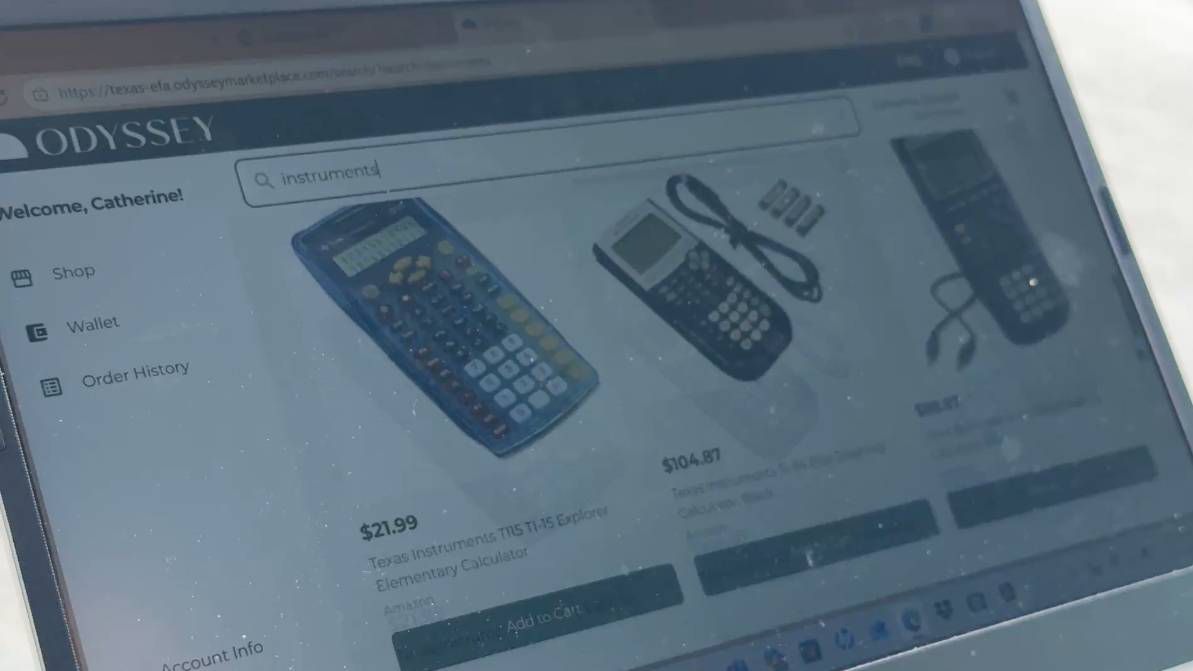
She showed Spectrum News what the portal looks like.
It has a search by vendor, price, category or item option for state-approved expenses, like books, instruments, calculators and Legos.
Legos being included in the approved expenses has been “controversial,” Douglas said. She got some pushback from other parents online when she posted her interest in buying Legos.
“It didn’t even cross my mind that people would think that that’s an item that shouldn’t be eligible,” she said.
Legos are on her list to help her son’s motor skills, which she hopes will build up her son’s education.
“We do have our curriculum kind of already, but it was the little extra things that I just wasn’t able to be able to provide for them financially, so this program that’s kind of why I enrolled is that I thought this program opens up more opportunities for them and more enrichment into our homeschooling,” said Douglas.
According to the state, 54,000 products are on the marketplace from about 2,400 vendors, and the state will audit it to make sure funds are tracked.
Private school students only received the first 25% of their funding this month. The state is breaking up the payments throughout the year. Another 25% comes in October, and the rest arrives in February.
Private school families have less than a week to select their school.
This week, an additional 5,499 families who were on the waitlist received funding after students opted out of the program or decided to go to homeschool instead of private school.
Altogether, nearly 107,000 students have been added to the program so far.