
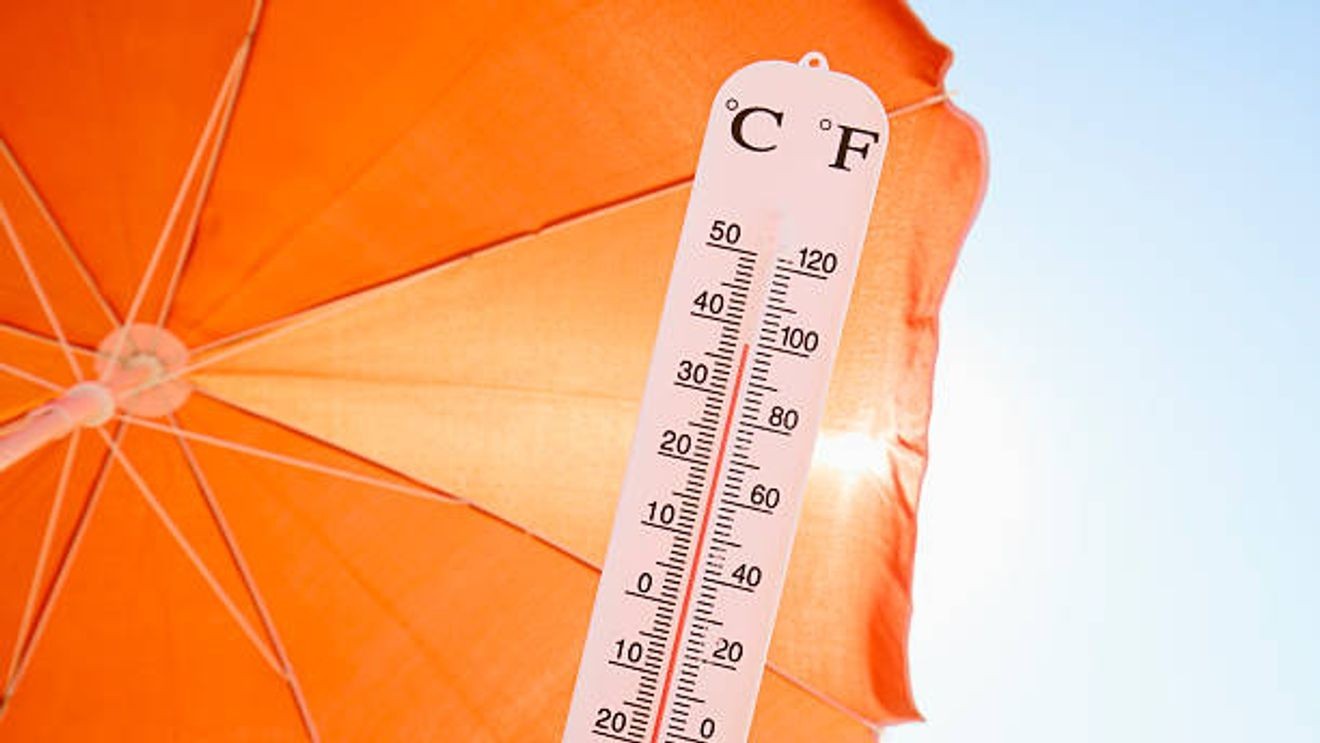
AUSTIN, TEXAS — Austin officially hit the century mark this July, hitting 100 degrees on the 8th of July. We usually expect to hit triple digits in the summertime in Central Texas, but isn’t it a little late to just now be hitting 100? How weird is it, and is it a sign of a mild summer? Is the world ending? Let’s tackle these questions. First, let’s go over some climatology.
In the past 25 years, 18 of those years had us hitting triple digits in May or June, with 2025 recording the third earliest 100-degree day in Austin’s history on May 13, when we hit 101 degrees two days in a row. The earliest 100-degree days before this were May 4, 1984, and May 7, 1998. But this year in 2026, we’re running a little behind. In fact, in previous years, a trend was materializing that our first triple-digit day would arrive earlier and earlier. With just the past 5 years occurring in May or June.
It’s not entirely unheard of for our first 100-degree day of the year to occur in July or possibly even later. There were actually 11 individual years in Austin’s history where we never even hit the century mark, with the highest temperature 1907 ever saw being just 96. However, the most recent time that happened was 1979. The latest 100-degree day was October 13, 2024, but in 1938, on the 2nd of October, the first and only day of triple digits was recorded at 100 degrees.
Is it normal to only hit triple digits in the first week or two of July? Technically, yes. But as I mentioned before: in the past 25 years, 18 had us hitting triple digits in May or June. But prior to 2000, it was pretty normal for the first 100-degree days to fall in July, or even in August or September. So, does this mean that we are getting hotter earlier every year?
ALSO| Fire engulfs abandoned building in Southeast Austin, spreads into surrounding brush
Not necessarily. In terms of correlation between El Niño and La Niña, there is a surprisingly small amount of crossover. La Niña usually leads to drier weather and hotter weather in Central Texas, while El Niño typically means cooler air and rainier weather. But these are just trends – not official forecasts. One of the hottest June days on record occurred right on the heels of a departing El Niño – one of the strongest we’ve ever seen. La Niña also resulted in 2025’s 101-degree days in May. The summer months typically don’t get affected too much by the trends, besides a slight likelihood of fluctuations in precipitation in most cases, but extremes can still occur.
The most concerning part of all this is the number of times we’ve hit 100 degrees early since 2000. Which is, as I’ve said before: 18 times. Compare that to the 40-year period between 1960 and 2000. Only 10 times did we ever hit 100 degrees in May or June during those years. That difference is no correlation to El Niño or La Niña, or small fluctuations in weather. In around 25 years, we have had 18 years with early triple-digit days, while during a much longer 40-year period in the 20th century there were only 10 years. That’s 72% of years since 2000 and 25% in 1960-2000.
This doesn’t mean we get hot every year; it just means that it is very likely to be the case. This year, we had a very fortunate set of circumstances nearly every week. High pressure stayed to our west, tropical moisture, southeasterly winds to introduce clouds, sea breeze showers and storms, high soil moisture content, or some niche ingredient to always keep us out of the triple digits. But is it likely we will see more than 100-degree days in May, June, or even April? Absolutely. We just have to track the forecast daily to see what niche forecast could keep us in the 90s or send us over the edge and dip into the sweltering Texas heat of 100 degrees or more.