
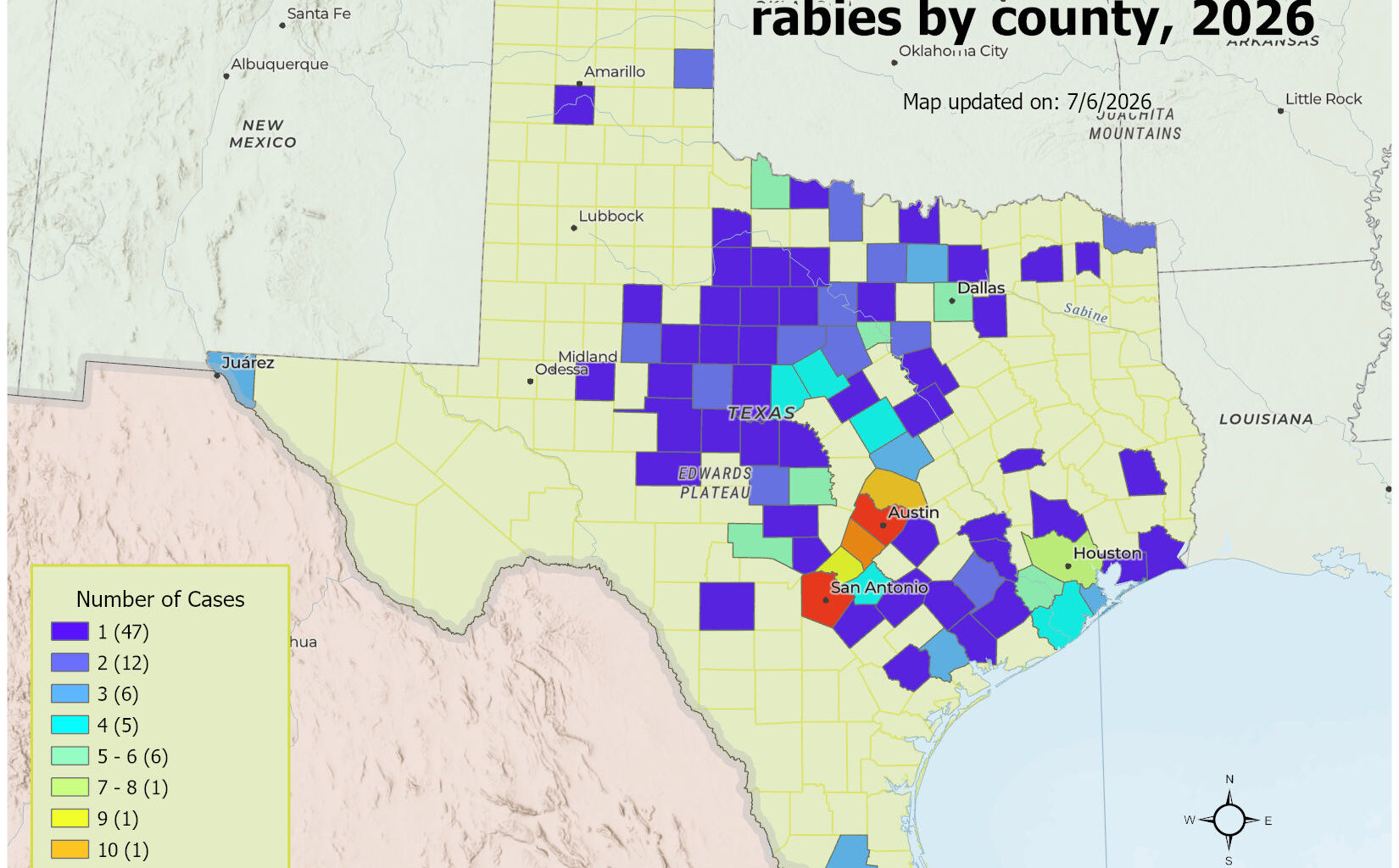
Bexar County is tied for the highest number of laboratory-confirmed rabies cases in Texas this year, according to updated maps released by the Texas Department of State Health Services.
The maps, updated July 6, place Bexar County in the highest case category, with 17 to 33 confirmed rabies cases in 2026. Only one other Texas county falls into the same category.
Rabies is a viral disease that attacks the brain and central nervous system. Although it is almost always fatal once symptoms develop, health officials emphasize that prompt treatment after an exposure can prevent infection.
Another statewide map shows a concentration of laboratory-confirmed rabies cases around San Antonio, with Bexar County among the areas reporting the highest number of cases this year.
Although the county map groups cases into ranges rather than exact totals, Bexar County has previously confirmed at least 18 rabies cases this year. County officials have issued several public health advisories in recent months after infected foxes, skunks and other animals tested positive for the virus.
Across Texas, bats account for the highest number of laboratory-confirmed rabies cases in 2026, with 90 confirmed infections. Skunks follow with 87 cases, while raccoons account for 25.
The state has also confirmed rabies this year in:
• 20 foxes
• 14 cats
• Two cows
• One dog
• One goat
• One horse
• One coyote
Bexar County officials say animals infected with rabies can display a wide range of symptoms, including sudden changes in behavior or movement. Warning signs include:
• Changes in behavior: A normally friendly dog or cat may suddenly become aggressive and bite without provocation, or become unusually shy and withdrawn. Wild animals, such as skunks, may also lose their fear of people and be seen active during the day.
• Unexplained paralysis: Rabies often causes paralysis in the rear legs or lower jaw, making an animal appear unable to walk or look as though it is intoxicated.
• Refusing to eat.
• Pawing at the mouth.
• Difficulty swallowing.
• Seizures.
• Eating unusual or non-food objects.
• Appearing to choke.
• Chewing at the site of a bite wound.
• Increased sensitivity to touch or sound.
Officials caution that not every animal displaying these symptoms has rabies, but any animal acting abnormally should be avoided and reported to authorities.
According to Bexar County, bats, skunks, raccoons, coyotes and foxes are the wildlife species most commonly associated with rabies. Officials advise residents never to approach, touch or handle these animals, especially if they appear sick or behave unusually.
If you are bitten, scratched or otherwise have broken skin after contact with an animal, officials recommend immediately washing the wound with soap and water. Residents should then seek medical attention as soon as possible and report the incident to Animal Care Services, the Bexar County Sheriff’s Office or 911. Prompt treatment after a potential rabies exposure can prevent the disease from developing.