
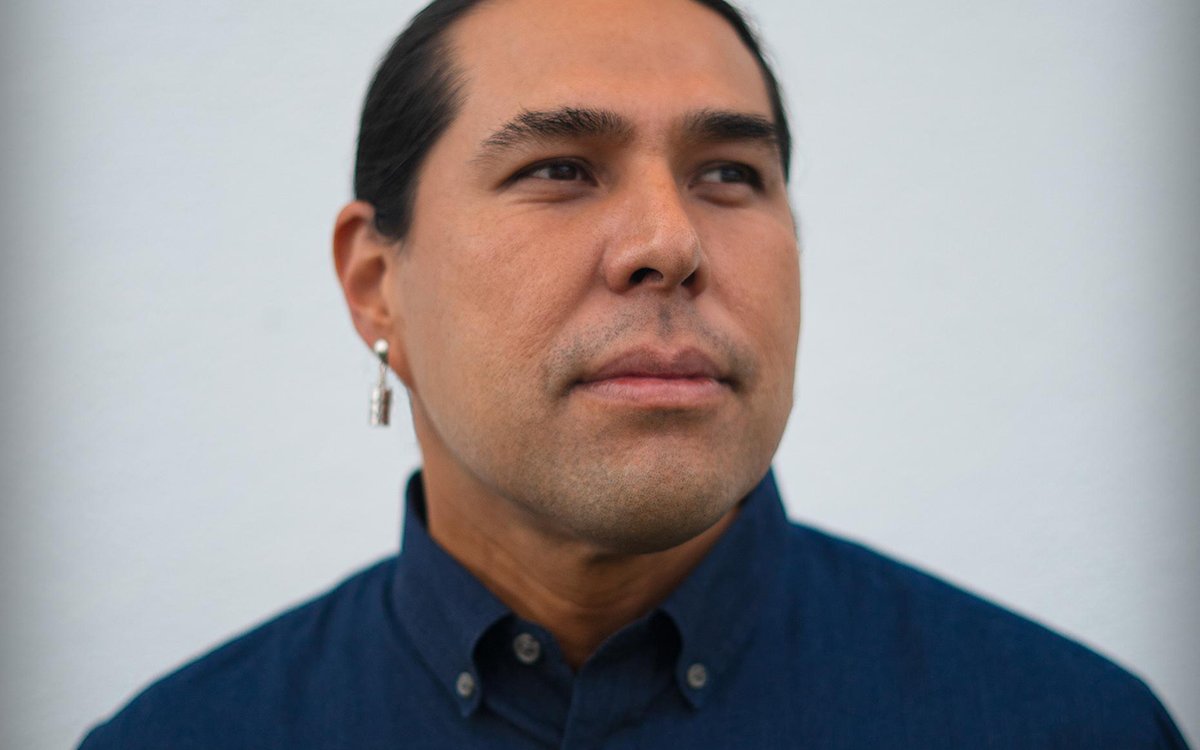
This summer’s Walker Art Center movie series is being curated by Dallas Goldtooth, the Native American environmental activist and performing artist. The series is titled Once Upon a Time in Manhood, and promises to revisit the cinema of Goldtooth’s youth, when he was growing up on the south side of Minneapolis and in Bemidji, renting Predator and Terminator on VHS from the Hollywood Video for movie nights with his dad and stepbro. The series promises to ask, “What did we inherit from these representations and what did we decide to leave behind?” It kicks off with a screening of Ron Howard’s Willow tonight, followed by Michael Mann’s Last of the Mohicans on Saturday night. Later this month, there will be screenings of Die Hard, The Shawshank Redemption, and Fight Club, and it concludes with Taika Waititi’s 2010 coming-of-age film Boy, set in 1983 New Zealand.
I reached Goldtooth at his home in Chicago. “I miss Minnesota, man, but this is a nice little town,” he says. “It’s right in the middle, so it’s a good home base, but funnily enough, I’ve never booked a Chicago acting gig. I should rent a firefighter costume.”
Goldtooth is a co-founding member of the 1491s, a Native sketch comedy group that includes his Native brothers from another mother, the Seminole filmmaker Sterlin Harjo, and Goldtooth’s actual stepbrother, the Ojibwe writer and producer Migizi Personeau. Goldtooth is probably most recognized for William “Spirit” Knifeman, his character from Harjo’s critically acclaimed television show, Reservation Dogs. He’ll be back home to attend the opening weekend’s screenings, where he’ll be giving a short opening presentation.
When you got the assignment, did you immediately want to do a series about cultural role models for men?
When they asked me, they left it open-ended. I’ll be honest, my first thought was, It’s the Walker Art Center—I got to be fancy schmancy here, I gotta step up the refined culture aspect. So as a Native person, I was thinking about a series of films around the concepts of comedy and transnational migration. I would’ve included Born in East LA with Cheech and Chong. The concept was like high-level. I [told them], “I might do something around migration.” And they were like, “Cool, cool, come up with your list and send it to us in a week.” And then in that week, I was like, I’m not really vibing with that, man. I wanted to show movies that would be fun to watch in a movie theater—some movies that I never got a chance to see in a movie theater. That made me think of the ’90s. And I’ve been on this path of talking about like masculinity. And I reference shitty movies all the time. I’m a kid born in the ’80s, raised in the late ’80s and ’90s, all that pop culture is just floating in my brain.
You’re in your mid-40s now, right?
Yeah. Me and my brother, Migizi—who’s planning to be there opening night—we always had a dream about being in the movie industry, making movies. He moved to LA, he just finished being a writer and producer on the Aliens TV reboot. He’s been killing it. Growing up, we just loved movies. We had different moms, same dad. When my dad divorced from both the moms, we would go spend time with my dad, and you know, it’s a single dad with his kids—he’d take us to the movie theaters or we would go to the rental spot. This was up in Bemidji. He introduced us to all these movies that we shouldn’t have seen, like Hellraiser.
Dad movie nights are fun, man.
Dad movie nights are really in many ways the origin of this film series. Like he introduced us to all these pop culture films, but also really thought-provoking stuff. I remember the rule was, for every movie we picked, he would pick a movie.
Ah, so dad had a dad movie night pedagogy!
Yes, he did. He would get international films, he would get documentaries. There was one really influential film for me: It’s really fucking obscure, and I have not watched it since. It was called Heart of Light. It’s a Greenlander film. And it’s a really interesting story about this guy who’s an alcoholic and he’s kind of living a shit life in Greenland. And he’s just like, You know what? Fuck it. I’m just gonna go out into the wild and die. Then he has this vision and he basically turns his life around. My dad also introduced us to Dune—the film, but also the books. He’s like, “If you’re going to watch the movie, you got to read the books.”
It makes sense that your dad, Tom B.K. Goldtooth, would recommend Dune, because he is an environmental activist with roots in the Southwest. What was your dad doing at this time in the 90s?
Man, I should have picked Dune. Damn it, that would have been a good movie!
True.
The problem is, they only gave me, like five, maybe six movies. Now I’m like, oh, dude, I should have picked Heat.
Heat is always incredible on the big screen and there’s all this Heat 2 casting news, but you are giving us Val Kilmer in Willow.
So my dad currently is the executive director for an organization called the Indigenous Environmental Network. 1992 is when he came on as the director of this environmental organization. Before that, in the late ’80s, he was the environmental director for the Red Lake Nation up in Northern Minnesota. And before that we lived in south side, Minneapolis, and he had a construction company. And for a minute there, he was the director of the Indian center in St. Paul.
That’s what he originally came to the Twin Cities for?
Yeah. My mom is from Lower Sioux Indian Rez in southwest Minnesota. After they divorced, he moved to the cities. Then he met Migizi’s mom, and she’s from Red Lake. So he stayed around for the kids, and moved up north, and we were immersed in all these movies in rural Minnesota.
So Bemidji had a cool rental spot?
They had two rental spots. One was small and the other one was a Hollywood Video. It’s not there anymore, of course. But yeah, Bemidji was big enough that where they had some obscure foreign films that they would get in every now and then.
It is a college town.
Definitely. I think that market played a big part into it. So me and my brother would go stay at his mom’s house and we would just sit in the basement and watch movies. And when we weren’t watching movies, we were quoting movies. I remember my dad would take us to these environmental conferences in like rural Montana. We’re young, we don’t care about the conference there, so to pass the time, my brother and I would challenge each other to reenact the entire script of Pulp Fiction. Same thing for The Princess Bride. I remember we would do whole scenes from memory, just talking back and forth. That’s how immersed we were. So I felt like this series was a great opportunity for me to explore that. The challenge is that some people just want to go watch Die Hard—they may not get the reason for it. So I’m going to be recording some introduction videos for each screening, just giving a breakdown.
I’d like to do some re-examining with an intentionality: I’m going back as me right now to look back and enjoy this, but also to have a conversation with the material. How did it help me get to where I’m at now? A lot of what we were taught in the ’90s came from these action films—they were the pinnacle of like machismo, right? We picture Arnold Schwarzenegger or Stallone. And that’s what [that era] is known for, and obviously it’s real, this hyper-masculine identity that’s been a part of this country for generations and generations. But in the ’90s, there were other kinds of depictions of masculinity as well, and that’s where I kind of wanted to venture into. Like Die Hard, hugely influential, right? He was a leading man, but he wasn’t like The Rock big or anything, but he had the attitude. And Shawshank Redemption, for lack of a better word, the softness of it. Andy Dufresne is a soft-ass dude in a hard-ass place. And the humanity of the inmates—its monsters are the prison guards and the warden. And Morgan Freeman as the narrator also brings such a depth—he actually admits to the crime that he did.
The only prisoner to admit it.
Yeah, and the way he observes Andy’s journey and his influence on everyone, and just the acknowledgement that you don’t lose your humanity in all of this. And Willow was like a major influence on me: this idea of like fantasy world building. But you had Madmartigan, played by Val Kilmer, who’s not even the lead character, it’s Willow. And they could’ve beefed up Madmartigan, but they didn’t. Which I think is wonderful.
Do you remember where you first saw it?
I think it was on VHS. I remember watching it with the little tracking thing across the screen. So even though the main content of this series is about ’80s and ’90s portrayals of masculinity, there was no question in my mind that I wanted to end the series with Taika Waititi’s film Boy.
I just watched it for the first time. It is a classic from the first five minutes. Its tone is perfect, it’s beautifully shot, and the kid actor crushes. And then when Taika shows up 10 minutes in, obviously playing his own dad, it gets at this idea of like how cool dads can be, even while they’re problematic and growing up at the same time. It’s a heavy movie, but it’s done in this really light, ironic tone. So is it a comedy to you?
I think it is a comedy, but it’s an Indigenous comedy where it carries all of that pain, like all of that unresolved anger, but with a lot of levity to it. It carries it in such a way that you just process it a lot better. And the ’80s timeframe it was set in felt appropriate for the series. As somebody who grew up in the ’80s and ’90s, reflecting on the pop culture media in which we as Native people were absent from. But we tried our best to put ourselves into it, right? So Boy is doing Michael Jackson moves and he’s making them his own. We did the same thing. We watched films where we’re absent from the entire dialogue. So where and how do we find ourselves in it? Dude, I remember growing up and realizing it wasn’t just me, but a lot of Native folks, we would just make up Native characters and claim them.
Haha, okay.
Joseph Gordon-Levitt, most of his young stuff, especially in the Third Rock of the Sun, he was Native, man. I was like, That kid’s at least part Native. I see him. Tommy, who played the Green Ranger in the Power Rangers, like I made him Native. I was like, Dude, he’s got the braid, he’s mysterious, he’s Native.
Incredible.
We find those moments. Like Billy, the dude from Predator. Remember the fucking Native dude? He’s supposed to be like Native presenting, but he doesn’t ever say it. But I’m like “Oh he’s Native!” It’s because we didn’t have nothing else. So we would just like pull these folks out that feel like they could somehow embody our experience. And that was just a part of growing up at the time. Now we have more films, more shows that are representative of our experience as Native people, and that’s really great, and that’s why I feel like Boy is a great package for all of that.
You’re opening this weekend with Michael Mann’s The Last of the Mohicans.
To be honest, because like I’m Native, I had to do at least one Native thing. I didn’t want to do Dancing with Wolves. There was another film I was actually on the fence about: Pow Wow Highway.
I love Pow Wow Highway.
I was really considering Pow Wow Highway, and this might be pretty shallow, but what really swayed me was being able to watch the final 15 minutes of Last of the Mohicans on the big screen with a massive sound system. The ending sequence is amazing.
Yeah.
You would think I’m drawn to it that because of all the Native characters, but I’m not. It’s a great film. But Daniel Day-Lewis was never interesting to me. He’s an amazing actor, but growing up, his character was not my interest. I didn’t watch it for Danny Day-Lewis’ heroics.
In the books Natty Bumppo has magical shooting powers. He can kill a deer from a mile away. He’s the original Hawkeye—the inspiration for the Marvel hero.
And he’s not even Native in the books, right? He was raised by the Indians.
Yeah, he was a white magical shooter guy who was raised by Natives.
My interest was always the side characters: Wes Studi’s character, Magua, the bad guy, that was the attraction for me. As a young Native guy, I was like, Dude, he’s badass. And is he wrong? You know, for taking different sides?
He’s got the right motivation! He’s pissed.
I guess the commentary I would like to provide for folks who go to see the films in this series, is to recognize who gets uplifted, who’s put in front in the narrative and who gets put to the sidelines. And the front narrative is like the peacemaker half-breed, which is such a classic archetype in Native films. But I think that it does tap into a story that you don’t get to hear much, right? The time of the French and Indian War.
Like the 1750s.
Most people don’t know about that time in history. And I think it does do some justice explaining how Native people’s allegiances were divided between the French and the British. It’s very complex. And watching it now, I remember my dad talking about it. He was like, “Just so you know, the Mohicans are still here.” The Mohicans are in Wisconsin, they’re folks who were relocated out here. So the closing image of like the vanishing, last-of-our-kind thing is super ironic from my perspective. We’re still here, but it plays well into the national mythology of America.
I guess I have to acknowledge my dad. He’d have us watch almost anything, but then he would also provide commentary of like, Hey, let’s watch this film, but just so you know, this film has problems and I have these issues with it. And that influenced me. The Last of the Mohicans was one of the first ones where I recognized, Oh, they don’t really care about the Native side—this is just a chance to talk about the white savior.
Your dad was hip to that stuff.
Yeah, he was. I remember he didn’t let us watch Pocahontas, the Disney film. As kids, you know, it was a big thing. But he was like, “No, you’re not going to watch that.” And he told us the real story: Pocahontas was like 13, and John Smith was a grown-ass man. So he was conscientious when it comes to Native stuff—”Let’s have a conversation about it.”
Did Russell Means mean anything to you when you saw him in Last of the Mohicans?
It’s funny because he showed up in my life in different ways. I grew up on the south side of Minneapolis, so the American Indian Movement was very much part of my life as a kid. My mom was a part of AIM. So Dennis Banks, Clyde Bellecourt, those are two heavy hitters from Minneapolis in the history of the American Indian Movement. So I just I knew some of them as dudes in the community, right? But Russell Means, I never knew because he’s from the Southwest, but I know his kids, I know his family. That’s the fun part, I know all their kids because we all kind of grew up with the same experience: Dads who are part of the movement who may not be the best dads, but they’re great movement leaders and they’re doing their best to provide good examples.
So Russell Means represented that class of men that, a lot of times, take themselves too serious, who are like eloquent speakers, but also are just dysfunctional in other ways, right? There’s a long history of American Indian Movement men who are womanizers—this ideology of, We’re bringing back the red nation, so we got to have as many kids as possible. So it’s a big part of our conversations as comedians and writers now. I was like, what did that do to us? There’s a lot of folks in their 40s now, where we’re finding new siblings. It’s like, “Oh, I’m going to go meet my brother.” “Oh, I just met mine like five years ago.” And someone else is like, “Well, me too, man.” And it’s such a common story, you’re discovering new siblings in the world. And so I think that that fed into a lot of the work that we did as 1491s.
Your dad was such a prominent activist, rebel, organizer. And he was obviously giving you fatherly movie insight as well. But did you ever rebel against that? Were there times when you were making fun of dad or was he a hero kind of god in your eyes?
Oh no, I definitely made fun of my dad. He’s definitely a part of it: His long-windedness and his perspective of things. There are parts of my character William Knife Man on Reservation Dogs, that I took from my dad. The far-fetched storytelling, that’s something my dad would often employ when we were younger.
You know, I think both my parents, my mom and my dad, I give them a lot of credit because they are two individuals who were never afraid to acknowledge their flaws to us as kids. I remember we were talking about astrology one time. And he’s like, “I believe in this astrology chart stuff—I’m a Leo, and Leos are prideful.” I was like 17 when he was talking to me about this. He was like, “That’s been my greatest struggle in life, my own pride. And it’s jammed me up so many times. And I’ve had to really work on checking myself. And sometimes you’ll see me do something, and I’m not proud of it because my pride takes over and I’m trying my best.” And I think back and I was like, that’s fucking amazing. So I think that’s also where my curiosity and my willingness to explore all of this, even in my own life, it comes from the example they set.
So many of the sketches from your comedy troupe, the 1491s, are about fathers and grandpas and uncles. There’s a men’s group sketch and another one where you’re giving absurd advice to a baby about how a man should be. So much of your material is unpacking masculinity. Did you realize that at the time?
In comedy, you pull from your life experiences. And comedy is also a method to expose and process the contradictions of life. And there’s nothing more contradictory and dysfunctional than men. There’s so much comedy in the shit we do as men. And the 1491s was like five of us guys. And so we always teased men—teased my uncles and cousins and also ourselves, whether it was our videos on YouTube or the stuff that we put on stage, and then eventually we ended up with the show Reservation Dogs. My brother Sterlin Harjo got the show and brought us on as a creative team, as writers. And we took stuff that we built in the YouTube skits, as well as stuff that we built on stage, and we brought it into the show to continue that conversation around masculinity. And I think people really resonated with that. Like a lot of stuff that they see, they’re like, “Oh shit, that’s real, man. That’s how my uncles are and that’s how we are. That’s funny.”
There’s a scene in Reservation Dogs, first episode of season 2, called “The Curse.” The kids feel like they’re cursed, so they have to find a way to break the curse. And so they go to one of the uncles who tells them, “You got to take this object and take it to the river and wash it away.” They go and get that, and by the end, Gary Farmer and West Studi end up at the river, and they have essentially a prayer off. That came a 1491’s sketch based on a real life experience that I had. We have a thing in our community is called Sweat Lodge. It’s a ceremony where you’re in the dark, and it’s basically like a sauna. And when I was 17-ish, I was in this sweat between two men. And everyone had to go around and do a prayer. So one guy starts off his prayer and he’s like, “You know, I’m having a hard time and I just want to pray for my ex and my kids. And she’s in this new relationship and I just want to pray that her and the kids are okay.”
And I’m fucking 17, and I’m scared. I’m like, “Skip.” And then the guy next to me goes, “Creator, I want to pray. My wife just got out of a relationship and I just want to let the people know she’s taken care of in that good way. And the only thing that we get stressed out about is that her ex doesn’t pay his child support. We’re just trying to make sure we can pay our bills.”
So the guy before me picks up and says, “Creator, I want to just add on to my prayer that I’m doing my best and I can’t pay my child support because I’m in between jobs right now.” And it turns out they’re talking about the same woman.
Same gal!
The guy on my left is going out with the guy on my right’s ex. And oh my, it was just so awkward and beautiful that they had this passive aggressive argument in a prayer. They didn’t talk to each other, they talked to God. And that prayer off became a sketch that we developed that ended up in Reservation Dogs.
You did get to work with The Last of the Mohicans Wes Studi on Reservation Dogs. He’s such a scary guy in Last of the Mohicans, and so sweet in Reservation Dogs.
He’s such a loving man, Wes Studi. He’s so giving, so loving as an actor. Knowing the roles that he’s had, you’d think that he’d be a certain way, but he’s so giving. And he’s a stage actor at heart. Like he loves collaboration and sharing the space.
A moment of pride that will stick with me for the rest of my life, is in Reservation Dogs in “The Curse” episode, which I wrote. [My character], the spirit, William Knife Man, shows up. And I can only communicate to Gary Farmer—that’s the bit, only Gary Farmer can see me. And when they finish their prayer, they send the curse off into the water, and everyone’s celebrating. And a lot of it got cut from the final sequence, but I close off by singing, Tom Petty’s “Free Falling.” But before that, I recited a litany of movie quotes from every Native movie I could think of. I’m like, “My name is Wind in his Hair, and I’m not afraid of you!” from Dancing with Wolves. I did the character from Predator: “Whatever is out there ain’t no man.” I did everything: I did Wes Studi in Smoke Signals. I did Gary Farmer in Pow Wow Highway and Dead Man. And Sterlin Harjo, who was directing it, he just let me go. I did take after take after take, with all these different movie quotes. Just all the junk in my head, I spewed it out, on horseback, half naked. And Wes Studi and Gary Farmer are way down below in the river, and I could see them kind of reacting and chuckling or whatever.
And then we finished the scene and it’s time to get in the van. And Wes Studi and Gary Farmer are already in the van when I get in there. And we start driving off and Wes is in front of me, and Gary’s behind me. And I can see Wes’s shoulders are shaking. He’s chuckling. He turns around, and he’s like, “I tell you what, young blood, that was one of the funniest things I’d ever seen. That was absolutely brilliant. How did you remember all those quotes?” And I was like, “Uncle, man, that’s the legacy you have given us. All those movies are locked into us.” And Gary Farmer in the back is like, “No shit, huh?”
Haha.
The way he said it was just so anticlimatic. He was like, “No shit huh—that’s pretty cool.” And Wes Studi was like, “Well that was mighty fine—you guys want to get some lunch?” I was like, “Alright, let’s go get some fajitas.”
So your 1491 stuff was obviously created for a Native audience. But when you’re making Reservation Dogs it’s for millions of people. Do you ever find yourself pulling your punches as your platform grows larger and larger?
Oh shit, that’s a good question, man. Yes and no. I think as an artist, I don’t want to be hampered by my own insecurities. And actually, it’s the insecurities that’s driving me to create in many ways. Because our films, our videos, our writing is an open dialogue with how we see the world. Especially in the 1491s, there’s an open dialogue about who we are as Native people—who we have been and who we are. And how do outside people see us? And in order to fully explore that, you have to dive into uncomfortable places. So yes, I’m more cognizant of what I say and what I do because there’s more non-Native people watching, right? There are like inside jokes. I do try to be careful with how I present this because outside folks could have their stereotypes reinforced. And at the end of the day, I want to challenge and break down stereotypes for the greater goal of finding our humanity in all of us.
I have a story. The 1491s were doing a talk at the University of South Dakota Vermilion. We’re showing our videos, and we’d talk about them. And so we showed one of our earliest videos. I don’t know if it’s online anymore, but it’s a video in which I portray a veteran. The crowd is half Native, half non-Native. And after the screening, this Native guy stands up in the crowd, and he’s a veteran, and he’s like “I just want to say, it’s never funny to make fun of veterans. And you’re making fun of us.” He’s checking us, right? So all of our heads droop down and we’re getting this tongue lashing. And he was like, “There’s nothing funny in who we are as people.” We put the checks out there and the checks are getting cashed right now—like this is what we’re to expect. And then he sat down. And then, after a public tongue lashing like that, it’s awkward silence.
And this elderly Native woman raises her hand. So we’re like, OK, what’s next? So she stands up and is like, “I am also a veteran. I thought that was funny as shit. We can’t take ourselves so damn serious that we can’t actually find our own humanity. And I think you young men are doing a great job in what you’re doing, making some people uncomfortable and some people need to be uncomfortable. And so I’ll just let you know, as a veteran, I’m okay with it.” And I was like, oh, shit! Like the prayer off, this was two veterans veteran-ing off up here. And that’s the purpose of art, to generate conversation where you can have two different reactions to the same material that sparks a conversation. You can say, Oh, she was right, or you could say, He was right. Either way, the art speaks for itself and people will take it as they wish.