
Austin City Manager T.C. Broadnax during an interview in his City Hall office, July 2, 2025.
Sara Diggins/Austin American-Statesman
Austin City Manager T.C. Broadnax proposed a $6.6 billion budget late Friday that relies on higher taxes and fees, along with millions of dollars in spending cuts and reallocations, to close a projected $26 million deficit while increasing funding for certain priorities like homelessness programs, public safety, employee pay raises and parks.

The recommended spending plan for the fiscal year beginning Oct. 1 would increase the city’s property tax collections by the maximum 3.5% allowed under state law without triggering a voter-approval election, and proposes higher electricity, water, trash and drainage rates. Together, the increases would cost the average Austin homeowner nearly $346 a year, or about $29 a month.
Article continues below this ad
At the same time, the spending plan cuts about $8 million from the city’s social safety net spending and includes $5.8 million in savings from a contentious and ongoing reorganization of the city’s technology infrastructure.
Broadnax on Friday characterized the proposal as an effort to move the city toward longer-term financial stability rather than simply closing a one-year shortfall. In a message to the mayor and City Council included with his proposal, Broadnax explicitly cited the state-imposed 3.5% revenue cap as a major constraint and cited the uncertainty miring federal grants and sales tax income.
“You will see reductions in this budget, but you will also see investments in critically needed
service expansions,” Broadnax wrote. “We are reshaping how departments operate to protect what people rely on every day, while still investing in service expansions that matter most to community.”
Read More: Austin budget fight takes shape as coalition targets police spending
Article continues below this ad
The proposal now goes to the City Council, which may amend the plan before adopting a final budget in mid-August. The public will have several chances to weigh in before then.
What homeowners and residents would pay
Under the proposal, the city’s property tax rate would rise to 57.9 cents per $100 of taxable value, up from 52.4 cents this year. The increase is larger than 3.5% because the state cap applies to certain property tax revenue, not the overall tax rate, which also includes money needed to repay debt.
For the estimated median Austin homestead valued at $484,907 before the city’s 20% homestead exemption, the annual city property tax bill would increase by $173.87, from $2,074 to $2,248.
That estimate remains preliminary because Austin did not receive certified appraisal rolls from Travis, Williamson and Hays counties in time. That means the final tax rate and homeowner impact could change.
Article continues below this ad
An Austin Energy crew works on a utility line on Metlink Road in Austin on Monday, Feb. 2, 2026.
Jay Janner/Austin American-Statesman
Austin Energy’s typical residential bill would rise by $3.66 a month, or 3.1%, to $120.73 for a customer using 860 kilowatt-hours. Austin Water’s typical residential bill would increase by $7.76 a month, or 7.8%, to $107.67 for a household using 5,800 gallons of water and 4,000 gallons of wastewater. Together, the two utilities would add about $137 a year to the typical customer’s costs.
A growing city budget
The $6.6 billion operating budget represents an increase of $301 million, or 4.8%, from the current budget. City staff attributed much of the growth to employee benefits and raises, inflation affecting contracts and commodities, and expanded capital investments by city-owned utilities and the airport.
Article continues below this ad
Most of the citywide budget is tied to self-supporting operations such as Austin Energy, Austin Water and Austin-Bergstrom International Airport. The General Fund, which pays for police, fire, parks, libraries, public health and other core services, would grow 3.6% to nearly $1.54 billion.
Public safety would continue to dominate General Fund spending.
The Austin Police Department would receive $549.6 million, a $24.2 million increase. The Fire Department budget would grow by $18.9 million to $287.9 million, while Austin-Travis County EMS would receive $157.1 million, up $6 million.
Austin police move through the crowd on 6th Street during SXSW, Thursday, March 14, 2019. [Stephen Spillman for Statesman] sxsw19
Stephen Spillman/for Statesman
Together, police, fire and EMS would account for nearly $995 million, or 64.7% of General Fund spending.
Article continues below this ad
The proposal also would increase the Homeless Strategies and Operations Department’s budget from about $10 million to nearly $32 million. Most of that apparent growth reflects the transfer of shelter contracts from another budget category rather than new spending.
The budget does, however, include $6 million in new funding for permanent supportive housing services and $3 million in ongoing funding to cover the full annual operating cost of the Marshalling Yard emergency shelter in Southeast Austin.
Broadnax also proposed a 3% raise for civilian employees and funding for negotiated increases under police, fire and EMS labor contracts. The city will also increase its contribution to health insurance by 5%. The budget includes $19.6 million for a citywide compensation review intended to determine whether municipal salaries remain competitive.
Cuts and savings
Those investments would be partially offset by $13.3 million in reductions and reallocations, including $8 million involving social service grants.
Article continues below this ad
Of that amount, $5.1 million represents direct cuts to contracts with third-party social service providers. The budget documents do not identify the individual organizations or programs that would lose funding.
The Sobering Center in Downtown Austin Wednesday, Jan. 15, 2025. The center offers the community a safe place to recover from intoxication as an alternative to jail or the emergency room and to then be referred to resources as needed. Officials have been working on plans to add beds for people waiting to enter a treatment program.
Mikala Compton/American-Statesman
The remaining $2.9 million would come from eliminating ongoing city funding for Travis County’s sobering center, where people can recover from intoxication and be connected with treatment or other services. Broadnax proposed placing the same amount in reserves to keep the center funded for one additional year while alternative revenue is sought.
The cuts are the first phase of a broader reduction to the city’s social services contract portfolio that officials have estimated at roughly $17 million over two years.
Article continues below this ad
The proposal also reallocates money within several departments. The Fire Department, for example, would save $1.5 million by adjusting the ratio of cadets to instructors at its training academy and returning some instructors to fire stations. The savings would help support firefighting operations.
Technology overhaul and citywide audit
Broadnax’s budget also claims about $5.8 million in savings from the first phase of “ONE Austin Technology Services,” his contentious effort to centralize the city’s decentralized information technology workforce and streamline software.
The plan would transfer 191 positions from 15 departments into Austin Technology Services. City officials said no jobs would be eliminated and that savings would instead come from cutting redundant software systems and technology contracts.
Article continues below this ad
The proposal also includes $1.5 million for a City Council-backed program of independent, citywide efficiency assessments.
In his message Friday, Broadnax strongly endorsed that effort, saying the city must go beyond reducing costs and tie departmental funding to performance measures and demonstrated results.
What happens next?
With Broadnax’s proposal now public, City Council members will spend the next several weeks reviewing the plan, questioning department leaders and debating amendments before a scheduled adoption vote Aug. 12.
Article continues below this ad
Budget staff is set to formally present the proposal to council next Thursday. That will be followed by a series of work sessions and public hearings focused on specific departments, spending categories and proposed rate increases. Council members also are expected to hold district town halls throughout July and early August to gather public feedback.
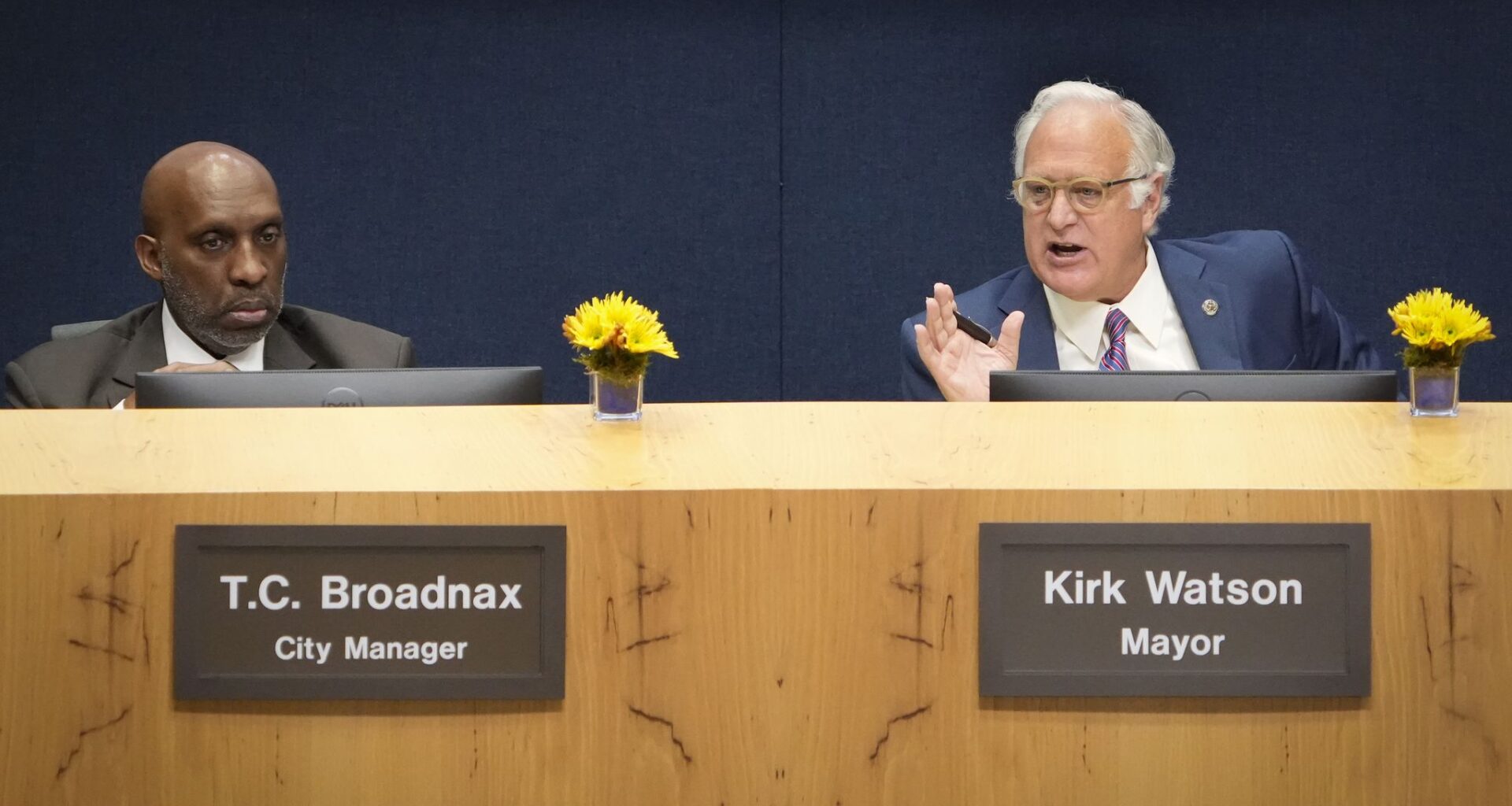
Austin City Manager T.C. Broadnax listens as Mayor Kirk Watson speaks at a city council meeting Thursday, Sept. 25, 2025.
Jay Janner/Austin American-Statesman
Mayor Kirk Watson has asked council members to submit proposed budget amendments by Aug. 4 so staff can calculate their costs and identify possible funding sources before the final vote. Any amendment that adds spending would generally require council members to identify cuts, new revenue or reserve funding to offset it.
The final budget could differ from Broadnax’s recommendation. Council members can restore proposed cuts, shift money among departments, alter fees and tax rates, or add new initiatives before adopting the spending plan and related tax and utility rates.
Article continues below this ad
How can Austinites get involved?
Austinites can weigh in on the budget through public comment during upcoming city council meetings and at district specific town halls with their city council members throughout July and August. You can find your city council district on the city’s website.
Here is a list of district town halls in the coming weeks:
Article continues below this ad
District 4 with Mayor Pro Tem Chito Vela: Thursday, July 16, 6–7:30 p.m. at Virginia L. Brown Rec Center 7500 Blessing Ave; Register here
District 7 with Council Member Mike Siegel: Monday, July 20, 6-7:30 p.m. at Violet Crown City Church 1300 Morrow St; Register here
District 9 with Council Member Zo Qadri: Friday, July 24, 6 p.m. at Austin Energy Headquarters Main Meeting Room 4815 Mueller Blvd
District 6 with Council Member Krista Laine: Saturday, July 25, time TBD at Lakeline Foundation Communities Learning Center
District 8 with Council Member Paige Ellis: Monday, July 27, 6-7 p.m. online
District 2 with Council Member Vanessa Fuentes: Wednesday, July 29, 6-7 p.m. at Communities in Schools Central Texas 2521 E St Elmo Rd; Register here
District 1 with Council Member Natasha Harper-Madison: Saturday, Aug. 1, 10 a.m. at City Hall 301 W 2nd St.; Register here
District 10 with Council Member Marc Duchen: Monday, Aug. 3, 5-8 p.m. at Huffman Hall at St. Matthew’s Episcopal Church, 4121 Steck Ave.; Register here
District 5 with Council Member Ryan Alter: Wednesday, Aug. 5, 5-6:30 p.m. at Menchaca Road Branch Library 5500 Menchaca Rd.; Register here
District 3 with Council Member José Velásquez: Monday, Aug. 10, time and location TBD