
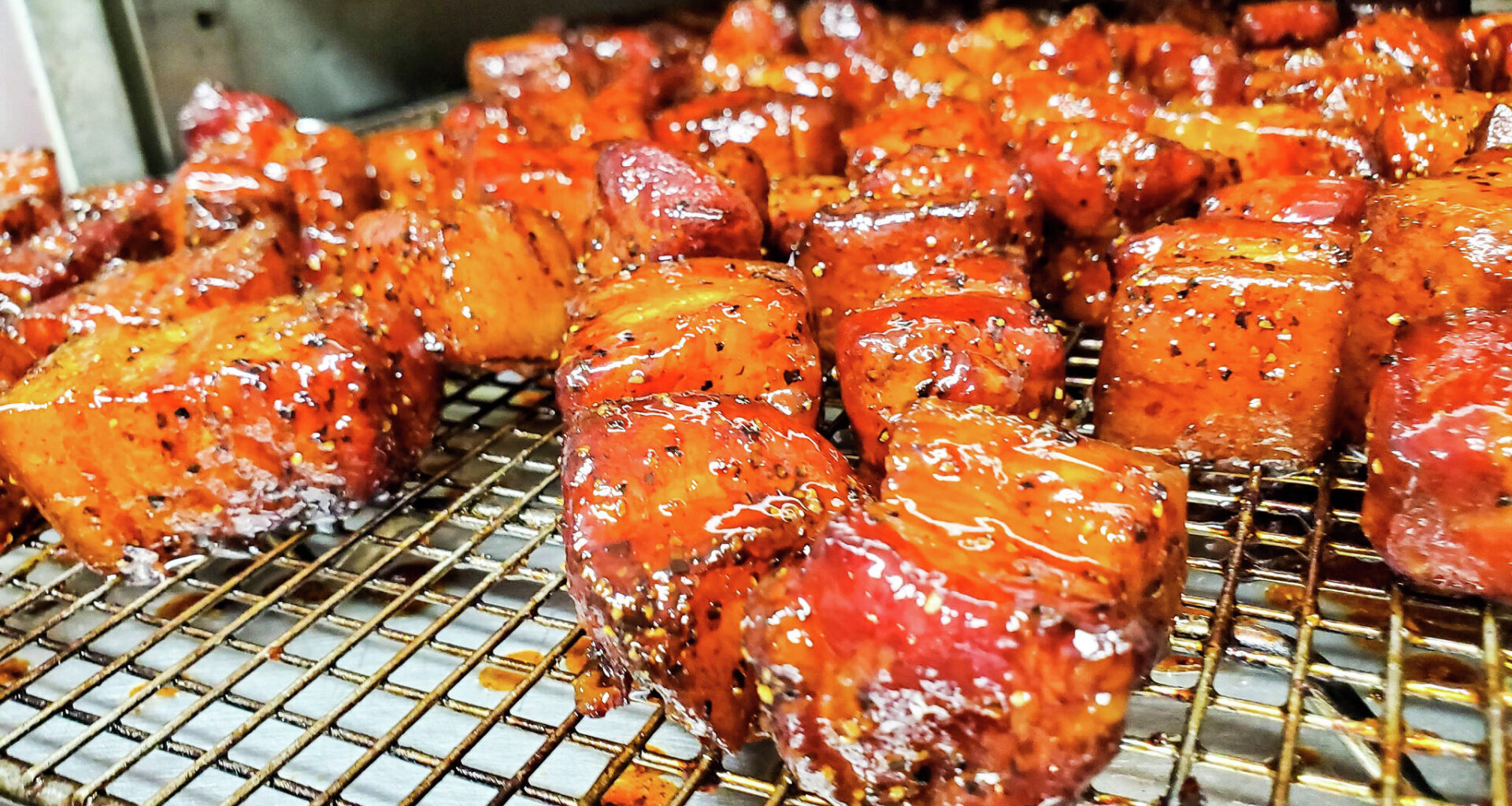
Pork belly burnt ends at Roegels Barbecue Co. in Katy
J.R. Cohen/Contributor
Pork belly burnt ends at Roegels Barbecue Co. in Katy
J.R. Cohen/Contributor
When you consider the origins of the many choices on a Texas barbecue menu, there’s rarely consensus about how they came to be.
Take brisket, for example. No one knows exactly when it became a standard menu item. The best guess is that it became widespread sometime in the 1960s.
More recent dishes, however, can often be traced to a specific time and place.
Article continues below this ad
Such is the case with bacon burnt ends. These sweet-and-savory cubes of cured and smoked pork belly likely originated at a backyard barbecue gathering in Fort Worth on June 29, 2013.
There, Travis and Emma Heim served bacon burnt ends at a pop-up that eventually led to Heim Barbecue, now a small chain with locations across the Dallas-Fort Worth area.
The dish became Heim’s signature menu item. The restaurant posted the first photo of its creation on Instagram on March 9, 2015, and in the summer of 2019 declared the first National Bacon Burnt End Day.
Among Texas barbecue enthusiasts, it eventually became accepted wisdom that the Heims invented bacon burnt ends. But is the story really that simple?
Article continues below this ad
Critics on social media and barbecue message boards argued that true burnt ends can only be made from brisket in the Kansas City tradition. Others noted that sweet-and-savory pork belly has long been served in several Asian cuisines.
Both arguments, however, overlook what made the Heim version distinctive.
Historically, the term “burnt ends” referred to the crispy tips of smoked briskets served at legendary Kansas City barbecue restaurants such as Arthur Bryant’s. Because briskets taper from thick to thin, the narrow end can become especially crisp during a long smoke.
Pitmasters sliced off those ends, cut them into cubes, tossed them in sweet barbecue sauce and served them as an inexpensive side. Like many humble barbecue traditions, the leftovers eventually became one of Kansas City’s signature dishes.
In recent years, however, “burnt ends” has evolved into a catch-all term for cubed meat that’s cooked until tender and glazed with sauce. It’s no surprise the Heims adopted the name for their own creation.
Article continues below this ad
The comparison to Asian pork belly dishes also misses an important step.
Rather than cooking raw pork belly, the Heims first cure and cold-smoke it, effectively making bacon. The slab is then cut into cubes and cooked with additional seasoning until the pork slowly renders and braises in its own fat, producing a rich, confit-like texture.
Over the years, confusion has grown over what qualifies as bacon burnt ends. Many barbecue restaurants now serve “pork belly burnt ends” or “pork belly bites.” Some skip the curing and smoking process altogether, while others remain faithful to the original Heim method.
In Houston, you’ll find pork belly burnt ends at places such as the Katy location of Roegels Barbecue Co. and Pappas Delta Blues Smokehouse in Webster.
But for the original bacon burnt ends, you’ll still have to head to one of Heim Barbecue’s three Dallas-Fort Worth locations.
Article continues below this ad
Heim Barbecue
Multiple locations; heimbbq.com
Roegels Barbecue Co. Katy
20702 Katy Freeway; 832-321-5135
Closed Mondays