
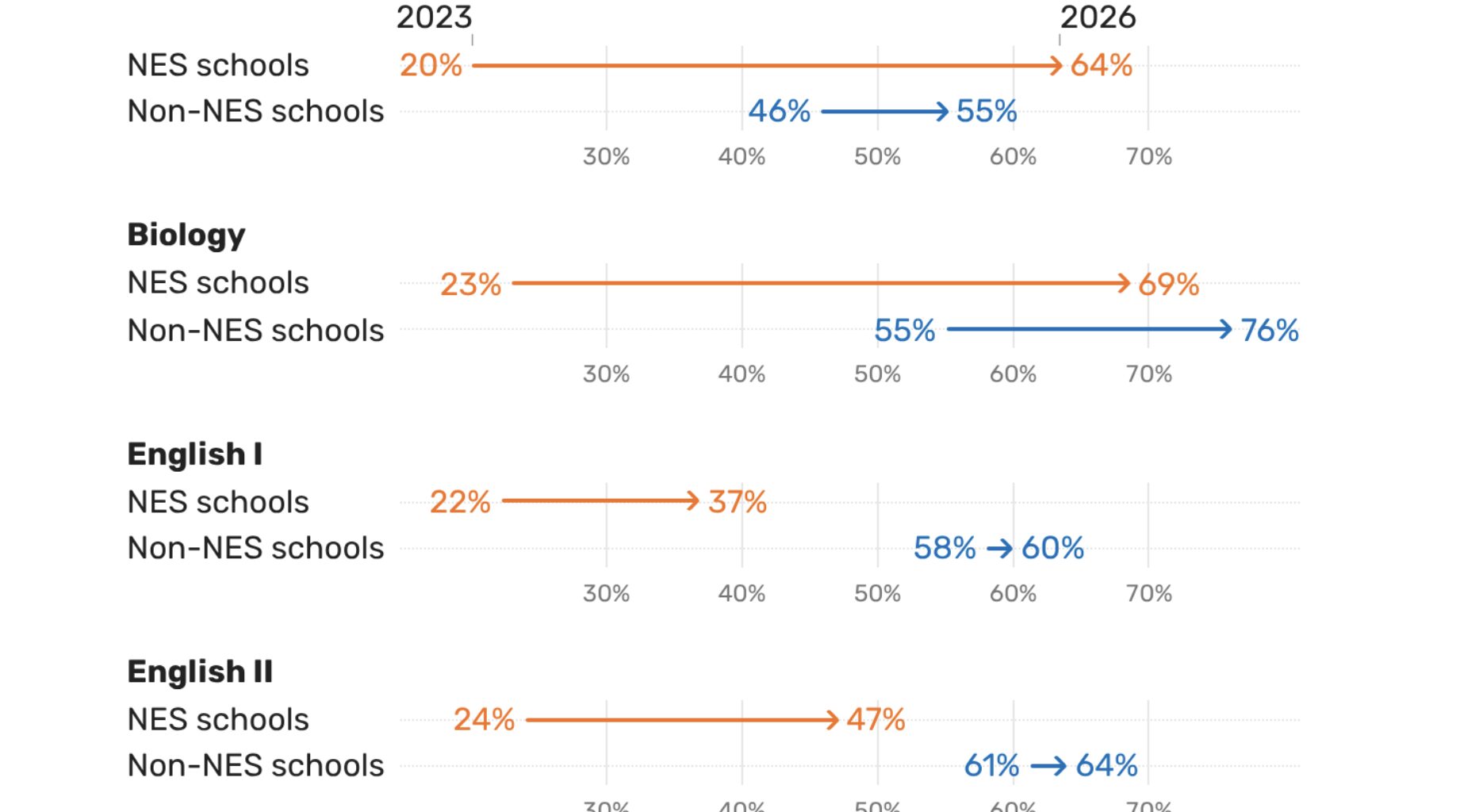
Schools in Houston ISD’s reform system continued to post dramatic gains on most STAAR exams this year, with some subjects improving more than 40 percentage points since the state takeover began in 2023.
The growth in the rate of students meeting grade level at schools within the New Education System — the model state-appointed Superintendent Mike Miles introduced at some schools to improve academics — has largely outpaced growth at schools outside of the model.
The results come amid changes in who took some exams. This year, about 3,500 fewer students took the seventh grade math STAAR because many high-performing seventh graders instead took the eighth grade test as part of a new advanced math pathway. Researchers say that type of change, along with other testing patterns, make it difficult to determine how much of the gains reflect improved student learning alone.
The mission of the HISD takeover, according to state leaders, is to boost student performance. The district must have no D or F-rated schools to exit the intervention. The stakes are particularly high at NES schools, which have historically received lower ratings. NES schools also receive more funding and staffing and use the district’s curriculum and scripted lessons for teachers.
Article continues below this ad
While leaders at HISD credit the investments from its reform model, researchers urge some caution when interpreting the test scores.
STAAR RESULTS: See how your Houston-area school performed.
Biology has also seen testing changes. Many students at NES campuses now take the biology STAAR a year later. Since the takeover, the number of students taking biology has dropped by more than 4,000 students, and the share of students meeting grade level has improved by 45 percentage points — more than any other subject.
“If you get gains this big, you have to look at how they were produced. You just don’t get (those) gains … if you’re testing the same kinds of kids and everybody’s improving. It just doesn’t happen,” said Daniel Koretz, a research professor of education at Harvard University who has studied testing policies and grade inflation for decades. “It’s time to lift up the covers and see what’s going on.”
Article continues below this ad
HISD said putting more funding, staffing and resources into classrooms has contributed to stronger performance. Next year, the district will allocate $8,459 on average to students at NES campuses, compared to $6,265 for students outside the system.
Schools outside NES have improved more slowly, although they continue to outperform NES schools, posting higher rates of students meeting grade level in almost every tested subject.
“As expected, schools starting furthest behind have made some of the fastest gains, but they also have the greatest distance to close,” the district said in a statement. “The goal is sustained improvement that enables every student, regardless of campus, to achieve at grade level.”
High schools see fastest growth
The biggest gains occurred on high school end-of-course exams. Texas students must take them in five subjects to graduate: Algebra 1, biology, English 1, English 2 and U.S. History.
Article continues below this ad
Since the takeover, the rate of students meeting grade level on end-of-course tests rose by 30 percentage points at NES schools. Schools outside of the system improved by 6 percentage points, although they still have a higher share of students meeting grade level than NES schools.
The curriculum used at NES schools is designed, in part, to help students succeed on the STAAR, said Erin Baumgartner, director of the Houston Education Research Consortium at Rice University’s Kinder Institute for Urban Research.
“We hope growth is happening. That was part of what the takeover was about,” Baumgartner said. “It’s probably not too surprising that we’re seeing some of that appear in those places.”
NES schools saw the most dramatic gains on two high school end-of-course exams: Algebra 1 and biology, with a 43- and 45-point increase in students meeting grade level since 2023, respectively.
Article continues below this ad
While the share of students meeting grade level jumped 45 percentage points, thousands fewer students took the exam after HISD delayed biology until the following year for many students at struggling campuses.
“When we see double-digit gains in performance over the course of a year or two, oftentimes that might be indicative of a policy change and not necessarily individual student-level growth,” said Toni Templeton, a senior research scientist at the University of Houston’s Education Research Center.
Non-NES schools also saw improvements, particularly in biology and Algebra I, but growth was minimal in other subjects, with a slight drop in the percentage of students meeting grade level in U.S. history.
NES schools remain behind non-NES schools in most subjects. But for the first time this year, schools within the reform system surpassed non-NES schools in Algebra 1, with 64% of students meeting grade level.
Article continues below this ad
TOP HIGH SCHOOLS: These Houston-area school districts have the best high school STAAR scores
Educators at Good Reason Houston hope NES schools eventually catch up in all tested grades and subjects, said Sara Sands Francis, the managing director of data impact and strategy at the education nonprofit. But she said that requires sustainable change.
“In an ideal world, we are certainly going to a place where the gap is non-existent, and all of our students across all of our schools are meeting and exceeding grade level expectations,” Sands Francis said. “The goal for us at this time is really digging into these numbers and … learning from everything happening in all of our schools, so we can use that to support all of our students.”
Gains in elementary, middle schools
While the most dramatic improvements came on high school exams, elementary and middle school students also posted gains.
The state tests students every year in reading and math for third through eighth grades; science for fifth and eighth; and social studies in eighth grade.
The share of students meeting grade level at NES schools rose 15 percentage points since the takeover began. While non-NES schools stayed relatively flat, the share of students meeting grade level remained more than 13 points above those at NES schools.
At NES schools, that growth appeared across every tested grade and subject, with particular growth in most middle school math and reading tests. Non-NES schools, meanwhile, improved by smaller margins, with drops in the share of students meeting grade level in fifth and seventh grade math since the takeover began.
The Texas Education Agency said fewer seventh graders took the seventh grade math exam statewide, contributing to lower scores.
Some signs of slowing growth
After two years of nearly continuous improvement, NES schools posted declines in several grades and subjects for the first time since the takeover.
NES schools saw declines in third- and seventh-grade math and fourth grade reading. While non-NES schools had drops in fifth- and seventh grade math, these schools actually saw fewer drops in 2026 compared to the first two years of the takeover.
HISD said that as more students reach grade level, future gains are likely to become more incremental.
STAAR OVERHAUL: Texas will soon replace the STAAR. Here’s what to know about what comes next.
“Student performance is not expected to improve at the same rate every year in every grade, subject, or campus,” the district said in a statement. “Some fluctuation is expected. What matters is that the overall trajectory continues to move in the right direction.”
Courtney Isaak Pichon, chief executive officer of Good Reason Houston, said she was encouraged by HISD’s continued growth in 2026 and said it was “a signal that something meaningful is happening.” Still, she said the district also needs to learn from the experiences of students, teachers and families to turn that growth into long-term results.
“Understanding both the data and the lived experience gives us the best chance of identifying what is helping students succeed,” she said.