
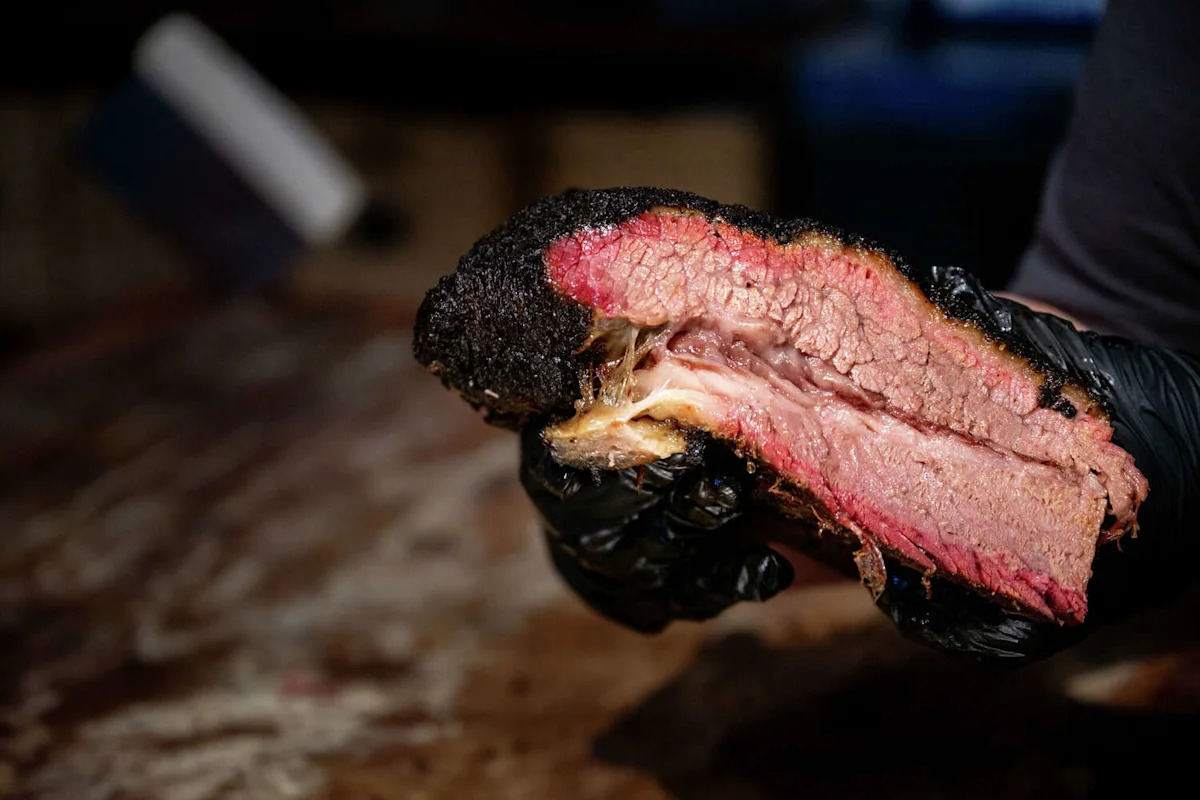
A few weeks ago, I spoke with a Texas pitmaster who pined for the days of barbecue past. He recalled the time he ate at Kreuz Market in Lockhart as a kid: a slice of brisket, a few crackers, some cheese and butcher paper. The thing he most remembered though was the price: $1.25 a pound.
Obviously, today’s barbecue isn’t as affordable, but that pitmaster put forth an idea I found intriguing: bring back USDA Select, the leaner and cheaper grade of beef that restaurant operators were using in the early days of Texas barbecue.
Is it time to reject brisket modernity and embrace brisket tradition? The answer from pretty much everyone I spoke to was a resounding “no.”
The cows are different …
Cattle are herded in a stable on June 05, 2026 in Hamilton, Texas. Dr. David P. Anderson, a cattle economist with Texas A&M’s Agrilife Department, says current cattle herds are drastically different than decades, even centuries, past. (Brandon Bell/Getty Images)
Dr. David P. Anderson, a livestock economist with Texas A&M University, told Chron that we’re simply too far gone from the origins of Texas barbecue and cattle herding to ever go back. In today’s market, Select is only marginally cheaper than Choice or Prime today.
“If I’m looking at primal values reported by USDA in June, I’ve got a Select brisket value for the month that was $3.43 a pound. I got a Choice that was $3.45 a pound. I’ve got a Prime that was $3.51 a pound. The branded product, certified Angus beef, was $3.54 a pound,” Anderson said. “You know, it’s cheaper, but not very much cheaper. And so, you know I’m not sure that fundamentally solves the problem.”
And the price is only a part of the equation. Today, there is more Prime than Select being produced by today’s cattle herds. According to the USDA’s Agriculture Marketing Service, in 1938, Select comprised 57.9 percent of the majority of beef graded. In 2016, Select made up 21 percent. In 2026, Select comprised 10 percent vs. Prime, which made up 14.9 percent.
Much of the shrinkage that we’re seeing is coming from a variety of sources, Anderson said. Cattle genetics have changed significantly over the years as ranchers breed out their herds to get desired traits, like faster growth and better marbling. The herds are also getting larger because ranchers can afford to put them on the feed for much longer. And yet the wants of the general public may be the biggest factor of them all. The demand for Choice and Prime products has created premium pricing for both varieties, a critical incentive for ranchers when they sell.
“It would be really hard in a big way to go back to Select,” Anderson said. “What would happen is if everybody decided to buy Select, Select prices would go up and Prime would go down.”
The people are different …
Russell Roegels, owner of Roegels Barbecue Co. at 2223 S. Voss pulls sausages out of the smoker. Roegels is among the Houston restaurant owners who are grappling with ways to stay in business since Harris Country enters 15-days of limiting service to only take-out and pick-up. (Karen Warren, Houston Chronicle / Staff photographer)
Those numbers are also playing out for Russell Roegels of Roegels Barbecue Company in Houston. Roegels told Chron his supplier doesn’t even carry Select. When it comes to solving the brisket price problem, he echoed a similar refrain I’ve heard from other pitmasters: it’s all down to the yield.
Specifically, that means how much of the brisket operators can utilize before they throw it into the pit. Typically, a brisket loses half of its weight once it’s trimmed and then another half when it’s done cooking. That cut-off fat can be reused in other products, including sausages, burgers and tallow, if done properly. It’s even easier when you splurge for a higher-quality product. Pitmasters have told Anderson that cooking a Choice or Prime brisket is more forgiving because of its higher fat and marbling.
“What we’re using right now is McClaren Farms Prime and we’re paying $6.55 a pound for it. Our yield on that is higher and we’re having less trim off it,” Roegels said.
The customer is also a consideration. They want the good stuff. As Texas barbecue took off in the 2000s and 2010s, the demand for better brisket spurred producers to embrace higher graded cattle. And it’s not slowing down as that demand extends overseas to Europe and Asia for Central Texas-style barbecue.
In other words, there’s no going back to the days when Texas barbecue was strictly a blue-collar meal. As Anderson put it, we’ve “trained the customer to like Prime and Choice.”
“We’ve created a monster, but it sure is good to eat,” Anderson laughed.
More Food & Drink
Closures | Houston Mexican restaurant suddenly closes after 25-year run
In-Depth | A Texas food giant says it’s not the villain critics say it is
Shocking | Houston spot tops list of Yelp’s ‘most outrageous’ restaurants
Courts | Cult-favorite Houston restaurant caught again in legal fight
For more food news and features from Chron, sign up for The Feed newsletter here.
This article originally published at The beef that built Texas Barbecue is disappearing. Also, it’s your fault..