
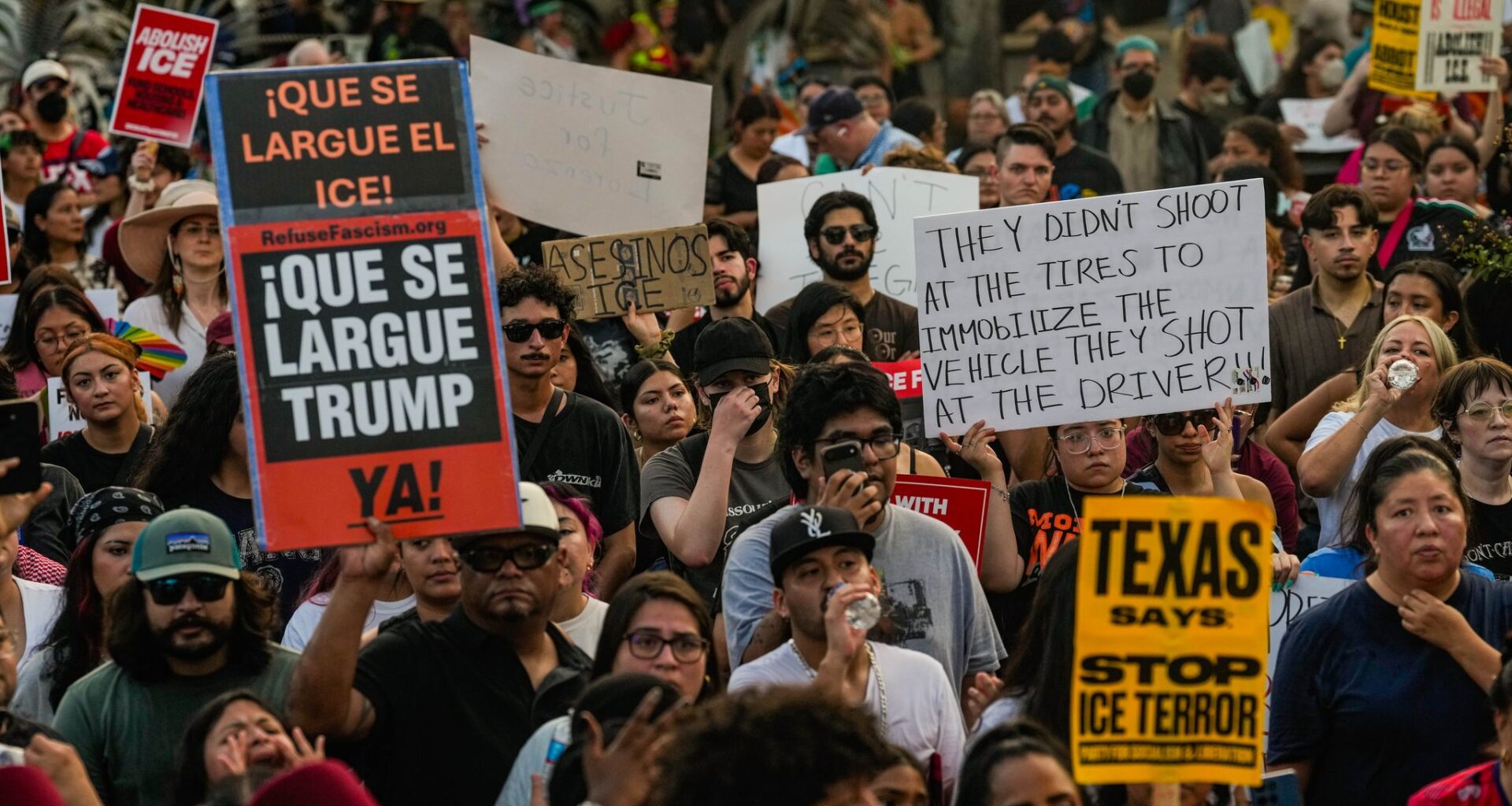
Hundreds of demonstrators march through Magnolia Park following the fatal shooting of Lorenzo Salgado Araujo by an Immigrations and Customs Enforcement agent.
Raquel Natalicchio/Houston Chronicle
Ronaldo Salgado, son of Lorenzo Salgado Araujo, holds a photo of his father during a news conference Wednesday, July 8.
Melissa Phillip/Houston Chronicle
Hector Cholom, 42, of Iglesia Bautista Kekchi, prays and weeps during a candlelight vigil for Lorenzo Salgado Araujo.
Raquel Natalicchio/Houston Chronicle
The more we learn about the U.S. Immigration and Customs Enforcement killing of Lorenzo Salgado Araujo, the more it looks to us as though ICE is hiding serious misconduct — the kind that could put any Houstonian in mortal danger.
The Department of Homeland Security claimed Tuesday’s shooting was part of a targeted enforcement operation. Instead, they killed a man with no criminal record, three U.S. citizen sons and decades of calling Houston home.
The FBI and the Department of Homeland Security, which oversees ICE, say they’re investigating the shooting. But at a press conference Friday, Congresswoman Sylvia Garcia said the acting ICE director has given her no timeline for any investigation. We still haven’t heard back from the feds about the investigation related to Renée Good, six months after an ICE agent killed her.
Of the many questions we have, the most urgent is: Will the federal government cooperate with local investigators? Or will it deny access to evidence and intimidate witnesses, three of whom are currently detained and reportedly being pressured to self-deport?
Article continues below this ad
Already, ICE’s story is contradictory and murky at best.
The acting director told Garcia that Salgado was not the target, but that the agents were going after someone with a final order of deportation and had only an administrative warrant. In other words, it’s unlikely the target was a hardened criminal — someone so dangerous that ICE truly needed to take reckless measures to capture him.
Garcia also says the director — these agents’ boss — apparently didn’t know the name of the person the agents were targeting. Guess it wasn’t that important.
In a separate statement, ICE has claimed that agents had been surveilling a pair of Guatemalan people at an address in southeast Houston, acting on a tip from local law enforcement, and had spotted two white vans at that property. We don’t know who those Guatemalan people were, and we don’t know why ICE thought they were worth targeting.
Article continues below this ad
When ICE agents returned to the address Tuesday morning, an ICE spokesperson told the Times, they saw a white van with “an individual who resembled the target and initiated a traffic stop.”
Southeast Houston is full of white vans with Hispanic guys inside. Was there any real reason to think that this particular van, driving along Wayside, held that particular guy?
At any rate, none of the men in the van were ICE’s target. What they may have been was low-hanging fruit — an easy way for the officers to hit their quotas.
Why didn’t ICE just go after their Guatemalan targets at the address they had already staked out?
According to reporting by the Atlantic, immigrants have learned not to open the doors to their homes, which means that ICE would have to get a judge to sign off on a search. (Thank you, Fourth Amendment, for protecting all U.S. residents from illegal search and seizure.) So ICE has intentionally shifted to stopping targets in their cars and trucks.
That change puts all Houstonians at risk. Traffic apprehensions are far more dangerous for everybody involved — for the agents, for the people stopped and for anyone nearby. Since September, U.S. immigration-enforcement agents have shot at more than 20 people. Some were killed. Nearly all were in vehicles.
Other law enforcement agencies train officers to avoid this kind of stop and, when it’s absolutely necessary to make one, how not to put themselves and anyone else in danger. ICE agents receive less training in conducting vehicle stops than most police officers. Garcia said she wouldn’t even “give them the credit of calling them law enforcement officers.”
Article continues below this ad
According to the Washington Post, the other men in Salgado’s van say that, as the van pulled away from a stoplight, an unmarked vehicle behind them pulled out onto the shoulder, accelerated and cut in front of the van. Then the unmarked vehicle tapped the brakes.
That’s the sort of move you’d expect from a cartel, and not something we can tolerate from a government agency on Houston city streets. Why aren’t the ICE vehicles marked? How is a driver supposed to know that a government agency is pulling them over — as opposed to, say, a criminal who wants to carjack him and steal his tools?
The witnesses say the van kept moving, but went no more than five miles an hour because of heavy construction on Canal Street. They say that ICE rammed their vehicles into the van, but that at no point did Salgado use the van to hit back.
Is ramming targets’ cars standard ICE procedure? That would be weaponization of a vehicle — the very thing that ICE accuses Salgado of doing.
Let’s not forget the case of Marimar Martinez, the Chicago woman that a Border Patrol officer shot five times last year. Martinez, too, was accused of using her car to assault federal officers, and was charged with the crime. But bodycam video and text messages showed that, in fact, it was the Border Patrol officer who rammed her car. The government dropped its charges against her.
Here in Houston, there’s good reason to think that, once again, immigration-enforcement officers are lying. At Friday’s press conference, Hugo Balderas-Ibarra, a lawyer representing two of the three men in the van with Salgado, said that ICE agents were never in harm’s way. The agents, the witnesses say, were standing on the sides of the van — not in front of it or even in back of it, where they could be run over.
How then could the van possibly have been used as a deadly weapon? Did the officers think the driver could somehow roll the van sideways on top of them?
One of the witnesses — Salgado’s brother, Victor Salgado — was in the van’s passenger seat. Victor says that the shot that killed his brother came when an ICE officer fired through the passenger window, so close that Victor felt the impact of the gun going off.
If the shot was fired through the passenger-side window, the officer couldn’t have been in fear for his own life.
Those witnesses’ testimony is damning evidence of ICE misconduct. We worry that ICE may do everything possible to suppress it. The lawyer says that his clients are being pressured to self-deport, and he’s requesting their immediate release from detention.
Garcia says that the acting ICE director has at least assured her that the men won’t be deported or moved out of the area for now.
Is that enough? How can we feel sure that these witnesses are safe and that ICE, with its vast history of abuses against detainees, will treat them fairly?
Article continues below this ad
Besides the witnesses, we also need to protect the evidence. Where’s Salgado’s white van? What story will its bullet holes tell?
And what story will the bullet hole in Salgado’s body tell, once the autopsy is released?
ICE says that none of the agents or vehicles were equipped with bodycams or dashcams. That’s unacceptable. With millions of dollars allocated to ICE and immigration enforcement — more than most countries’ entire military budgets – the agency has no excuse.
Garcia says that the acting director of ICE promised her that all agents in the field will be equipped with body cameras by the end of July. Our elected leaders must hold him to that promise. Unless the agency has something to hide, it should want its actions documented. They’ve already lost our trust. Now, if we’re to believe them, we need to see videos.
It’s still not clear how many ICE officers were shooting, how many shots were fired or how many officers were involved — much less who, exactly, did the shooting. We certainly haven’t heard directly from the agents who were on the scene.
Instead, the congresswoman said, the agents involved in the shooting were rapidly “whisked away” from Houston the next morning.
Including, we assume, the ICE agent at the scene where Salgado lay bleeding. Victor, Salgado’s brother, remembers how an ICE agent mocked him then: “Se querían escapar, verdad?”
You wanted to escape, right?
The flippant cruelty should come as no surprise. It reflects the swaggering, dehumanizing rhetoric spewed constantly from the White House, and is the product of a culture that values meeting quotas, no matter what.
Article continues below this ad
As Congressman Al Green stressed at the press conference, Salgado belongs to us. He is one of our own.
ICE must answer Houstonians’ many questions. After all, they work for us, the people. “We don’t have to beg,” Green said. “We don’t have to grovel. We can demand! We have the Constitution.”