
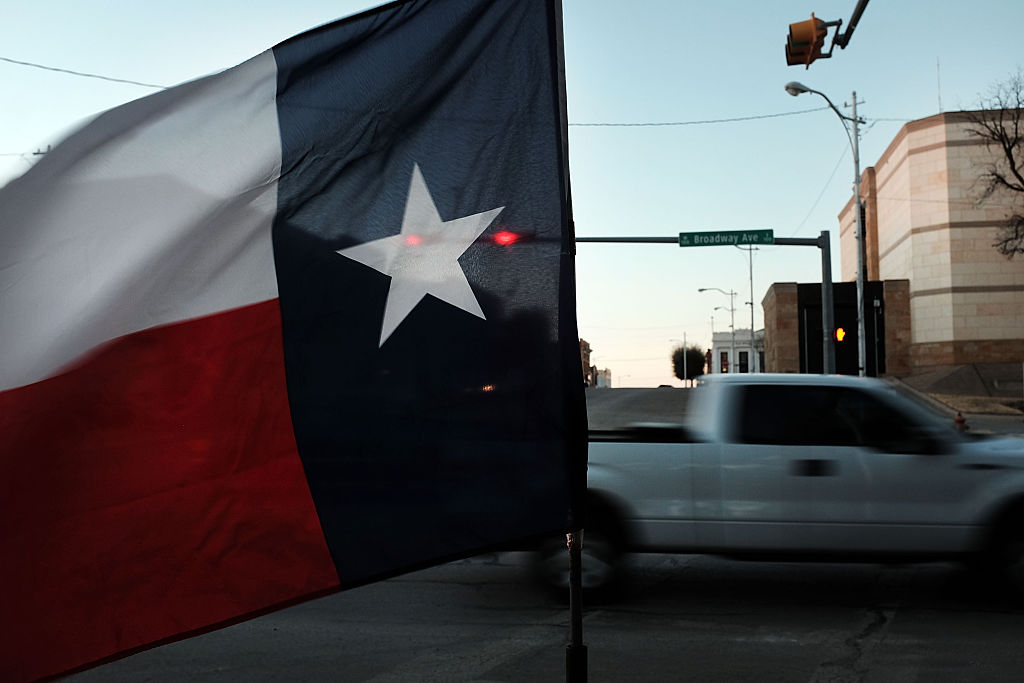
More companies are flying the Texas flag than you might think.
Spencer Platt/Getty Images
There are certain businesses that are as synonymous with Texas as the state flag. We can’t think of H-E-B, Buc-ee’s and Blue Bell without the Lone Star State, and would probably send them as ambassadors to represent Texas at the United Nations.

But there are other brands that tend to elicit an incredulous “That’s from Texas?” And you’ll insist on it as your disbelieving friend ignores you and insultingly looks it up themselves. But yes, Texas isn’t all nuggets and oil and butter tortillas. We totally have other goods and services that originated here as well. Let’s take a look at a few.
Article continues below this ad
Whole Foods
Mario Tama/Getty Images
When you ask people where they think Whole Foods originated, they might list cities like San Francisco and New York and Portland. Texas is associated with barbecue and chicken fried steak and Tex-Mex, and Whole Foods is obviously none of those things, with its eight varieties of quinoa and other healthy, upscale foods.
It was founded as a spoof. In 1978, Austinites John Mackey and Renee Lawson opened a health food store called SaferWay (a shot at Safeway), and after merging with a Clarksville Natural Grocery, opened the first Whole Foods in 1980. It soon expanded to Houston and Dallas, and eventually opened more than 500 locations internationally, with Amazon purchasing the company in 2017. (Amazon is definitely not from Texas.)
Article continues below this ad
7-Eleven
This photo taken on September 13, 2024 shows a woman walking past a 7-Eleven convenience store in Tokyo.
Richard A. Brooks/AFP via Getty Images
Texas is more than beaver-themed convenience stores. We don’t often associate 7-Eleven with the Lone Star state, but considering its origins as an ice shop, perhaps we should. Founded as the Southland Ice Company in Dallas in 1927, it later became 7-Eleven in 1946 to reflect the new, expanded hours.
As of 2005, Japanese supermarket chain Ito-Yokado gained 100 percent ownership of 7-Eleven, and the company holds upward of 85,000 locations around the world. It begs the question: Does this mean Texas also created the legendary Slurpee? Yes and no. That was technically invented by Omar Knedlik, a Kansas City Dairy Queen franchise operator, eventually turning into ICEE. But 7-Eleven licensed the ICEE machine technology from him in 1965, and a star was born.
Article continues below this ad
Neiman Marcus
An exterior view of the downtown Dallas Neiman Marcus building, February 20, 2025.
Tom Fox/Dallas Morning News
Texas fashion is obviously more than cowboy boots and reusable H-E-B bags. One of the forerunners of the clothing industry here is Neiman Marcus, which has called the state home for more than 100 years. In 1907, Herbert Marcus, his sister Carrie Marcus Neiman and her husband, A.L. Neiman were stuck on a decision: Should they invest in an up-and-coming soda company, or start their own business bringing the fashions of the world to Texas?
That little-known company turned out to be Coca-Cola. But they decided instead to open Neiman Marcus in downtown Dallas, and “the family joke became that Neiman Marcus was founded on a bad business decision,” their site says. The original store burned down in 1913, but a replacement opened the next year. Today, there are 36 stores throughout the country, and as of 2024, Neiman Marcus is owned by New York City-based Saks Global. The original flagship one that opened in 1914 is set to close as of September.
Article continues below this ad
James Coney Island
Google Maps
With “Coney Island” in the name and a history of East Coast eateries making their way to Texas, one wouldn’t assume offhand that James Coney Island is of local origins. But it’s one of the longer-lasting fast food joints in Texas. In 1923, after spending time in New York, Greek immigrant brothers Tom and James Papadakis opened a hot dog stand in downtown Houston. Its menu was a little different than today’s, offering “goose liver and Roquefort combination,” bowls of chili for only 15 cents, and hot dogs for a nickel.
The brothers didn’t expand beyond that single location for 40 years, and eventually sold their interest to local investors in 1990. Though locations numbered around 20 in the Houston area at one point, several closings over the years have left the company with five spots remaining. They still feature their original Coney Island dog (with a few others now), using the same chili recipes as in 1923. But it’ll cost a little more than a nickel.
Article continues below this ad
Bumble
Hong Kong, Hong Kong – AUGUST 08: A smart phone with the dating app Bumble is seen on the screen in Hong Kong, Hong Kong, on August 08, 2018.
Yu Chun Christopher Wong/S3studio/Getty Images
Anyone who’s had a nice awkward date courtesy of Bumble can be thankful that the dating app was founded right here in Texas. Created by former Tinder executive Whitney Wolfe Herd in 2014 in Austin, Bumble offered an alternative dating app experience where women had to send the first message after a match. It was intended to empower women in the process, not that dating apps leave anyone feeling good about themselves.
The name Bumble, of course, is a reference to the matriarchal society of bees, a point probably brought up too many times by guys on the app trying to appear deep. Bumble soon grew to a global brand and turned Herd into a billionaire after she took the company public in 2021, and has been downloaded more than 100 million times. The headquarters are still in Austin today, and naturally, it’s called the “Beehive.”
Article continues below this ad
Half Price Books
Shoppers look through products at Half Price Books vinyl section in Montrose Friday, Sept. 16, 2016, in Houston. The store closed in 2019, but a new one will replace it come 2027.
Houston Chronicle/Hearst Newspap/Houston Chronicle via Getty Imag
Countless Texans have made the trip over to Half Price Books in an effort to free up space on their shelves at home, only to find themselves inevitably purchasing more. It’s an adorable little cycle courtesy of bibliophiles Pat Anderson and Ken Gjemre, who opened the first location at an old laundromat in Dallas in 1972.
It’s where you’ll encounter the long-familiar phrase: “We buy and sell everything ever printed or recorded (except yesterday’s newspaper).” And they seem to stick to that credo at the now more than 100 locations nationwide, as America’s largest family-owned retailer for new and used books.
Article continues below this ad
Indeed
The Indeed Tower on May 14, 2024 in Austin, Texas.
Brandon Bell/Getty Images
If you’ve ever slogged through job applications on Indeed and felt like you’re making an effort by copying and pasting and clicking a few buttons, Texas is at least partly responsible. That’s because the job-hunting app Indeed was founded in two states at once. Launched in 2004, Indeed was cofounded by Paul Forster and Rony Kahan in both Austin and Stamford, Connecticut.
Its innovation lay in the creation of a metasearch engine that aggregated job postings from across various pages on the web, and in doing so became the largest job-hunting site in the world, with hundreds of millions of monthly visitors. That’s probably why it may be taking a bit of time to hear back from that one employer.
Article continues below this ad
Dave & Buster’s
Dave & Buster’s is an American restaurant and entertainment business.
JHVEPhoto/Getty Images
Parents are always telling their kids to share with others. David Corriveau and James “Buster” Corley appeared to be listening. Corriveau was operating a restaurant in Arkansas while a few doors down, Corley ran a gaming parlor, and both couldn’t help but notice that customers were rotating between the two. So they combined forces, but not in Arkansas—in Dallas, Texas, where the first Dave & Buster’s opened in 1982.
Article continues below this ad
Known for their array of games, full menu of food and drinks, and plenty of flashing lights and sounds, Dave & Buster’s now operates more than 170 locations, most of which are in the U.S., with a few others in Canada, Australia and Puerto Rico. Interestingly enough, Arkansas, where the idea was formed, didn’t get its one location until 2016. Why? Because legislation at the time prevented anyone from winning more than $5 in amusement games. A bill raised that to $500, and the state finally got one of its own.