
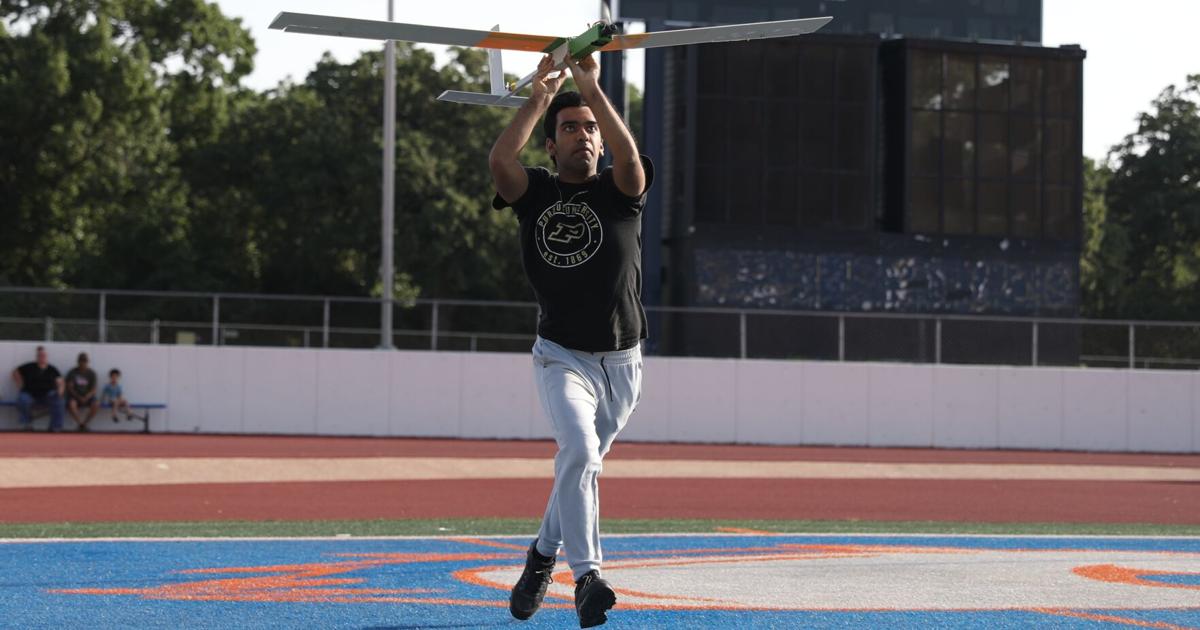

Aryan Kashyap, Purdue University aerospace engineering junior, throws his team’s plane into the air during the 10th Annual 3D Printed Aircraft Competition on July 11 at Maverick Stadium. Kashyap said he handled the electronics while building the plane.
Under the summer heat, student-made airplanes soared through the air, one larger than the others, in a blur of red and purple, flying low. The Tennessee Tech University Team, Eagleprint, hoped their engineering would carry them through the competition.
Surrounding teams clapped and cheered as they watched each flight, anticipating their own shot.
On Saturday, students from several universities competed alongside UTA students in UTA’s 10th Annual 3D Printed Aircraft Competition at Maverick Stadium.
Each team, whether in the rotary-wing or fixed-wing category, completed three rounds a flight. Volunteering judges watched each flight for disqualifications and flight durations.
Robert Taylor, UTA professor of practice in mechanical and aerospace engineering, said the competition is often a senior capstone project for many engineering students.
“It’s a very comprehensive design project, so they have a lot of freedom to go and pursue all of these different aspects of the design,” he said.
Alex Savage, Tennessee Tech University mechanical engineering graduate student, said the competition combines 3D printing and aircraft design, both parts of engineering he’s interested in. For his second year in the competition, he is working as part of Team Eagleprint for the fixed-wing category.
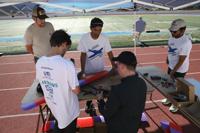
Tennessee Tech University students work on their 3D printed aircraft, Eagleprint, during the 10th Annual 3D Printed Aircraft Competition on July 11 at Maverick Stadium. Teams were able to repair their planes after each flight.
This year, Eagleprint faced challenges balancing its planes’ design with its ability to stay in the air for a sustained amount of time. The team relied on test flying to work out issues with their planes.
“The test flights that we had, it behaved in ways we didn’t understand,” he said. “So it crashed. We had a lot of crashes.”
Despite the challenges, Savage said 3D printing allowed the team to experiment with different design possibilities and structures than with typical manufacturing.
While Eagleprint focused on creating a lightweight aircraft, other competitors faced their own challenges.
“We only had about one and a half semesters to get this done, whereas other teams have two full semesters, so we’re just keeping the design as simple as possible,” Israel Fallad, UTA mechanical engineering senior, said.
Most members of Fallad’s team weren’t familiar with drones or the software needed to make the device work.
“Once we figured that out, the test flights were perfect,” he said. “I mean, we couldn’t ask for much more.”
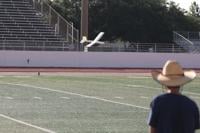
A judge watches a 3D printed aircraft fly during the 10th Annual 3D Printed Aircraft Competition on July 11 at Maverick Stadium. Teams from several universities built and designed their planes and drones.
Even after months of preparation, teams still found themselves making last-minute adjustments between flight attempts.
Savage’s team gathered around the aircraft in their limited time between rounds. Multicolored wires ran through the plane as team members focused on different parts of the design.
“We don’t have to worry about repairing anything necessarily, but we only have one propulsion system, so we have to rip that out of the plane and then put it back into the plane,” Savage said.
Despite the team’s adjustments, the aircraft faced another setback when it crashed during its next flight attempt, but the team brought a third plane as a backup, just in case.
Win or lose, the competition taught the participants something important — problem solving.
Whether the students are going to go into aerospace engineering and work for a government agency or go into mechanical engineering and work for a private company, they’ll be able to use what they learned at the competition.
“You keep working until you get it to work,” Taylor said. “It’s a lot of trial and error, a lot of engineering analysis, a lot of build it and see what works.”
@kh.kennedyaharvey