
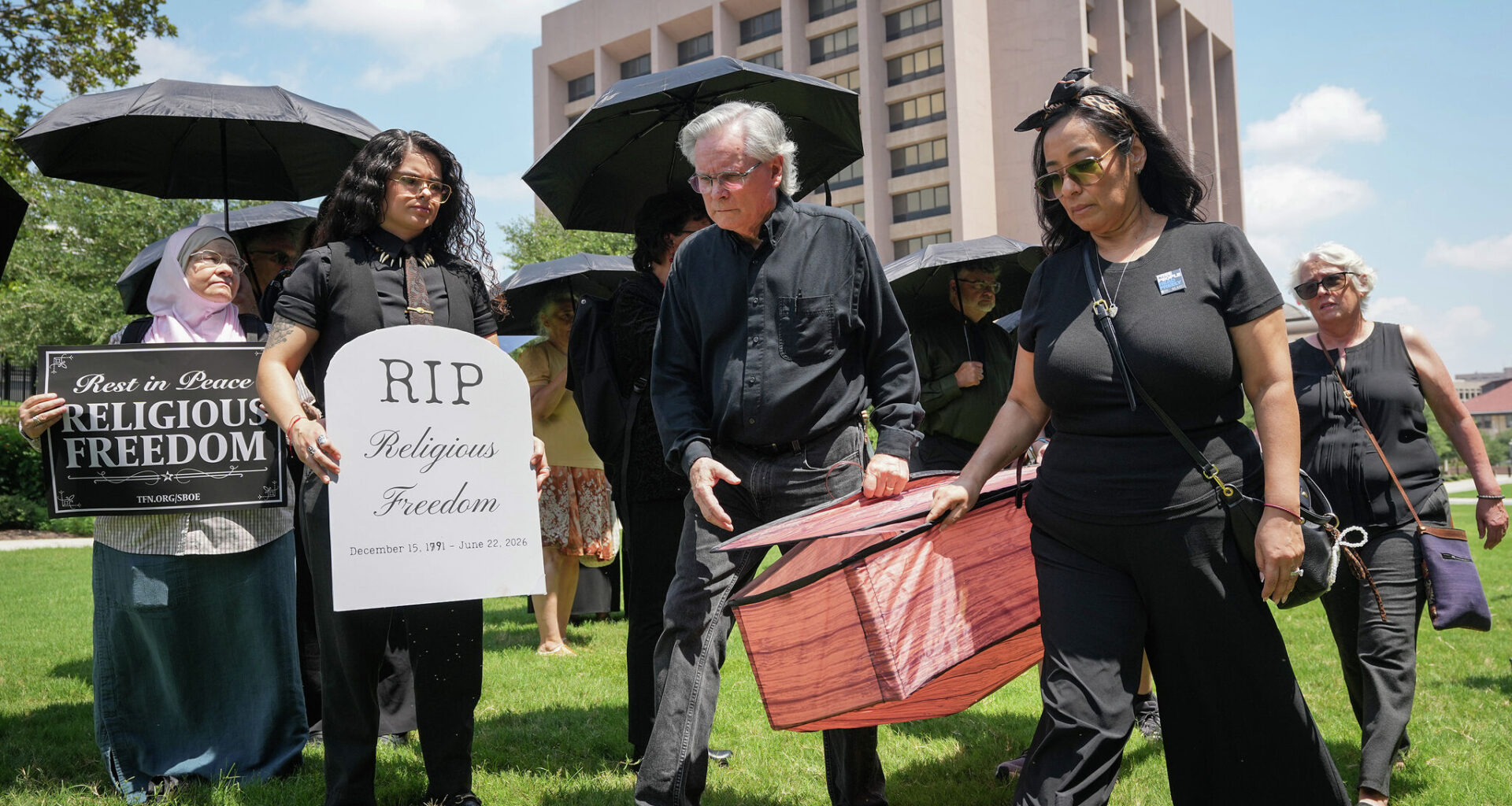
People participate in an interfaith funeral-themed protest outside the Barbara Jordan Building in Austin on Monday, June 22, 2026, as the State Board of Education considers proposed social studies standards that would place greater emphasis on Christian history and biblical content in public school classrooms. Organizers said the demonstration symbolized what they described as the death of religious freedom in public schools.
Jay Janner/Austin American-Statesman
Last month, Texas overhauled what the state’s 5.5 million public school students will be expected to learn about history and literature, embedding Christianity and biblical readings into the standards on a scale no other state has matched.
Now, the Texas Education Agency is capitalizing on those changes, spending millions to develop new textbooks and lesson plans that districts will be incentivized to use.
READ MORE: See the Bible verses and books Texas public school students will now be required to read
Article continues below this ad
The move could edge out private publishers and further cement the agency’s role in dictating how and what public schools teach, industry observers and critics said.
“There’s a time in the future where Bluebonnet will no longer be optional,” said State Board of Education Member Evelyn Brooks, a Frisco Republican, referring to the state’s materials. “That is where it’s heading, just whatever the state puts in front of you.”
Texas is the only state in the country to own and publish its own line of textbooks and lesson plans. The program, called Bluebonnet, rolled out in 2024 and is currently optional for districts, though those that participate receive extra state funding. Just under a third of the state’s 1,200 districts are using Bluebonnet, which so far covers elementary-level math and English.
The TEA confirmed to Hearst Newspapers this week that a $67 million contract it signed last year with Florida-based company MGT Solutions includes the development of new Bluebonnet materials for reading and social studies aligned to the new standards, as well as other subjects.
Article continues below this ad
READ MORE: Everything you need to know about the TEA’s Bible-forward lesson plans
Any textbook publisher is free to make their own materials that cater to Texas’ new standards, which become mandatory in 2030. But experts say many will be reluctant to invest because the social studies overhaul is so drastic.
Unlike other curriculum rewrites, this process produced a top-to-bottom overhaul, reordering history and inserting brand-new lessons on Western civilization, religious history and biblical concepts. Many of the new courses are unrecognizable from their current iterations, teachers have said. The State Board of Education also set a first-of-its-kind literary list, making Texas the only state to mandate nearly 200 specific readings for all of its students, including 14 passages of the Bible.
Traditional textbook publishers would have to essentially start from scratch, instead of updating their current editions. And the final product may be hard to market outside of Texas because no other states have so far taken a similar approach to social studies.
Those materials would also have to compete with a state-backed alternative.
Article continues below this ad
READ MORE: Are you smarter than a first-grader? See if you could pass Texas’ controversial new standards
“As a national publisher, if you can only market the program in Texas, you have to ask yourself some hard questions about if there is going to be a return on investment in dollars I spend,” said Eve Myers, a Houston-based education consultant and former publishing executive.
Bluebonnet
The Bluebonnet program, spearheaded by Education Commissioner Mike Morath, is meant to bring standardized, “high-quality” materials to schools, including more fleshed-out lesson plans and teacher scripts to ease the workload for classrooms. The state has spent at least $100 million to develop the curriculum so far. Leaders in other conservative states, including Florida and Alabama, have attempted, but so far failed, to replicate the Texas model.
Texas’ curriculum has been controversial, particularly among Democrats, for its inclusion of Christian themes as well as thousands of grammatical, copyright and other errors that the TEA had to pay $8.4 million to correct earlier this year.
Article continues below this ad
But a handful of Republicans, including Brooks, also blasted the effort as “textbook socialism,” saying it’s a state-funded competitor crowding out private counterparts. The state publishes the material for free and provides a $60-per-student state incentive for districts to adopt and print it.
“This is a serious issue for publishers,” said Fairview Republican Pam Little, a frequent critic of TEA who also previously worked in the publishing industry. “We’re limiting our free enterprise system.”
Little and others have also criticized the agency for a lack of transparency in the development of its curriculum. The Bluebonnet contract was published in May, nearly a year after it was signed, which critics say gave the state’s curriculum writers an unfair head start.
The agency has said it followed contracting notification rules and that all textbook publishers have had equal opportunity to draft and edit textbooks ahead of 2029, when any submitted materials will undergo an approval process by the State Board of Education.
“Based on what was approved at June’s SBOE meeting, the agency will be revising the curriculum documents to precisely align the newly approved standards,” said TEA spokesman Jake Kobersky.
Article continues below this ad
District costs
The overhaul could be a huge financial endeavor for school districts across the state, which could make the free Bluebonnet materials more appealing.
Democrats on the state board, who have voted against the overhauls, commissioned a study that put the total cost of the history rewrite alone between $800 million and $1.7 billion over the next five years. Those costs cover textbooks, lesson plans and teacher training.
Districts will also have to figure out how to procure the over 170 mandated works on the literary lists, which range from novels to picture books. Many of the rights are owned by various publishing houses, which may negotiate licensing with the state or offer them in bundles to districts.
All curriculum overhauls cost money to implement, said Chris Carmona, a San Antonio-based consultant who published the cost study.
“Practically, this means redesigning your entire curriculum,” Carmona said. “They’re basically pushing the funding cost to individual districts to be able to implement this.”
To pay for new materials, districts can draw from an existing pool of state funds, which had a budget over the last biennium of roughly $1 billion. That number could double
Republican proponents have said they believe the state Legislature will appropriate more dollars to the effort next year. But that increase is far from guaranteed, especially as lawmakers float proposals to significantly slash property taxes.
There are also indirect costs, like retraining or reassigning teachers. That’s especially true for elementary teachers, most of whom lack special social studies certifications and will now be asked to explain complex topics from slavery to religion.
“It’s going to be a heavy lift to get these folks retrained,” said Kelsey Kling, policy analyst for the Texas chapter of the American Federation of Teachers, the state’s largest teachers’ union. “This is probably going to drive some teachers to just leave.”