
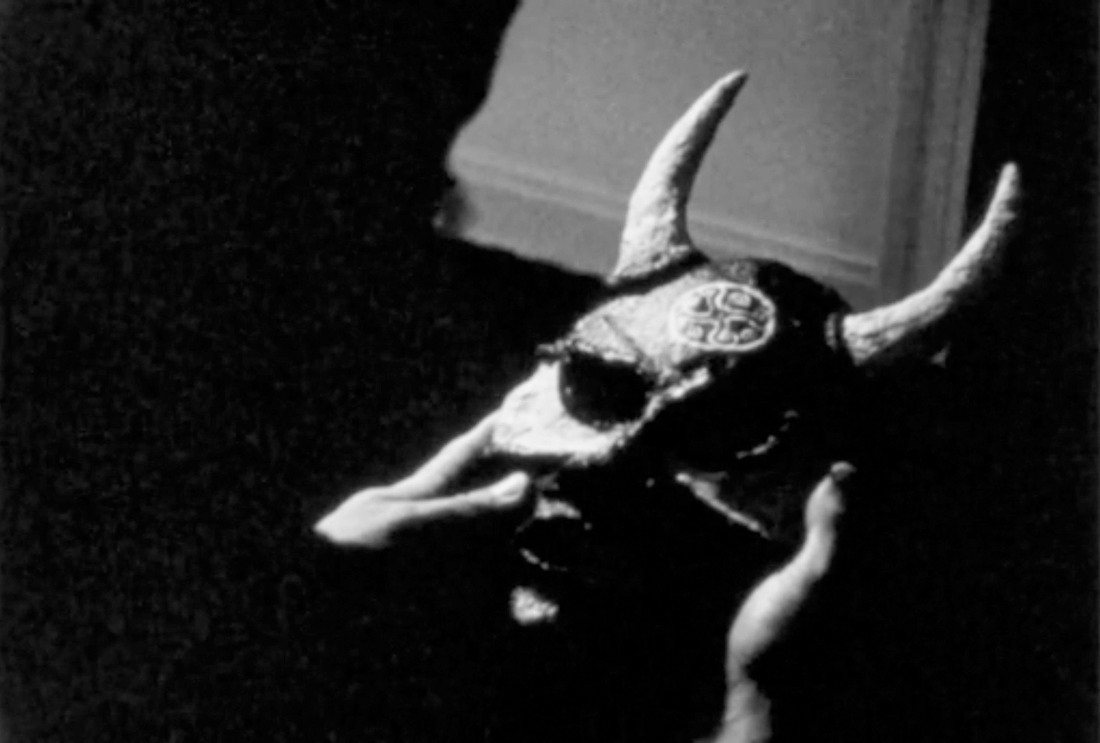
An infamous gem of Austin’s 1980s underground film scene gets a special screening this weekend, but that’s not what’s getting director Neil Ruttenberg excited. It’s that the screening of “Mask of Sarnath” will see the world premiere of a lost recording by industrial pioneers Throbbing Gristle
Well, “lost” isn’t really the word. Ruttenberg had the music in his possession since he made the film in 1980. Back then, he used seven minutes out of the half-hour recording for the film: now, along with his nephew and editor, Zane Ruttenberg, he has completely dismantled the original Student Academy Award-nominated short into the Nightmare Cut, which Ruttenberg called “a visualizer” for the whole piece by Throbbing Gristle – a work previously unheard in its complete form. “The Nightmare Cut is the first time I can put the soundtrack out,” he said.
The Sunday show at Hotel Vegas will feature a rare screening of the original version of “Mask of Sarnath” as well the Nightmare Cut’s premiere, plus live music from Larry Seaman (Standing Waves), Steve Marsh (Terminal Mind), and Neil himself, as he prepares for a reunion of his old band, F-Systems. “We haven’t played probably in 45 years,” Neil said, “but it wasn’t so hard picking up the bass again. You just get the muscle memory back.”
The Path to Sarnath
Let’s go back to his band days. Like many Seventies artsy kids before him, San Antonio native Neil made his way to Austin, where he got a job at the now-legendary Inner Sanctum, “which was the pivotal record store in Austin. It was central to all the music scene.”
When he got the gig, he was heavily into prog – until one day in 1976 when a co-worker turned up with a copy of the first single by some band out of New York called the Ramones, with a song called “Blitzkrieg Bop.” Neil recalled, “They played it in the store, and I looked at it and went, ‘Holy fuck, what is this?’”
Then his musical horizons opened up further when he traveled to the UK and saw the Damned and the Stranglers “and I went, we have to import this shit.” Neil became an evangelist for this kind of music, sourcing vinyl directly from London-based Caroline Records and shoving it at unsuspecting customers. “We were terrible employees,” he laughed. “We were like High Fidelity. ‘You don’t want that, you want to buy this.’”
He was also playing that imported punk on KUT-FM, under his DJ guise of Reverend Neil X, and channeling it into noise band Radio Frē Europe, which he proudly noted had been banned from every punk club in Texas, even the legendary Raul’s. “We played ‘In-A-Gadda-Da-Vida’ and left the club during the drum break, just left the club. [Guitarist Brian Hansen] had built a drum machine from Radio Shack, and we left the club with this little drum machine going doot-doot-bang-bang-bang. They went, ‘You can never play here again!’ OK, fine. That was funny, but we were the only band banned from Raul’s. That’s our claim to fame.”
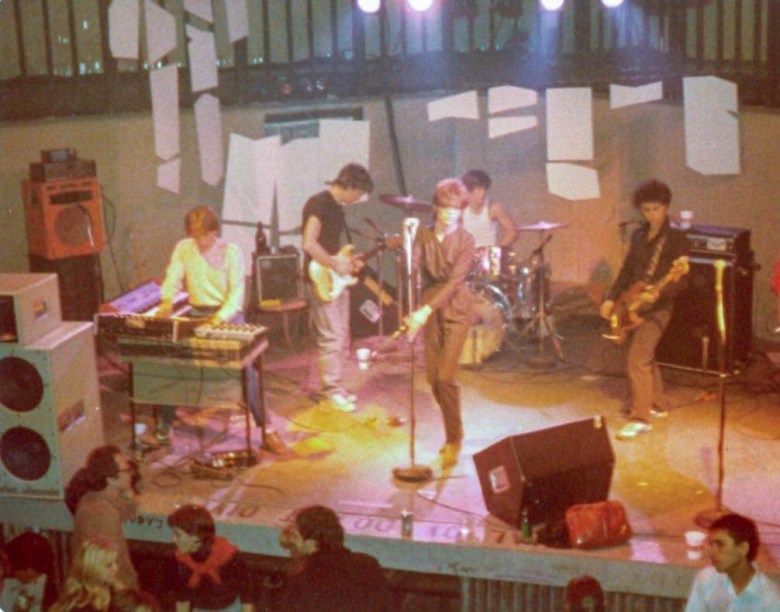 Neil Ruttenberg’s old band, F-Systems (Ruttenberg on the right on bass) Credit: Neil Ruttenberg
But music wasn’t his real passion (“I didn’t want to sleep in vans”) nor was his supposed actual reason for moving to Austin: studying entomology at UT. “I was too much of a weirdo for those people, and one of my favorite movies was Them! so I went to film school to make a giant ant movie.”
At that time, he recalled, the UT Department of Radio-Television-Film “was really primitive. Their equipment was garbage. They were Arriflexes from World War II, and they would willingly give you the equipment if it worked, and it only worked half the time.” However, he didn’t end up making a giant ant movie. Instead, he made a very different kind of horror flick – one that had been festering in him since childhood.
Late Night Double Feature
San Antonio isn’t exactly a movie capital, and when Neil was a kid there were only 10 cinemas in the city. However, for him there was really only one: the old Texas Theater, a Spanish Revival picture palace in the theatre district. Ruttenberg recalled, “I was 10 or 11, I would tell my mother I was going to play football, I’d hop the bus and go downtown. And it was in the worst part of downtown, but I’m a kid, so I’m bulletproof, right? It was the worst kind of audience you could imagine. People were throwing shit off the balcony, there were fights in the aisles, but that’s where I saw Horror of Dracula and all those other Hammer films. … There was this movie called Mr. Sardonicus and they handed out these cards with phosphorus on them that would glow in the dark. But it was hot, so it oxidized the phosphorus so the whole theatre smelled like rotten eggs.”
On days when he couldn’t sneak out, there was always late-night TV. “First there was the local news, which was all car wrecks. Then there was wrestling. And then there was something called Project Terror.” That was where he got to watch flicks like The Creeping Unknown, Blood of Dracula, and one film that was a direct influence on “Mask of Sarnath,” 1961 Canadian 3D horror The Mask. Ruttenberg said, “I can clearly remember seeing it on my black-and-white television in my room, and when I was doing ‘Mask’ that was in the back of my mind.”
However, not all his influences were cinematic. The name “Mask of Sarnath” is an homage to “The Doom That Came to Sarnath,” a short story by master of the arcane H.P. Lovecraft. Neil credited his old Hebrew teacher with introducing him to the Cthulhu mythos. “He caught me with some comic books in my Torah, and he said, ‘Hey, Neil, you like this kind of stuff’ and he handed me a book of short stories by H.P. Lovecraft. I stayed up all night reading it and it blew my mind. Cosmic evil? Yes! I’m all in.”
Filmmaking on a Budget
Having decided to make a horror movie, Neil took the last $800 from his bar mitzvah funds out of his bank in San Antonio and ploughed it into the production, calling in every favor possible. Luckily, everyone he knew through the punk and film scenes was happy to get involved. “It was a crazy shoot, but we got it done.”
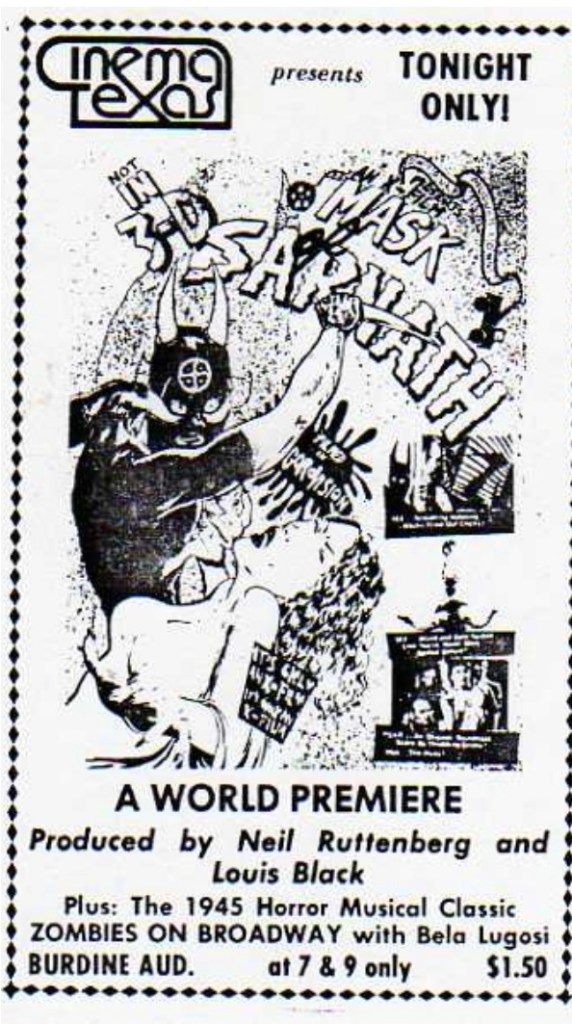 Poster from the original premiere of “Mask of Sarnath” Credit: Neil Ruttenberg
However, even with UT’s equipment and plenty of friends to call on, that $800 wasn’t going to go far. So he had to get creative, especially when it came to locations. The house in the final scenes was actually his own home, which they nearly burned to the ground for one special effect. As for the other sequences, let’s just say that he got creative with the truth. “To get the bus from the Austin Transit Authority I had to lie to them,” he confessed. “I told them I was making a documentary about bus drivers at night, and they believed me and gave me a bus to shoot the death scene. I gave the driver a six-pack of beers and a burger, and he just sat there watching us.” As for the pivotal opening museum heist, he got access to the Laguna Gloria Art Museum (now the Contemporary Austin – Laguna Gloria) by telling the management he was making a documentary about art museums at night, “and they believed me. Of course, they were mad at me afterwards.”
One location was completely out of his reach: re-creating the ancient city of Sarnath from whence the mask came. Instead, it’s seen through glimpses of strange illustrations which were actually the original storyboards by Rick Cruz. “I really was going to shoot that,” said Neil, and that was when producer and future Austin Chronicle co-founder and editor Louis Black stepped in and reminded him that he didn’t have Cecil B. DeMille money. “He goes, ‘Neil, you’ve got $150.’ OK, we’re just going to shoot the story boards instead.”
Black wasn’t the only future Chronicle figure involved with the film: his co-founder and future Chronicle publisher, Nick Barbaro, designed the title credits. Neil recalled, “I went to him and said, ‘I want you to do this sequence, and I want blood to fill the screen.’ He did it as a practical effect, and I asked him recently and he said, ‘I don’t remember.’” (Barbaro confirms that he doesn’t remember what he did, but does confirm that he got the job because “I was the only one of us who knew how to use UT’s animation stand.”)
Somehow, that $800 stretched to make the movie. Or rather, $750 of it did, as fifty bucks ended up going to create a piece of musical history.
The Sound of Sarnath
Among those shipments from Caroline Records was a 7-inch of “United/Zyklon B Zombie,” the debut single by a strange little band from Kingston-Upon-Hull called Throbbing Gristle. “I played it and went, “Wow, this is out-there shit.”
Their music was like nothing he’d ever heard before, a heavier, percussive, unnerving, and very punk re/deconstruction of the experimental works of avant-garde artists like John Cage. “They challenge you,” Ruttenberg said. “They make you work to listen to them.”
And they were also going to be perfect for his film. But how does a film student in Texas get a radical and enigmatic British band to score his debut film? He sent them a letter via their UK label, Industrial Records. Not really expecting anything, he was shocked when a month later he got a reply. “I got a letter from [founder and singer] Genesis P-Orridge and it said, ’Sure, send us $50.’ So I sent them a $50 bill in an envelope, and a month later the reel came in the mail. Just like that. It was like, what the fuck?”
Years later, he would find out via an interview with the British music press that they’d actually recorded it on Pink Floyd’s studio equipment. What they sent him was what he called “the most coherent piece of music they ever wrote. … It’s got this boom-boom-boom-boom and when I first heard it I went, ‘That’s pretty good music.’ It was spectacular, and the theme was perfect for a horror movie.”
The Return of Sarnath
“Mask of Sarnath” became the launching point for Ruttenberg’s career. After scoring a nomination in the 1980 Student Academy Awards for the film, he was able to move to Los Angeles and begin a career in Hollywood. His first gig was writing sword-and-sorcery sequel Deathstalker II for Roger Corman, which led to film and TV work, as well as unproduced scripts for early attempts to film both Spider-Man and Ant Man.
However, “Mask of Sarnath” developed an (after)life of its own. Jonathan Demme screened it in New York in 1981 as part of his Made in Texas series and then it returned to the public consciousness in 2015 when it and the other five films curated by Demme were screened at South by Southwest. The following year, it even got a Blu-ray release. A couple of years ago Ruttenberg even got to see the film projected for the first time since 1981 “and I was pleasantly surprised it looked pretty good.”
But that complete score still bothered him. That’s when he remembered:e may not have the rights to release the score by itself, but according to the original agreement “I had absolute rights to release the music with film elements.” So the obvious solution was to re-edit the original movie to fit the score.
Three years ago he’d had the original tape – the only recording in existence – transferred to digital, and this is where nephew Zane came in. He had grown up hearing about his uncle’s wild short, and when he heard about the Throbbing Gristle soundtrack, he was immediately on board. “This thing is like musical history gold,” Zane said, “and we wanted to find a way to release it as it lay.”
The only problem is that the score was half again as long as the film, so this wasn’t going to be a simple re-edit. Instead, Zane said he was making “a psychedelic montage as a visual aid. … There’s going to be a lot of repeating the same images, and really extreme color correction.”
However, Zane wanted the new Nightmare Cut to be more than just an extended remix of random visuals. This is when he recalled a lesson from one of his documentary film class teachers: “You have to give it a spine.” He used repeated images of people waking up and falling asleep “to create almost a dream sequence. I used eyelines to blend two spaces together, and it’s just like in a dream – you walk through a door in your house and there’s an ocean on the other side.”
Long Live Sarnath!
Now Ruttenberg gets to show both the original cut and the Nightmare cut, and get that full, lost Throbbing Gristle recording out to the masses. But there’s still a twist in the tale.
“Here’s the punchline,” he said. He’d been promoting the upcoming show on Reddit, and out of the blue “two weeks ago, a guy sends me an interview with Genesis P-Orridge from 1981 where Genesis talks about how he recorded this soundtrack and gave it to me for nothing. It was mine. 100%. I’ve been worried about this since 1981, about having quasi-ownership, and I went through this entire cycle of burning it, cutting it, releasing it, when I could have released it all along? …. I showed [the article] to my lawyer and he said, ‘Wow. Slam dunk. Congratulations!’”
However, there are no regrets. “Putting the movies out is a lot of fun.”
“Mask of Sarnath” Nightmare Cut: Horror Fest & Punk Show is this Sunday, Nov 9 at Hotel Vegas. Tickets at texashotelvegas.com.
A note to readers: Bold and uncensored, The Austin Chronicle has been Austin’s independent news source for over 40 years, expressing the community’s political and environmental concerns and supporting its active cultural scene. Now more than ever, we need your support to continue supplying Austin with independent, free press. If real news is important to you, please consider making a donation of $5, $10 or whatever you can afford, to help keep our journalism on stands.