
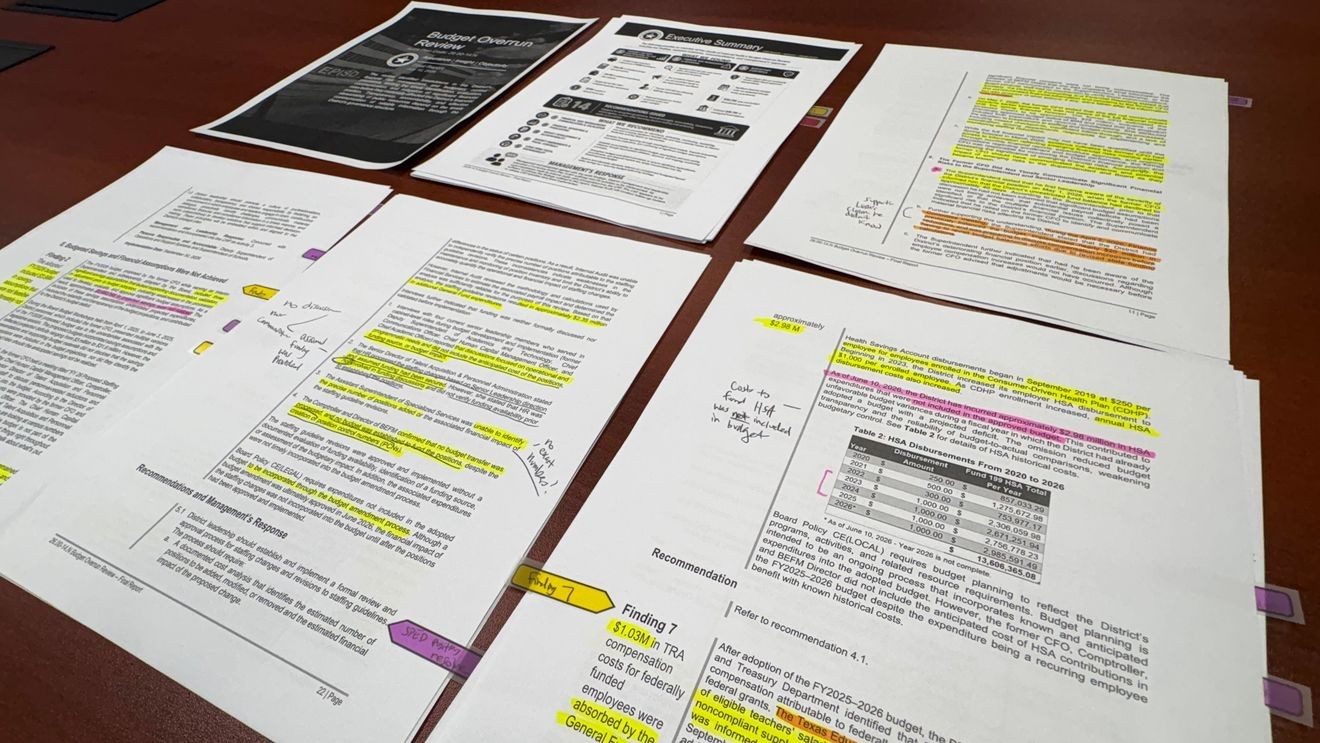
EL PASO, TEXAS (KFOX14/CBS4) — An internal audit found EPISD’s projected $52.8 million budget crisis was caused by underestimated expenses, unrealistic budget assumptions, poor financial oversight, and weak budget controls.
The 33-page Budget Overrun Review, completed July 10, was ordered by the Board of Trustees after the district declared a financial exigency in June.
Auditors reviewed budget development, financial reporting and expenditures through May 2026 and interviewed 25 employees, all five current trustees and the district’s former chief financial officer.
The audit’s central conclusion is that significant financial risks were known within EPISD’s financial management department but were not communicated or addressed.
Auditors concluded the former chief financial officer, Martha Aguirre, who also served as interim superintendent for several months, failed to adequately fulfill responsibilities as the district’s principal financial advisor.
According to the report, Aguirre did not effectively:
Evaluate the district’s financial position.Monitor budget performance and fund balances.Timely inform the superintendent and Board of Trustees about the district’s deteriorating finances.Recommend corrective actions to maintain fiscal stability.
The audit says EPISD ultimately projected a fiscal year 2025-26 financial deficiency of approximately $52.79 million, while unrestricted fund balance, also known as the district’s piggy bank, fell to the equivalent of about 38 days of operating expenses, prompting the district’s declaration of financial exigency in June.
RELATED: Audit: El Paso ISD knew of budget risks before financial crisis became public
Finding 1: Significant financial risks were not monitored, communicated, or addressed
The audit recognizes this finding as the most significant finding centering on the district’s financial crisis.
Auditors concluded the district’s former chief financial officer, Martha Aguirre, failed to monitor the district’s financial condition or communicate growing financial risks to the superintendent and board of trustees.
According to the report, financial management staff had information throughout the school year showing:
declining enrollmentrevenue shortfallsunrealized budget assumptionsincreasing payroll costsDistrict spending added after the board adopted its budget
But auditors found those risks were never combined into a full picture showing how severely the district’s finances had deteriorated.
Finding 2: Nearly $4 million in budget savings options were not implemented
The audit found the former CFO included approximately $3.99 million in savings in the 2025-26 budget when the savings options were not implemented or approved by the district administration and the school board.
Those included:
$1.4 million from a multi-age classroom initiative that district officials had already determined was not operationally possible$1 million from reassigning displaced teachers to vacant positions, although actual savings were never calculated$1.5 million from shifting Special Education costs to the IDEA-B federal funding grant, even though those grant funds were already used and no longer available
According to the audit, the Budget & External Financial Management director told auditors she recommended to Aguirre removing some of the savings before the board adopted the budget because the saving options were not implemented or approved.
She said Aguirre instructed staff to leave the savings projection in the budget because removing the assumptions would have required presenting trustees with a significantly larger projected deficit.
Finding 3: District budgeted $20 million in salary savings but fell more than $6 million short
Auditors also found wrongdoing in EPISD’s calculation of vacant-position savings to balance the budget.
The district assumed $20 million in lapsed salary savings.
Lapsed salary savings are the unspent money that is calculated in the budget when a funded position remains vacant or is filled at a lower salary than originally budgeted.
Instead, actual savings totaled about $13.7 million, not $20 million, leaving a $6.31 million shortfall.
The report says district officials could not provide documentation explaining how the $20 million estimate was calculated.
The Budget & External Financial Management director told auditors the figure had simply been carried over from the previous year’s budget (2025) despite calculations suggesting only about $10 million was realistic.
Both the director and comptroller said they raised concerns during budget development, but Aguirre directed staff to keep $20 million in savings within the budget.
RELATED: El Paso ISD approves final round of layoffs ahead of new school year amid budget crisis
Finding 4: About $3 million in additional spending was approved after the budget was already adopted, despite no approval from the board
Between July 2025 and May 2026, district leadership approved 27 Additional Budget Requests totaling about $3 million.
Auditors found that those expenditures were not incorporated into the Board-approved budget through timely amendments as required by state law and district policy.
Of those requests:
17 totaling $1.74 million were approved by the former CFO, Martha Aguirre10 totaling $1.26 million were approved by the current superintendent, Dr. Brian Lusk and former CFO, Martha AguirreFinding 5: Special Education staffing changes added $2.35 million in payroll costs
Auditors found that changes to Special Education staffing resulted in approximately $2.35 million in additional payroll costs.
The audit initially found 77 new positions before later changing that number to an increase of 134 positions.
Auditors said inconsistencies in staffing records prevented them from verifying the exact number of positions added, but determined the impact on the district’s payroll was not accurate.
The report found staffing changes were approved without proper calculations, documentation, and a funding source before approving the additional positions.
Finding 6: Nearly $3 million in Health Savings Account (HSA) costs were never budgeted
The audit found EPISD historically did not budget Health Savings Account contributions even though the expense happens every year.
Instead, HSA costs were charged directly to the district’s general operating fund, thus increasing the district’s spending out of its general fund.
Auditors identified $2.98 million in HSA expenses that were not included in the approved 2025-26 budget.
The comptroller and Budget & External Financial Management director both told auditors they suggested including the cost in the budget, but Aguirre directed staff not to include it in the budget.
RELATED: EPISD considers health plan changes, stipend reductions amid budget crisis
Finding 7: Teacher Retention Allotment costs shifted $1.03 million onto the General Fund
The audit found that approximately $1.03 million in Teacher Retention Allotment compensation for federally funded teachers had to be charged to the General Fund because federal grants could not legally pay those salary increases.
Financial Services adjusted payroll in September 2025 after learning of state funding requirements.
Although the district expected to receive state funding, auditors found the additional General Fund expense was never incorporated into the adopted budget or addressed through a timely budget amendment.
Finding 8: Late grant application for special education grant cost the district more than $627,000
Auditors found that Special Education staff submitted the IDEA-B federal grant application past the grant’s deadline.
The IDEA-B grant is a federal program under the Individuals with Disabilities Education Act (IDEA) that provides supplemental funding to states and school districts.
Its purpose is to help cover the excess costs of providing special education and related services to children with disabilities.
As a result, approximately $627,812 in July payroll costs became ineligible for federal reimbursement and had to be paid from the district’s general fund, adding another expenditure.
The assistant superintendent for specialized learning services told auditors the department believed the application could be submitted anytime before the state’s September 30th deadline and did not realize spending costs were calculated before the grant was approved.
Meaning payroll costs for July 2025 would not be covered by the grant.
The audit noted the department has made resolutions to make sure future grant applications are submitted before June 30th.
Finding 9: Retirement incentive approved without estimating total cost
The Board approved an early resignation and retirement incentive program offering eligible employees up to $3,000.
The audit states that a total of 224 employees participated.
Auditors calculated the program will cost the district $672,000, but found district officials did not calculate that cost in the 2025-26 budget and did not notify trustees of the costs before approving the incentive program.
Although one agenda item from February 17 stated the money would come out of the district’s general operating fund, no district official had an accurate number to present nor did district trustees ask before approving the program.
Finding 10: Leadership transition added roughly $459,000 in costs
The audit found that leadership changes last year added more expenses in the district’s general fund by $459,000.
Those costs included:
$347,851 for the former superintendent’s (Diana Sayavedra) early retirement agreement$60,556 in supplemental pay for the interim superintendent, (Martha Aguirre)$50,700 for annuity and relocation benefits for the new superintendent (Dr. Brian Lusk)
Auditors found that those costs were known for months without making a budget deficit amendment and without presenting it to the board of trustees.
Bottom line
The audit concludes EPISD’s budget crisis was due to a combination of unrealistic budget promises, poor financial reporting, and inadequate communication of financial risks.
The audit states that without the proper communication and breakdowns of the contributing factors that led up to EPISD’s budget crisis, it reduced transparency, prevented board trustees from receiving a complete picture of the district’s financial position, and limited opportunities to prevent the crisis from growing, ultimately leading to the district’s declaration of financial exigency.
District leadership agreed with all 14 audit recommendations and submitted a corrective action plan, which Internal Audit will monitor through future follow-up reviews.
You can read the full audit and the district’s response to each of the findings below:
Sign up to receive the top interesting stories from in and around our community once daily in your inbox.